
Researchers propose Zcash-style private Bitcoin transfers without a soft fork

Researchers at the cryptography research firm Alloc Init have proposed a system for bringing Zcash-style private transfers to Bitcoin without requiring a soft fork.
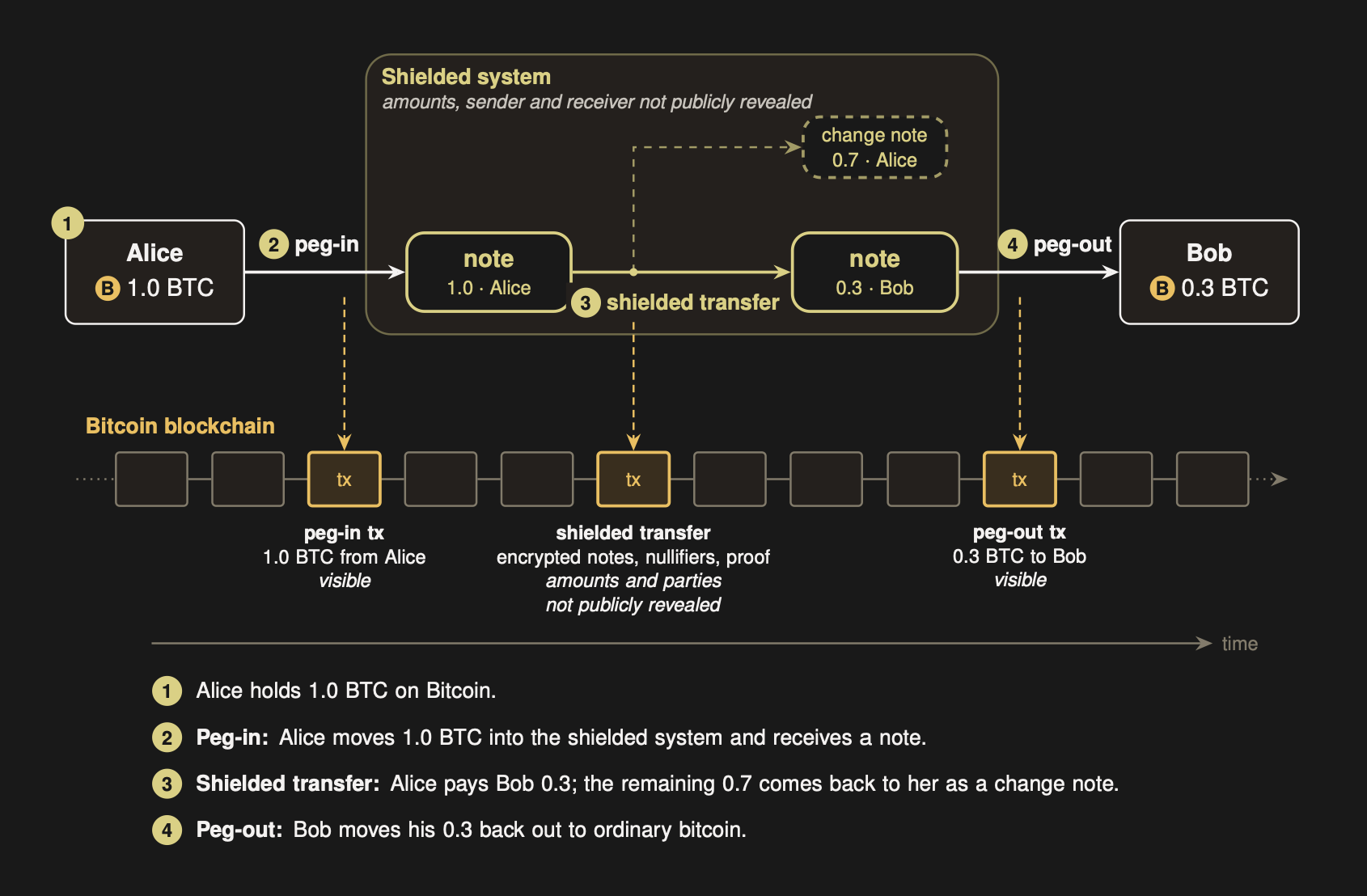
The proposal, called Shielded Bitcoin, would conceal transaction amounts, senders, receivers and links to previously spent funds using encrypted notes and zero-knowledge proofs. The paper was published on Thursday by Clara Shikhelman, Mikhail Komarov and Aleksei Moskvin.
The proposal offers a potential path to stronger privacy for Bitcoin users without requiring consensus changes to the base protocol.
Instead of having miners enforce the privacy protocol, Shielded Bitcoin would use Bitcoin as “a neutral publication and ordering layer,” the researchers wrote. Separate software called indexers would then verify zero-knowledge proofs, check that funds haven’t been double-spent, and reconstruct the state of the shielded system.
Shielded Bitcoin’s design explicitly draws from Zcash’s architecture. The researchers said it similarly uses encrypted notes, public nullifiers that mark notes as spent, and zero-knowledge proofs that show transactions are valid. Unlike Zcash, Shielded Bitcoin would not operate its own blockchain or consensus mechanism.
Shielded Bitcoin draws mixed reactions
“Privacy is a function of the crowd. Zcash has a real shielded pool built over years,” he wrote. “A brand new metaprotocol starts at zero, so your first private transfer hides in a crowd of one.”
In a companion post explaining the proposal, the Shielded Bitcoin researchers acknowledged a similar limitation, saying that large deposits do not automatically create a large anonymity set. They said observers may still be able to narrow down relationships between transfers if a small number of actors create most notes or wallets exhibit distinctive behavior.
Ben-Sasson said he had not yet read the Shielded Bitcoin paper but would like to see the vision of privacy and scalability through zero-knowledge proofs materialize on Bitcoin’s base layer.
Disclaimer: The content of this article solely reflects the author's opinion and does not represent the platform in any capacity. This article is not intended to serve as a reference for making investment decisions.
You may also like
Why Is Tether Bringing USDT Back to Bitcoin Now? Morgan Stanley Offers a Clue
Swiss Franc: Dovish SNB keeps CHF under pressure against US Dollar – ING

Japan Central Bank inflation indicators accelerate, providing grounds for further interest rate hikes
An indicator used by the Bank of Japan to measure underlying inflation accelerated last month, significantly exceeding its target level, providing further justification for continuing to raise the benchmark interest rate.

Hut 8 Wins $140M Bid For Poolin’s Texas Data Centers
Crypto prices
More


