
Even though inflation data is better than expected, US Treasury yields continue to rise; Wall Street speculates "Japan is the behind-the-scenes driver."

The U.S. Treasury sell-off continues, with the market turning its attention to Japan. Even with inflation data unexpectedly weakening, the 10-year U.S. Treasury yield climbed to a multi-decade high of 5.28%. Wall Street analysts are fiercely debating exactly how Japan is driving this wave of global bond market turmoil.
On Thursday, despite core PCE data coming in weaker than expected, U.S. Treasury yields continued their rally, dashing market hopes that “cooling inflation would ease sell pressure.” Both Yardeni Research and Deutsche Bank are pointing the finger at Japan, but their interpretations of the transmission mechanism sharply differ—the former attributes it to the unwinding of yen carry trades, while the latter believes that the rise in Japanese Government Bond (JGB) yields themselves is the key.
The central question behind this dispute is: when will the U.S. Treasury sell-off end, and will it depend on Japan’s ability to stabilize its own bond market? Goldman Sachs’ latest report shows the net short position of CTA trend-following funds in global bond markets has reached a record -$170 billion (in DV01 terms) and is still expanding, indicating that bearish sentiment on bonds is now at historic extremes.
Two Interpretations: Carry Trade Unwinding or Rate Repricing?
Ed Yardeni, President and Chief Investment Strategist of Yardeni Research, notes in his report that investors engaged in carry trades funded by cheap yen are likely exacerbating the global bond market sell-off. He believes that as the Bank of Japan (BOJ) raises rates, carry traders are forced to sell government bonds of various countries that were previously purchased with low-cost yen loans. “This trade once allowed many sovereigns to fund budget deficits without pushing yields higher—now it’s time to pay the bill.”
Ed Yardeni also points out that during the time when the BOJ and other major central banks kept borrowing costs abnormally low, governments worldwide issued vast amounts of debt, accumulating enormous liabilities. He characterizes the current situation as the “revenge of the bond vigilantes”—a concept he first proposed and promoted in the 1980s.
However, Shoki Omori, Chief Japan Fixed Income Strategist at Deutsche Bank, questions this reasoning. He argues that unwinding carry trades would mechanically drive the yen higher, leaving a “fingerprint” in markets: a surge in the yen, a collapse of speculative yen shorts, a drop in equities, and a rally in Treasuries due to risk-off flows. “But what we’re witnessing now is quite the opposite,” he states. “Bonds and the yen are falling in tandem—this signals inflation and rate repricing, not deleveraging.”
Flows data also supports this view. According to weekly data from Japan’s Ministry of Finance, Japanese residents were net buyers of foreign long-term bonds for the two weeks ending September 12 (purchasing a net 1.1 trillion yen from September 6 to 12), after being net sellers of 2.8 trillion yen in late August. Meanwhile, non-residents were net buyers of Japanese long-term bonds for four consecutive weeks, buying 2.2 trillion yen just in the week ending September 12. Omori interprets this as “foreign flows into JGBs, Japanese funds flowing back out”—the opposite of what capital repatriation logic would suggest.
Consensus Amid Divergence: The Root of the Problem is Japan’s Bond Market
Despite disagreements over the transmission mechanism, both analysts agree on one point: the root cause of the U.S. Treasury sell-off lies in Japan, specifically the turmoil in the Japanese domestic bond market.
Goldman Sachs strategist Isabella Rosenberg points out in her latest report, “What are Japan Spreads Signaling About Fiscal Risk?” that since May, JGB swap spreads have widened across the curve as yields rise. She notes that JGBs have outperformed swaps relative to expectations—meaning swap rates have increased more than bond yields—making it hard to attribute the sell-off to “JGB supply and absorption issues,” in contrast to what happened after the scrapping of Yield Curve Control (YCC).
Goldman notes that JGBs’ relative strength may reflect a number of factors: declining issuance at the long end, market optimism around domestic demand (especially relating to GPIF and NISA-related policy moves), and some marginal easing of long-end supply pressures by policy actions in Japan, the U.S., and the UK.
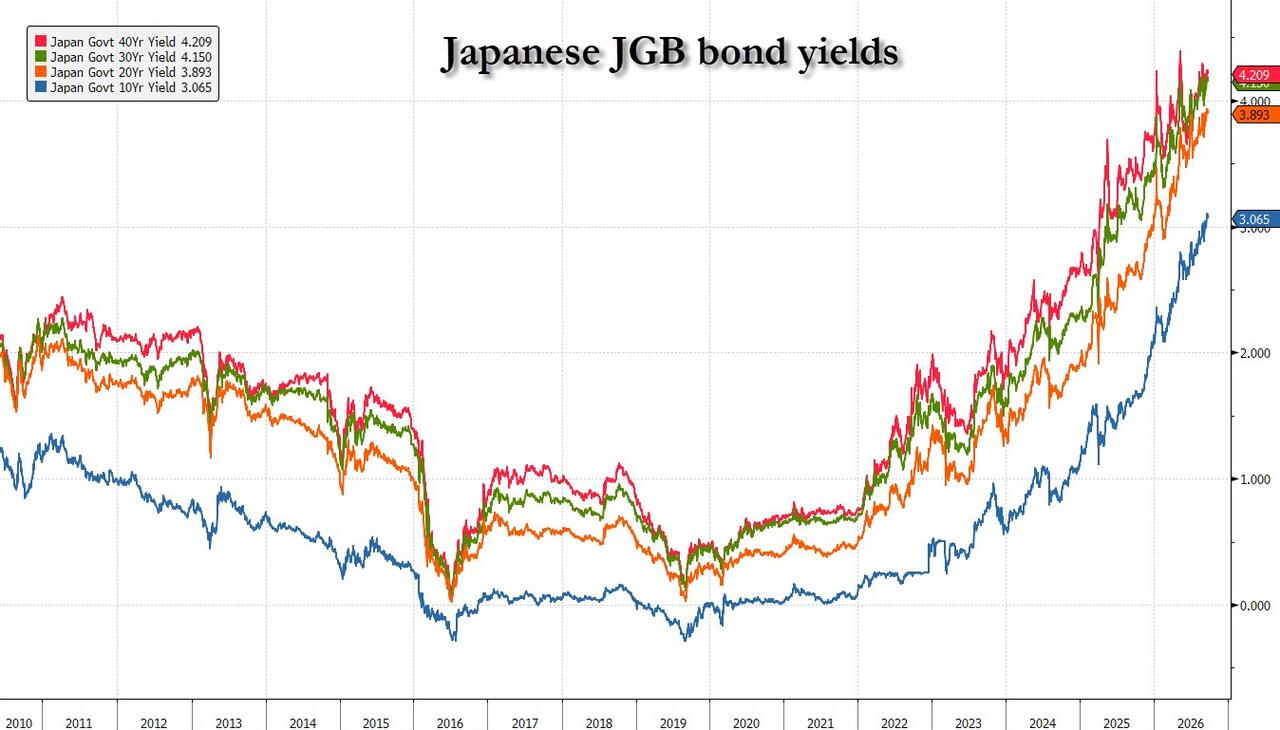
However, Goldman also warns that in the medium term, with JGB issuance expected to rise next year and the BOJ’s balance sheet contraction continuing, swap spreads should revert to tighter levels. In other words, if the Japanese bond market cannot stabilize, the pressure on U.S. Treasuries may hardly ease—the majority of long-term JGB yields are now at historic highs.
Political Constraints Limit BOJ’s Actions
The policy space for the Bank of Japan is also a growing concern for the markets.
New Prime Minister Sanae Takaichi has voiced dissatisfaction with recent rate hikes and plans to replace several BOJ board members with more dovish candidates, suggesting there is little political will at the BOJ for further policy tightening.
Against this backdrop, the 10-year JGB yield has climbed to a rarely seen historic high and markets clearly believe the BOJ’s rate hikes are far from enough to curb persistently rising Japanese inflation. Finance Minister Besant’s recent close attention to the Japanese situation further underscores the profound impact Japan’s bond market has on U.S. Treasuries.
Currently, CTA trend-following funds’ net short position in global bond markets has reached -$170 billion and continues to expand week by week, reflecting how bearish bets on global bonds have hit historic extremes. However, Goldman Sachs also notes that should deflation signals or an economic slowdown emerge, short positions in both U.S. Treasuries and JGBs could face the most violent short squeeze in history.
Disclaimer: The content of this article solely reflects the author's opinion and does not represent the platform in any capacity. This article is not intended to serve as a reference for making investment decisions.
You may also like
Goldman Sachs: AI Must Endure Hardship Before Rewards
Euro weakens below 1.1350 on higher US Treasury yields, Lagarde's dovish tilt
What does Trump's "AI self-regulation" mean? Jensen Huang achieves a major victory, leads the charge questioning Anthropic's Amodei behind the scenes
Trump promotes AI "self-regulation," which appears to enhance safety but actually paves the way for the expansion of computing power: requirements for testing, auditing, and monitoring as part of "security compliance" will generate new demands for inference and optical interconnects, making Nvidia potentially the biggest winner. Jensen Huang even joined forces with Zuckerberg to oppose strict regulation, and directly questioned Anthropic's Amodei about his excessive public statements regarding AI risks.
US Stock Market IPO Preview | Henghong Technology (HCPC.US): Revenue Growth Without Profit Increase, Can Multi-dimensional Narratives Support the IPO Valuation?
After the valuation increase, is the market willing to fully subscribe at this price?
Crypto prices
More


