
Bloom Energy Q3 2026 Earnings Highlights: Revenue Surges 138% to $1.24 Billion, Quarterly Operating Profit Exceeds Full Prior Year, Full-Year Guidance Raised for the Third Time This Year
 2026/10/23 03:05
🔥 US Stock Hotspot Radar is Live! Content: 3 major themes + 6 selected stocks + 7 key events. Where are this week’s opportunities? Click the link to see all 22 trading directions in one chart →
Core Views:
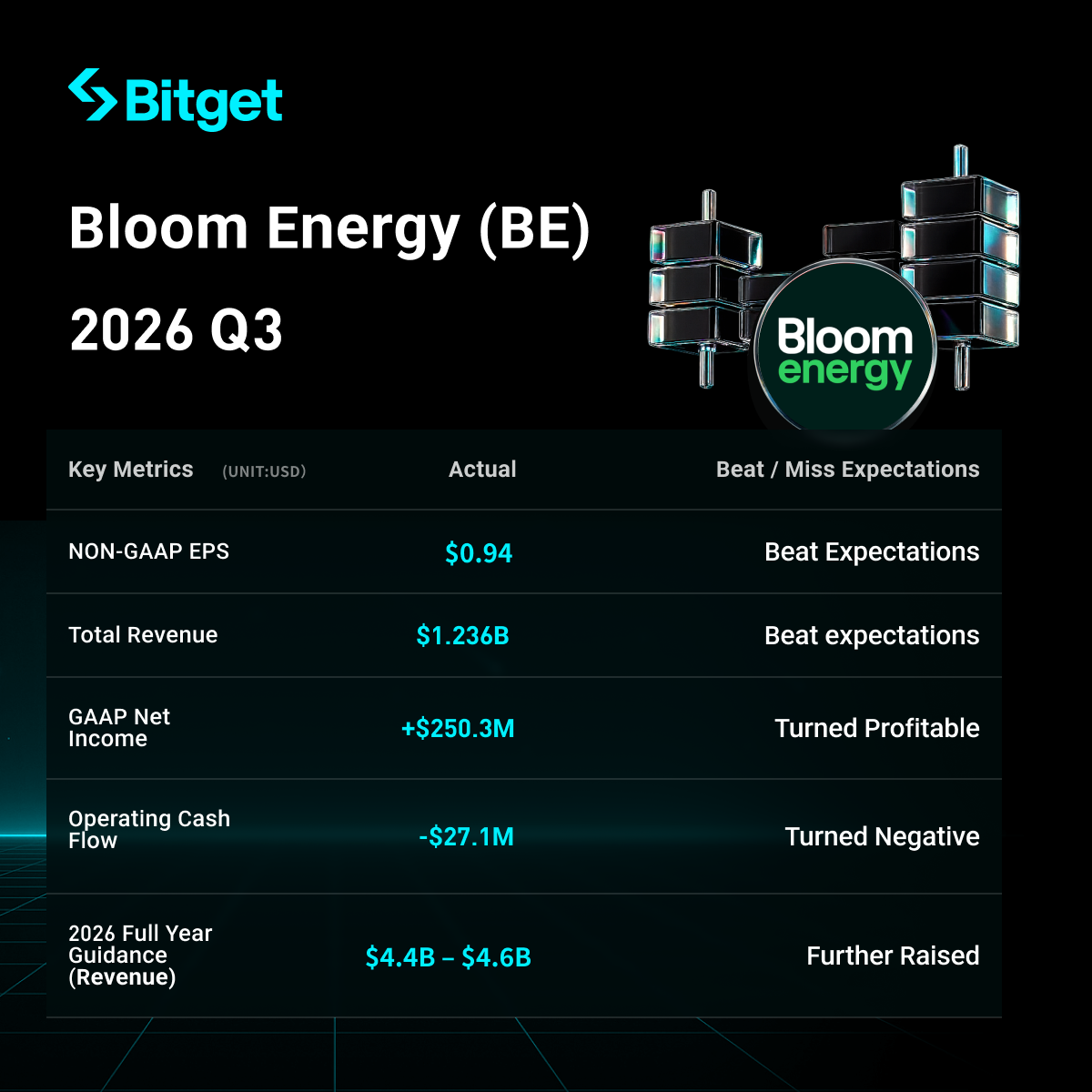
Bloom Energy (NYSE: BE) reported Q3 results on October 22, 2026 (period ended September 30, 2026). Revenue reached $1.2358 billion, up 138.1% year-over-year and well above analyst expectations of approximately $1.07 billion. Non-GAAP diluted EPS was $0.94, far exceeding the $0.69 consensus. Non-GAAP operating income for the quarter was $285.7 million, up more than 500% and exceeding the company’s entire prior-year total, with operating margin expanding from 8.9% to 23.1%. The company raised full-year 2026 guidance for the third time this year, with the revenue midpoint implying roughly 122% year-over-year growth. Despite the strong fundamentals and the company’s addition to the S&P 500, free cash flow outflow of $181 million, expected margin pressure from capacity expansion, and elevated valuation contributed to an 8.7% stock decline on the day to $217.77, with further weakness after hours.
Detailed Breakdown:
- Overall Revenue and Profit Performance
- Quarterly revenue: $1.2358 billion, up 138.1% from $519.0 million in the prior-year period and approximately 16% sequentially, significantly beating analyst expectations of ~$1.07 billion.
- GAAP net income: $250.3 million (diluted EPS of $0.78), compared with a loss of $23.1 million in the prior-year quarter. Non-GAAP diluted EPS of $0.94 (versus $0.15 a year earlier) beat expectations of $0.69.
- Non-GAAP operating income: $285.7 million (23.1% margin), up more than 500% from $46.2 million a year earlier. GAAP operating income was $225.4 million (18.2% margin versus 1.5% a year earlier). Revenue grew 138% while operating expenses rose only about 26%, demonstrating strong operating leverage.
- Gross margin: GAAP 33.8% (up 453 basis points year-over-year); non-GAAP 34.5% (up approximately 412 basis points).
- Adjusted EBITDA: $299.5 million.
- Cash flow: Operating cash flow outflow of approximately $27.1 million; free cash flow outflow of $181 million (positive in the prior-year quarter), driven by timing mismatches between large deliveries and cash collection, accumulation of contract assets and receivables, and rising working-capital needs. Cash and cash equivalents ended the quarter at approximately $2.49 billion.
- Core Business (Product / On-Site Power) Performance
- Product revenue: $1.0736 billion, up 179.4% year-over-year and surpassing $1 billion in a single quarter for the first time, accounting for roughly 87% of total revenue.
- Key drivers: Explosive demand for on-site power solutions for AI data centers. CEO KR Sridhar cited NVIDIA’s CEO remarks at the Berlin GTC: a one-quarter delay for a 1 GW data center equates to roughly $10 billion in lost revenue (approximately $1 billion for a 100 MW facility). Bloom highlighted its rapid deployment capability: power was delivered to Oracle’s Utah site in under two months, and the Nebius project in New Jersey received planning-board approval within three months of contract signing, with the first power ready two months after approval. Management stated Bloom is currently the only solution that simultaneously meets the three requirements of fastest permitting (no air-pollution permit required), fastest deployment, and future scalability, and that it will not become a bottleneck for customers bringing data centers online.
- Management positioned Bloom as leading the largest architectural shift in the power industry in 150 years, moving from a century-old centralized grid model to distributed on-site generation.
- Other Business Segment Performance
- Installation: approximately $84.9 million, with negative gross profit.
- Service: approximately $67.6 million, with a gross margin of about 17.8% (non-GAAP approximately 21.4%).
- Electricity: approximately $9.8 million.
- Product revenue drove the majority of growth; other segments remain smaller in scale but contribute more stable recurring revenue streams.
- Capital Expenditure and Capacity Expansion Plans
- Q3 investing cash outflow was approximately $157.2 million, of which property, plant, and equipment purchases accounted for about $153.5 million. The CFO stated that capital expenditure is already roughly four times last year’s full-year level.
- Main investment areas: Capacity expansion at Fremont and Newark to support hyperscale data-center orders. New production-line ramp-up and expedited deliveries are temporarily elevating costs, and several cost-reduction initiatives will take time to materialize. Expansion-related startup costs are expected to create temporary pressure on 2027 gross margins.
- Competitive comparison: Bloom’s solid-oxide fuel cell (SOFC) modular systems enable rapid deployment, in contrast to traditional gas turbines (with delivery timelines extending into the 2030s) and grid interconnections (which commonly face delays of 1.5–2 years). Shipments into low-electricity-price markets such as Texas demonstrate cost competitiveness.
- Full-Year 2026 Guidance
- Revenue: Raised to $4.4 billion–$4.6 billion (previously $3.9 billion–$4.2 billion). The midpoint of approximately $4.5 billion implies roughly 122% year-over-year growth.
- Non-GAAP operating income: $960 million–$1,030 million (midpoint corresponding to approximately a 22% margin).
- Non-GAAP EPS: $3.10–$3.40 (previously $2.55–$2.85).
- Non-GAAP gross margin: Approximately 34% (original guidance at the start of the year was ~32%; 2025 was ~30%).
- Quarterly results remain dependent on customer readiness and delivery timing. The timing of a limited number of year-end deliveries will determine where full-year results land within the guidance range, introducing quarterly volatility risk. This was the third guidance raise of the year.
- Market Background and Investor Concerns
- Core tension: AI compute expansion is outpacing the aging traditional grid, making on-site power a trillion-dollar necessity. Bloom secured an AEP order for up to 700 MW of systems supporting carbon capture and storage (CCS) to supply near-net-zero power to Google. Management views CCS as a >$1 trillion total addressable market opportunity because the technology can directly supply high-concentration CO₂. Management also referenced 800 V DC architecture, which could save more than $5 billion in the first five years for a 1 GW data center compared with traditional architectures. Utilities are shifting from competitors to partners and actively procuring equipment to enhance distribution-network stability.
- Investor concerns: Persistent negative free cash flow (driven by working-capital and CapEx needs), temporary margin pressure from expansion into 2027, elevated valuation (the stock had already pulled back significantly from its June highs), and uncertainty around delivery timing that creates quarterly volatility. Despite the earnings beat and raised guidance, the stock closed down 8.7% at $217.77 on October 22 (with further after-hours weakness), reflecting a “sell-the-news” reaction and caution over cash-flow quality. The company’s addition to the S&P 500 was a notable milestone.
Disclaimer: This content is for reference only and does not constitute any investment advice.
Disclaimer: The content of this article solely reflects the author's opinion and does not represent the platform in any capacity. This article is not intended to serve as a reference for making investment decisions.
You may also like
ECB Presidential Contest Centers on Crisis Management: French Debt Risk Becomes the Touchstone
The competition for the position of President of the European Central Bank is increasingly centered on a key question: which candidate is best equipped to deal with the "vigilantes" of the bond market? As France's debt issues revive memories of turmoil in the Eurozone and the current president, Christine Lagarde, prepares to step down early, Dutchman Klaas Knot and Spaniard Pablo Hernández de Cos may soon take over amid financial turbulence.

Peter Schiff’s ‘$75K Bitcoin call’ meets a vital week: Fed, inflation, and ETF outflows loom

Deutsche Bank, which "accurately called the top" two weeks ago: Tech stocks need to "fall another 5%" to reach the "long-term trend bottom"
After Deutsche Bank downgraded its rating on US tech and large-cap growth stocks two weeks ago, tech stocks have underperformed the rest of the S&P 500 components by 12 percentage points. However, Deutsche Bank noted that tech stocks still have about 5 percentage points of downside before reaching the bottom of their long-term trend channel. Institutional positions have been quickly cooling, and signs of outflows from the $30 billion bottom-fishing funds are beginning to appear. Going forward, earnings performance, capital flows, and external risks will determine whether the adjustment stops at structural rotation.
Smart Trader 0xe813 Opens $63.88M ETH Long After Market Drop — 100% Win Rate

Crypto prices
More


