
Amazon Q3: AWS Posts Fastest Growth in 5 Years, Operating Margin Hits Record High, but Cash Flow & AI Spending Spark Biggest Concerns — Shares Plunge 7%+ After Hours!
 2026/10/30 02:53
🔥 US Stock Hotspot Radar is Live! Content: 3 major themes + 6 selected stocks + 7 key events. Where are this week’s opportunities? Click the link to see all 22 trading directions in one chart →
Core View
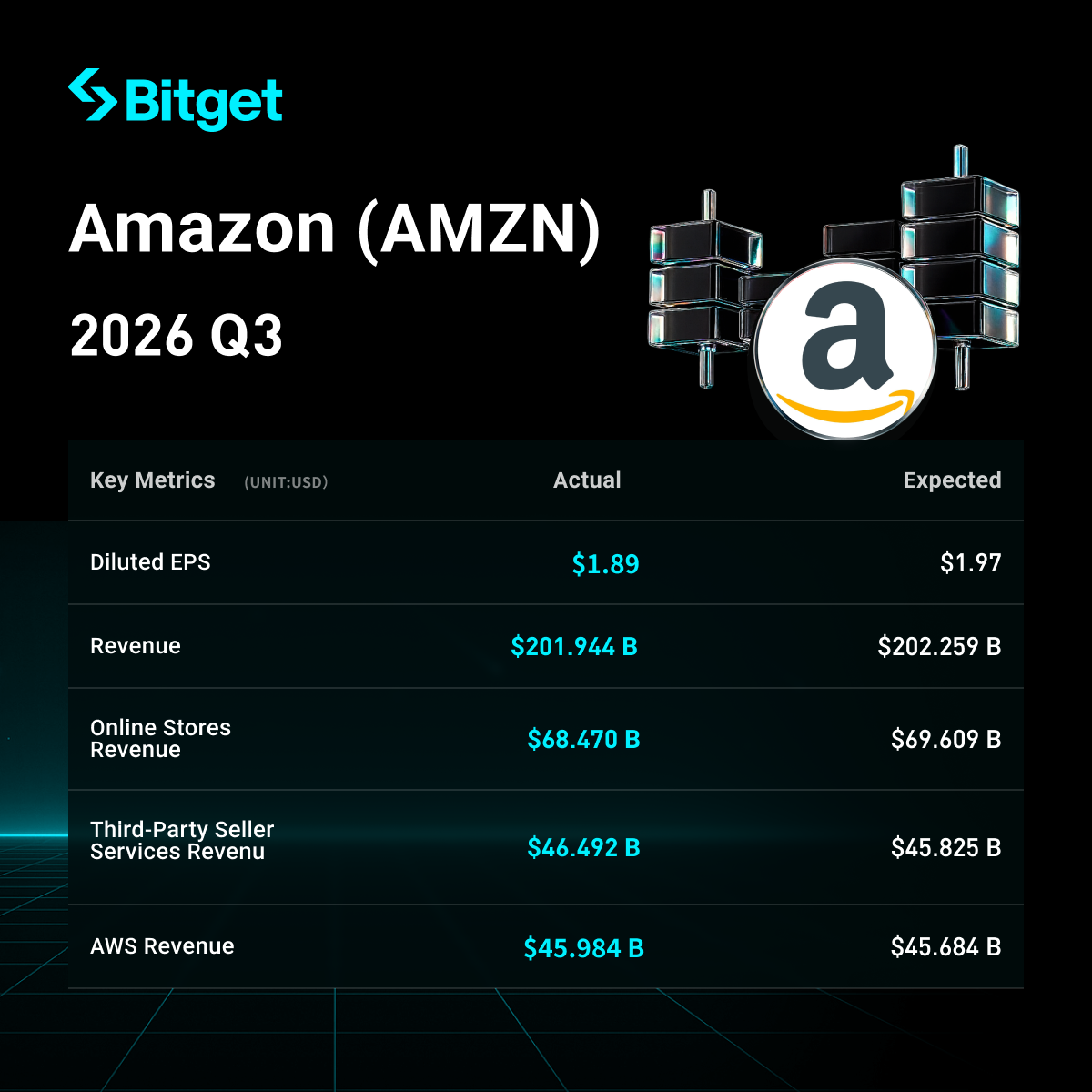
Amazon’s third quarter of 2026 (ended September 30) reported net sales of $201.94 billion, up 12% year-over-year (13% excluding FX), slightly below analyst expectations. Diluted EPS was $1.89, down about 3.1% year-over-year and below the $1.96 estimate. Operating income reached $28.08 billion, up roughly 61.5% year-over-year, with an operating margin of 13.9% — the highest in company history. AWS net sales were $45.98 billion, up 39.3% year-over-year (the fastest quarterly growth in nearly five years), with an annualized revenue run rate of $184 billion, contributing about 63% of total operating profit. However, online sales rose only 2% (the lowest since early 2023), advertising revenue missed expectations, capital expenditures hit $77.26 billion (well above estimates), and trailing-twelve-month free cash flow was negative $42.36 billion (the second consecutive negative quarter, versus positive $14.79 billion a year earlier). Shares fell more than 10% at one point after hours and ultimately closed down more than 4% (having already declined about 4.25% in regular trading), as investors worried about the AI investment payback cycle and cash-flow pressure.
Detailed Breakdown
- Overall Revenue and Profit Performance
- Net sales: $201.94 billion (precisely $201.944 billion), up 12% year-over-year from $180.17 billion; up 13% excluding roughly $0.9 billion of unfavorable FX impact. Excluding the Prime Day timing shift (mostly in Q2 this year versus entirely in Q3 last year), growth would have been about 400 basis points higher. Slightly below analyst expectations of approximately $202.26–$202.31 billion.
- Diluted EPS: $1.89, down about 3.1% from $1.95 a year earlier and below the $1.96 estimate. Net income was $20.69 billion, below the prior-year $21.19 billion (which included roughly $9.5 billion in pretax gains from Anthropic investments).
- Operating income: $28.08 billion, up 61.5% from approximately $17.42 billion a year earlier; operating margin of 13.9%, a company record and more than 7% above market expectations.
- Operating cash flow (trailing twelve months): $168.3 billion, up 29% year-over-year.
- Free cash flow (trailing twelve months): negative $42.36 billion (precisely –$42.4 billion), about 5.6 times the Q2 outflow of $7.6 billion and versus a positive $14.79 billion a year earlier — the second consecutive negative quarter.
- Drivers: Profit improvement came from greater efficiency in fulfillment, sales & marketing, and G&A expenses. The Prime Day timing shift weighed on year-over-year growth rates, while net income was affected by the high base of prior-year non-operating gains.
- AWS Performance
- Net sales: $45.98 billion, up 39.3% year-over-year from $33.01 billion, above analyst expectations of roughly $45.4 billion and the fastest quarterly growth in nearly five years (accelerating further from 37% in Q2). Annualized revenue run rate at quarter-end was $184 billion, up about 8.9% sequentially from Q2.
- Operating income: $17.77 billion, up 55% year-over-year, with an operating margin of 38.7% (versus 34.6% a year earlier). AWS accounted for about 23% of total net sales (18% last year) and roughly 63% of overall operating profit.
- Key drivers: Strong AI-related demand. Amazon Bedrock spend among Fortune 500 companies grew nearly 7x year-over-year, with token volume up nearly 17x; Bedrock AgentCore agent deployments more than doubled the total of the prior three quarters combined. New agreements signed with Meta, NVIDIA, OpenAI, Salesforce, Oracle, Qualcomm, Verizon, and others. CEO Andy Jassy expects AWS revenue growth to exceed 40% in both 2027 and 2028 and believes AWS can become a trillion-dollar revenue business within 5–10 years (with Amazon potentially having two such businesses).
- Other Business Segment Performance
- North America: Net sales $112.85 billion, up 6% year-over-year (slightly below the ~$113.39 billion estimate); operating income $8.72 billion, up 82% year-over-year, with a 7.7% operating margin (versus 4.5% last year).
- International: Net sales $43.11 billion, up 5% year-over-year (+8% excluding FX); operating income $1.58 billion (up from $1.2 billion), with a 3.7% operating margin (versus 2.9%).
- Online retail breakdown:
- Online stores revenue: $68.47 billion, up only 2% year-over-year (the slowest quarterly growth since early 2023), accounting for roughly one-third of total net sales.
- Third-party seller services revenue: $46.49 billion, up 9%.
- Physical stores revenue: $5.71 billion, up 2%.
- Worldwide paid units grew 12%; shipping costs rose 11%. Prime member delivery speeds were the fastest on record for the quarter, with more than 1.5 billion items delivered same-day or next-day.
- Advertising revenue: $19.64 billion, up 11% year-over-year (+12% excluding FX), about 6% below analyst expectations of ~$20.87 billion. Growth slowed from the prior 20%+ pace, affected by Prime Day timing and other factors. Q4 growth is expected to reaccelerate into the high teens.
- Subscription services revenue: $14.01 billion, up 11% year-over-year and above the $13.69 billion estimate.
- Efficiency gains supported improving retail margins, but near-term online growth remained soft.
- Capital Expenditures and Cash Flow
- Q3 purchases of property and equipment: $77.26 billion, roughly 2.2× the prior-year level (~$35.1 billion) and more than 30% above market expectations of $57.47–$58.7 billion. Trailing-twelve-month net purchases totaled $210.66 billion, up 82% year-over-year, primarily reflecting AI-related investments.
- Full-year 2026 cash capital expenditure guidance remains approximately $220 billion. Management expects to spend meaningfully more in 2027, with a clear line of sight to attractive returns.
- Free-cash-flow deterioration was driven mainly by the large increase in CapEx (trailing-twelve-month net PPE purchases rose by about $94.8 billion year-over-year).
- Balance sheet: Cash and cash equivalents $55.78 billion (down from $86.81 billion at year-end 2025); long-term debt $173.13 billion (up from $65.65 billion). Approximately $48.1 billion of new long-term debt was issued in Q3, and roughly $115.1 billion in the first nine months.
- The company gave no signal of slowing AI spending and emphasized that the investments will generate larger long-term revenue and free cash flow.
- Q4 2026 Guidance
- Net sales: $240.0–$247.0 billion, representing 12–16% year-over-year growth (including roughly 60 basis points of unfavorable FX impact). Midpoint of $243.5 billion is slightly below analyst expectations of ~$244.52 billion.
- Operating income: $28.5–$33.5 billion, midpoint $31.0 billion, below the market expectation of ~$33.1 billion (upper end slightly above consensus, lower end below). Prior-year Q4 operating income was approximately $25.0 billion.
- Advertising revenue expected to grow in the high teens year-over-year.
- Market Context and Investor Concerns
- The report showed clear two-sided results: rapid AWS growth (fastest in nearly five years) and a record operating margin, offset by soft e-commerce growth (lowest in three-and-a-half years), revenue and EPS misses, elevated AI capital spending (more than 30% above estimates), and sharply negative free cash flow.
- Core tension: the payback period on AI infrastructure investment versus near-term cash-flow pressure. Investors are concerned that high CapEx will continue to weigh on free cash flow, with no indication of a spending slowdown; the Q4 guidance midpoint also came in below expectations, suggesting online business is unlikely to rebound quickly in the near term.
- Market reaction: Shares fell more than 10% at one point after hours and ultimately closed down more than 4% (regular-session close was already down ~4.25% at $243.79; after-hours decline was roughly 6–7%). This coincided with similar AI-spending concerns at Meta, Google, and other tech giants.
- Company stance: Management stressed that the AWS strategy is working, returns on investment are accelerating, retail market share and margins continue to improve, and it sees long-term potential for two trillion-dollar businesses.
Disclaimer: This content is for reference only and does not constitute investment advice.
Disclaimer: The content of this article solely reflects the author's opinion and does not represent the platform in any capacity. This article is not intended to serve as a reference for making investment decisions.
You may also like
Intel: PC Market Falters First, Foundry Plans Still "To Be Discussed Later"
Server orders are still queued, and AI demand hasn't collapsed. What has changed is pricing: PCs are constrained by memory costs, gross margin guidance is being revised downward, and external OEMs still can't be incorporated into the model. Next year, free cash flow is also likely to turn negative. The market is no longer willing to pay for an unfulfilled OEM timeline or the pace of PC recovery.
Capital B’s Alexandre Laizet points to Bitcoin as answer to France’s debt crisis

Crypto prices
More


