
Who can stop tech stocks from falling? Nomura: Elections won't help, only the Federal Reserve!

Global tech stocks are mired in a correction rut. While the market generally hopes for a rebound opportunity after clearer policies following the US midterm elections, Nomura strategist Naka Matsuzawa poured cold water on such expectations. He explicitly pointed out that the impact of the midterm election results on the stock market is far less than market expectations, and the only true catalyst to end the tech stock slump is for the Federal Reserve to stop raising interest rates.
In his macro strategy weekly report on October 30, Matsuzawa predicted that during the week of the November 2 midterm elections, US stocks would remain soft, the bond market would be strong, the dollar weak, and the yen strong. He believes that the root cause of tech stock weakness doesn’t lie in election uncertainty, but in two deeper themes: pressure on AI investment prospects and ongoing credit concerns. Against this backdrop, any rebound in semiconductor stocks is both short-lived and narrow, unable to drive a broader recovery in the global tech sector.
The Market Impact of Midterm Elections Is Overestimated
The mainstream market expectation is that if the Democratic Party wins both the House and Senate, US stocks will fall, the bond market will rise, and the dollar will weaken, driven by concerns about fiscal policy gridlock and stricter AI-related regulations (including restrictions on data center construction).
However, Matsuzawa is skeptical. He points out two key pieces of evidence: first, the event premium around the midterm elections in futures markets and others has already declined significantly; second, the stocks of companies expected to be hit hardest by stricter regulation have not significantly underperformed the market. In other words, the current tech stock slump isn’t necessarily directly linked to regulatory tightening concerns, and the election itself may not be the core driving force of the financial markets.
He concludes: ending the election will not dispel the uncertainty shrouding tech stocks, and investors betting on a post-election stock market rebound are likely to be disappointed.
Internal Rotation in the Tech Sector Hints at Deeper Issues
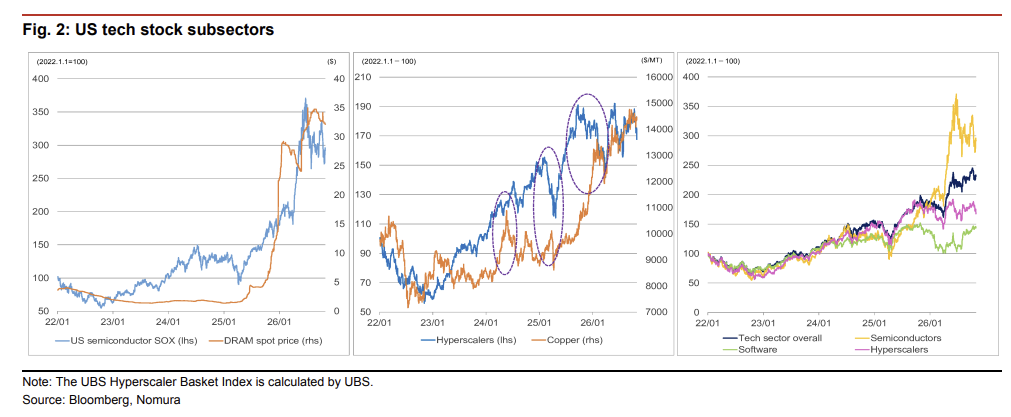
Over the past week, there has been a clear divergence within the tech sector. Semiconductor stocks, which have led the declines since July, rebounded, while hyperscaler and software stocks, previously relatively resilient, fell back.
Matsuzawa believes this can’t be simply characterized as internal sector rotation; there are deeper underlying logics that need to be clarified.
Currently, investors are showing two clear tendencies: first, they aren’t particularly impressed by revenue and profit outperformance in core businesses, but respond harshly to underperformance; second, compared to aggressive capital expenditure plans, the market prefers restrained investment, improved cash flow, and increased shareholder returns. This reflects deeper concerns about a significant slowdown in AI investment.
In semiconductors, the US SOX semiconductor index surged 6.9% this week, but semiconductor stocks in Japan and South Korea have yet to recover from their corrections. Capital goods and machinery stocks—usually early indicators of a recovery in AI investment—also haven’t shown improvement, further indicating that confidence in the AI investment outlook hasn’t fundamentally improved.
Credit Concerns and Fed Rate Hikes: Two Central Themes
In the bond market, an intriguing phenomenon emerged this week: although credit concerns eased somewhat, US long-term rates fell while long-term rates in Japan and Germany rose. Matsuzawa attributes this divergence to differing hawkish or dovish tones in major central bank policy meetings versus market expectations.
The Federal Reserve was more dovish than the market expected, acknowledging that financial conditions have tightened; the European Central Bank also acknowledged tighter financial conditions but clearly signaled a December rate hike; the Bank of Japan did not mention tighter financial conditions, stated that underlying inflation had reached 2%, and raised its inflation forecast.
Regarding the reasons for the easing of company credit concerns this week, Matsuzawa offers two interpretations: first, it was mainly driven by lower US rate hike expectations; second, improved earnings reports and IPO prospects for tech companies boosted confidence in their financing capabilities. Given the poor performance of hyperscaler stocks this week, he leans toward the first interpretation. If next week’s US employment report beats expectations, it will raise the market’s expectations for more Fed rate hikes and could reignite credit concerns, making the situation more complex.
Dollar and Yen: Credit Sentiment Dominates as Rate Hike Expectations Recede
In the forex market, the dollar strengthened and the yen was under pressure this week, with USD/JPY reaching the 157.5-158.0 range. This move is somewhat surprising—falling US rate hike expectations would typically weigh on the dollar, but the easing of credit concerns spurred rebounds in semiconductor and bank stocks, supporting US equities and attracting previously outflowing funds back to dollar-denominated assets.
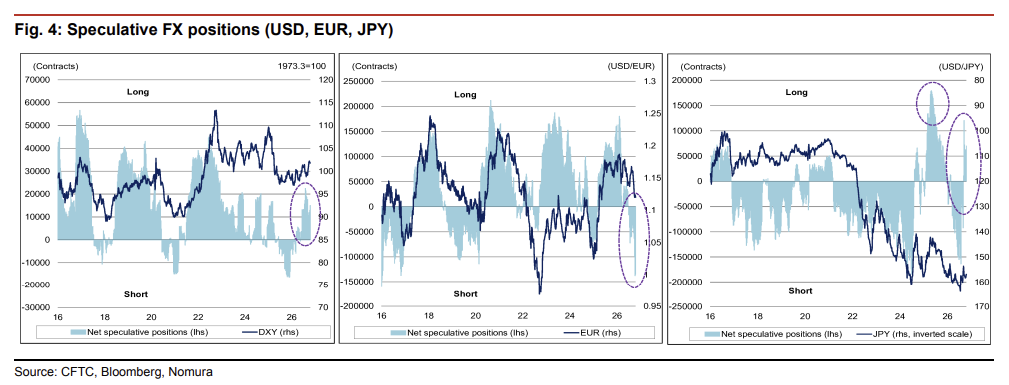
Matsuzawa warns that if the rebounds in semiconductor and bank stocks lack sustainability, the logic of lower rate hike expectations will dominate again, putting significant downward pressure on the dollar.
On the yen, speculative forex positioning as of October 20 shows an increase in yen long positions, but the current size is still only equivalent to 39% of the peak during the US tariff shock in April 2025, suggesting there’s still considerable room for further yen long positions.
Only the End of Fed Rate Hikes Can Break the Deadlock
Matsuzawa makes it clear that it is currently difficult to find any catalyst strong enough to lift global tech stocks out of their downturn. Election results, sector rotation, or individual earnings reports are not enough to fundamentally change the underlying logic of tech stock performance.
He wrote in his report that the most important identifiable potential catalyst is the end of the Fed’s rate hike cycle. Until this premise materializes, tech stocks will continue to face valuation pressures from tighter financial conditions and doubts around the sustainability of AI investment are not likely to dissipate.
As for the future market direction, Matsuzawa maintains his core forecast: before the Fed truly pivots its policy stance, a substantial systemic rebound in global tech stocks is unlikely.
Disclaimer: The content of this article solely reflects the author's opinion and does not represent the platform in any capacity. This article is not intended to serve as a reference for making investment decisions.
You may also like
Lifelong Scars: Goldman Sachs finds that workers replaced by AI often struggle to find new jobs and frequently become targets in AI’s next wave
AI layoffs are spreading across the entire industry! Goldman Sachs warns that those who are eliminated are falling into a "trap from the moment of employment": not only is finding another job difficult, but 75% will again be within AI's replacement range. Even more dangerous is that if the economy declines, tens of millions of accumulated AI layoffs could erupt all at once, meaning the real unemployment storm is only just beginning.

Ondo Brings Seven Tokenized Investment Portfolios to Solana
Uber Tests Weekend Tokenized Fund Redemptions With HSBC on Canton

Aave Expands Stock-Backed USDC Loans on Base for Eligible Investors

Crypto prices
More


