
The US midterm elections may become a turning point for gold, as deficit concerns are expected to reignite safe-haven demand

Gold is facing its most severe annual decline in over a decade, but the upcoming U.S. midterm elections may be brewing a narrative shift—concerns over fiscal deficits and inflation are returning to focus, potentially reviving the safe-haven attributes of this precious metal.
The ongoing AI investment boom continues to draw capital toward risk assets, while rising bond yields and expectations of interest rate hikes keep exerting pressure on this non-yielding asset. The midterm elections held on Tuesday prompt the market to reassess the trajectory of fiscal deficits and monetary policy, possibly giving gold some breathing room.
This year, gold's price has plunged from a historic high above $5,500, now falling below the $4,000 mark, with a year-to-date decline exceeding 8%.
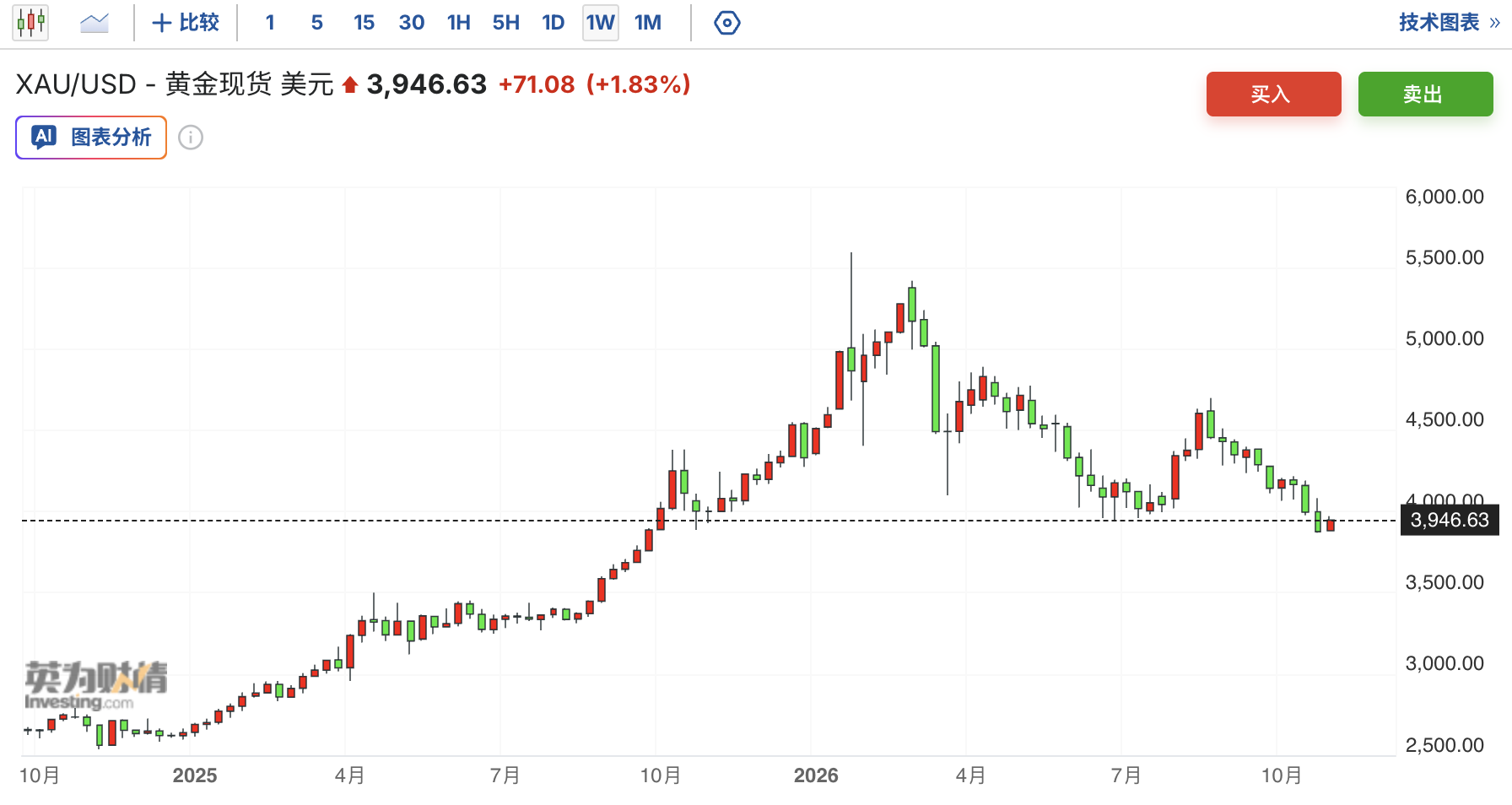
If the election results in a split Congress—similar to the situation after the midterm elections during Trump’s first term—legislative progress will likely stall, making it difficult to effectively contain the approximately $2 trillion U.S. fiscal deficit.
Matt Miskin, Co-Chief Investment Strategist at Manulife John Hancock Investments, stated that if the 2027 trend repeats what happened in 2019, the current weakness in gold could see a reversal.
Congressional Gridlock May Be a Catalyst for Gold Prices
Several polls show that the Democrats have an advantage in retaking the House of Representatives, but the outcome of the Senate majority remains uncertain. Even if the Democrats control both chambers, the President’s veto power would still limit the room for fiscal expansion, putting downward pressure on Treasury yields—a key factor that has weighed on gold prices this year.
“Political gridlock could lower the risk of fiscal policy further pushing up real yields,” Miskin said. This would be “a very positive development” for gold. He expects this election to result in a moderate shift in the political landscape, with limited changes on the policy front.
Anthony Saglimbene, Chief Market Strategist at Ameriprise, pointed out that regardless of the make-up of Congress, the next session will face a challenging fiscal backdrop.
Gridlock not only restricts spending but also hinders politically difficult measures such as budget cuts or revenue increases, making substantial improvement to the U.S. fiscal situation unlikely. Saglimbene expects that investors concerned about the U.S. fiscal outlook will seek safe-haven assets beyond government bonds, which could benefit gold.
Rising Real Yields and Dollar Strength: A Dual Burden
This year, gold prices have come under pressure primarily due to the twin forces of rising real yields and a stronger dollar. As a non-yielding asset, gold is naturally disadvantaged in a high-yield environment, and the AI-driven economic boom has further attracted investor attention and capital to risk assets.
At the same time, rising oil prices are intensifying inflation concerns and reinforcing market expectations for tighter monetary policy, which has led investors to favor high-yield government bonds. This has been a prominent feature of the market this year: even as geopolitical risks rise and U.S. fiscal issues continue to ferment, gold has struggled to play the safe-haven role investors expect.
This dynamic has created a unique tension for gold investors: fiscal concerns drive yields higher, making interest-bearing assets more attractive and putting short-term pressure on gold. Yet persistently rising yields are themselves a sign of accumulating fiscal strain; if investors start to lose long-term confidence in the dollar, gold’s appeal as an alternative store of value will strengthen.
Sustainability of the AI Trend and Fed Credibility Are Key Variables
Gold’s performance depends to a significant extent on whether the AI investment boom can continue. The massive capital needs for AI infrastructure are prompting companies to flock to the bond market for financing, while the U.S. government also needs to raise funds for its large deficit. Combined, these forces are pushing bond yields higher and suppressing gold’s performance.
Roger Aliaga-Díaz, Global Head of Portfolio Construction at Vanguard Group, noted that the AI capital expenditure boom is one of the strongest investment cycles in decades and is unlikely to end abruptly. Vanguard expects economic growth next year to exceed market consensus.
Under the Vanguard framework, large deficits do not automatically benefit gold: if policymakers maintain credibility and are willing to use rate hikes to contain inflation, fiscal expansion will ultimately translate into higher yields rather than a collapse in dollar confidence, which is still negative for gold. “If the Fed does its job,” fiscal issues should not be the primary driver of gold prices, said Aliaga-Díaz.
However, if investors begin to question the Fed's independence or its willingness to contain inflation, gold’s appeal would rise significantly.
Some Investors Are Already Buying at Lows
Despite divided outlooks, gold's break below $4,000 has started to attract bargain hunting.
Doug Daly, Portfolio Manager at CoreCommodity Management, said that his portfolio is still focused on energy and Middle East dynamics for election-related positioning, but after gold dropped below $4,000, he has gradually shifted to a more bullish stance. Miskin also revealed that his strategies added allocations around $4,000, with overall positioning now neutral to slightly overweight.
From a longer-term perspective, Kristina Hooper of Man Group sees the path towards stagflation as a critical watchpoint—persistent inflation combined with slowing economic growth has historically created the most favorable macro environment for gold. “The bigger story is whether we are really entering a stagflationary scenario,” Hooper said. She is closely monitoring signs of weakening job growth coexisting with price pressures.
If economic growth slows, real yields fall, or worries about Washington's inability to rein in fiscal imbalance persist, gold’s former appeal could quickly return. However, if AI investing continues to support growth, the Fed remains hawkish, and U.S. Treasuries continue to offer attractive yields, gold may stay in the shadows waiting for its moment.
Disclaimer: The content of this article solely reflects the author's opinion and does not represent the platform in any capacity. This article is not intended to serve as a reference for making investment decisions.
You may also like
Sixth Consecutive Season Exceeds Expectations: Roku (ROKU.US) Revenue Hits $1.5 Billion, Beats Forecasts; $22 Billion Acquisition Remains Unresolved
Roku (ROKU.US) released its Q3 2026 financial results after the U.S. stock market closed on Monday.
Overnight US Stock Market | Nasdaq surged and then pulled back, the three major indexes were mixed; Marvell Technology (MRVL.US) fell 12.7%
At the close, the Dow Jones Industrial Average rose by 213.67 points, or 0.41%, to 51,983.98 points; the S&P 500 Index fell by 38.67 points, or 0.51%, to 7,541.40 points; and the Nasdaq Composite Index dropped by 272.68 points, or 1.07%, to 25,164.32 points.
Meta (META.US) Plans to Issue at Least $20 Billion in Cross-Border Investment-Grade Bonds, Marking Its First Foray into the Euro Bond Market
According to sources familiar with the matter, Meta Platforms is considering raising at least $20 billion through an investment-grade cross-border bond issuance to support its expanding artificial intelligence investment plans.

Palantir (PLTR.US) Q3 revenue surged 96% year-on-year; U.S. commercial business revenue surpassed government business for the first time
Artificial intelligence data analytics company Palantir announced its financial results for the third quarter of 2026 on Monday.

Crypto prices
More


