
Gold price rebounds, oil price plunges, suppressing Federal Reserve rate hike expectations

Forex Network, November 3rd—— Spot gold and December gold futures on the New York Mercantile Exchange both rose by more than 2% after hitting a one-year low last week. West Texas Intermediate (WTI) and Brent crude oil both fell by over 6%, easing inflation concerns and prompting the market to lower expectations for further Federal Reserve rate hikes.
On Monday (November 2nd), falling oil prices dragged down the US Dollar Index, providing yet another layer of support for the non-yielding asset, gold.
Gold prices rebounded following a sharp drop last week, as traders shifted their focus from the Federal Reserve's rate hike expectations to declining oil prices and the US midterm elections.
Gold prices hit a one-year low last Friday, and in Monday’s early session, both spot gold and gold futures surged by more than 2%. The early decline in oil prices eased market worries over inflation, spurring short covering and speculative buying. At the same time, some investors opted to square their positions and adjust holdings ahead of Tuesday's US midterm elections, which could influence future government policy directions.
The decline in oil prices has not yet changed market bets on a December rate hike, but it does affect expectations for the overall magnitude of rate increases during this tightening cycle.
Market expectations for a December rate hike have slightly declined today—enough to suppress the US Dollar Index and thus support gold prices.
The core driver of current market moves comes from the oil market. Iran and Qatar held talks for a third consecutive day, negotiating a possible US-Iran ceasefire, which led to WTI and Brent crude both plunging more than 6%.
Expectations of easing inflation and cooling rate hike outlooks are the main factors impacting the market today—both directly influencing the valuation of the non-yielding asset, gold.
Some believe that last Friday’s gold sell-off was triggered by a sharp drop in US tech stocks. Weakness in equities triggered margin calls, forcing hedge funds to liquidate gold holdings to meet margin requirements.
Other analyses point out that the main theme this week is the political risk around the US midterm elections, with the outcome possibly impacting US fiscal policy. However, some believe the impact will be limited: neither party is likely to tackle the current US high debt issue, and a high-debt environment is long-term positive for gold prices.
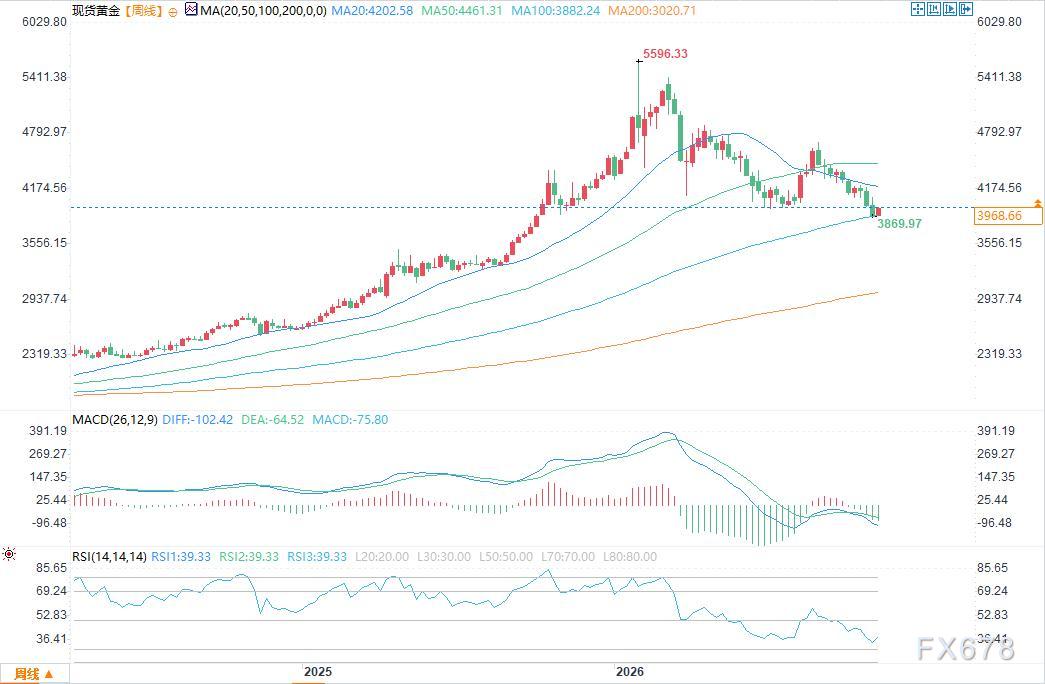
In the early Monday session, spot gold on the weekly chart slightly rebounded after last week’s sharp decline. The price saw buying interest before falling below last week’s low, indicating that capital is either bottom-fishing or reacting technically to an oversold market.
The weekly swing chart indicates the primary trend is still downward. If the price falls below $3,870.32, a renewed downtrend will be confirmed; only an upside breakout above $4,697.11 would shift the primary trend upwards.
The secondary trend is also downward. Holding above $4,217.39 would turn the secondary trend bullish, likely driving a shift to a bullish market.
The key range currently being tested is the large wave band between the November 2024 low of $2,536.85 and the January 2026 high of $5,602.23, with the retracement zone between $4,069.54 and $3,707.82. Many long-term investors view this zone as a value accumulation area.
Upper resistance: The 52-week moving average at $4,447.29 is a major long-term trend resistance; next is $4,481.78, which is 20% below the all-time high of $5,602.23 and is viewed as the starting point of a bear market.
Key points for further observation
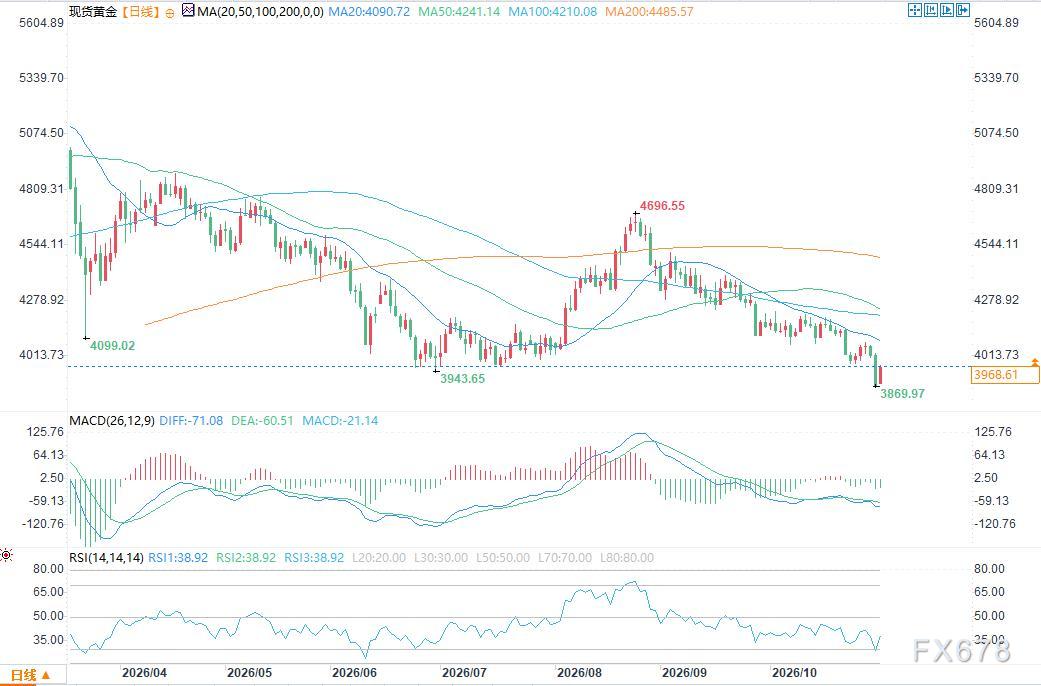
The major trend remains down, with prices significantly below the 52-week moving average, confirming a bear market and an overall bearish bias.
For value-oriented traders (passive limit orders, active market orders), the focus should be on the range: $4,069.54 to $3,707.82. How the market reacts in this range will reflect whether bulls are willing to actively take out sell orders near $4,069.54, or if capital opts for passive buying at the 61.8% retracement level of $3,707.82.
A steady hold above $4,069.54 will weaken bearish expectations; a break below $3,707.82 would further reinforce a bearish outlook.
Disclaimer: The content of this article solely reflects the author's opinion and does not represent the platform in any capacity. This article is not intended to serve as a reference for making investment decisions.
You may also like
Apple's revenue and earnings last quarter exceeded expectations, but high memory costs, shrinking gross margin, weaker performance in China, and slowing growth in services | Earnings Report Insights
In the fourth fiscal quarter ending at the end of September, Apple's total revenue increased nearly 12% year-on-year. iPhone revenue exceeded expectations with a 17.5% increase, and Mac revenue grew nearly 24%, surpassing analysts' expectations by 11%. However, iPad and wearable device revenue both fell short of expectations. EPS rose 14% year-on-year, and the gross margin of 47.9% reached its lowest point in a year, supported by U.S. tariff exemptions. Service revenue hit a record high for a single quarter. Greater China revenue increased 21%, though it was still 6.5% below analyst expectations. For the full fiscal year, revenue set a historic record, but shareholder returns declined, with stock repurchases down nearly 5% from last year to $86.4 billion. During the earnings call, management disclosed that rising memory prices are eroding profit margins, and guidance for next quarter’s gross margin is only 45% to 46%, much lower than this quarter’s 47.9%. After-hours stock price fluctuated and turned downward, at one point dropping more than 4%.
Marvell plunges 13%, Lumentum plunges 19%! The second largest tech merger in history triggers sell-off
Marvell announced the acquisition of Lumentum for an enterprise value of $115 billion, making it the second largest deal in the technology industry’s history after the merger of SpaceX and xAI. Upon completion of the transaction, former Marvell shareholders will hold approximately 67% of the merged company, and the deal is expected to be finalized in the first half of 2028. However, as AI-related stocks are currently under pressure, the market is not optimistic about this deal. Both Lumentum and Marvell shares plummeted on Monday as investors are concerned about the limited potential for cost synergies and the uncertainty of regulatory approval.
CITIC Securities: Tech sector turbulence, gold hit by liquidity impact
The decline in CFTC gold fund long positions and SPDR holdings suggests that gold may be experiencing a liquidity shock to supplement margin requirements for tech stocks. Despite capital inflows into US Treasuries for risk aversion causing Treasury yields to fall, this has not managed to stimulate bullish sentiment for gold.

Midterm elections coupled with non-farm payroll data may boost market volatility! Oracle (ORCL.US) leads 17 companies in rushing to issue bonds
Oracle (ORCL.US) leads 17 companies entering the U.S. high-grade bond market, rushing to issue bonds ahead of the U.S. midterm elections.
Crypto prices
More


