
Gold and silver face a liquidity stampede, fund managers say this may be a once-in-a-lifetime buying opportunity

FX168 News, November 3—— After last Friday’s sharp drop, gold and silver saw a slight rebound but recorded their worst October performance since 2008. Jen Bawden, founder of Bawden Capital, believes this move is a liquidity crunch. Referring to 2008 and 2020, after forced selling concludes, precious metals may rally sharply. In the short term, further downside remains likely, with Asian physical demand providing support, and in the long run, global debt pressures will eventually force central banks to shift to easing, benefitting gold and silver.
After the sharp declines last Friday, gold and silver staged a modest recovery, but this round of declines marked the worst October performance for precious metals since 2008. Jen Bawden, founder of Bawden Capital, offers a different perspective. She believes that this sell-off, triggered by tighter liquidity, may be a rare long-term buying opportunity, though risks of continued short-term downside remain.
The Multiple Practical Logics Behind Pressure on Gold and Silver
Recently, global central banks have continued policy tightening to curb inflation, increasing the opportunity cost of holding non-yielding assets like gold and silver. Combined with the major equity sell-off last week that caused a liquidity squeeze, gold and silver saw simultaneous capital outflows. Jen Bawden noted that although the Federal Reserve kept rates unchanged last week, the market still bets on a rate hike in December, and rising rate expectations continue to suppress precious metal valuations.
Many retail investors misunderstand the current environment, questioning why tensions in the Middle East and Brent crude stabilizing above $113 per barrel have not led to higher gold and silver prices. She explained that since energy trade is settled in US dollars, rising oil prices force energy-importing countries to exchange more local currency for dollars to buy oil, fueling strong dollar demand and lifting the US dollar index. High oil prices also keep inflation expectations elevated, which further strengthens anticipation of tighter policy, driving up US Treasury yields and jointly pushing down gold and silver prices.
This round of declines is a classic example of cross-asset margin call shock. When risk markets crash, large institutions first sell their most liquid assets to raise cash, making gold and silver—given how easily they can be liquidated—prime targets for selling. The S&P 500 fell 2% last Friday, its largest one-day drop since early June, and the increased market volatility heightened downward pressure on precious metals.
Reviewing Historical Liquidity Crises: Major Moves Often Follow Crashes
Jen Bawden compared the market patterns during the liquidity crunches of October 2008 and March 2020. In the early stages of both crises, gold and silver plummeted in tandem with stocks. After the collapse of Lehman Brothers in 2008, gold fell by roughly 29% from its March high, while silver lost more than 50%; during the panic in March 2020, gold dropped around 10% in just a few days, and silver retreated nearly 35%.
After forced selling and margin-driven liquidations played out, gold and silver then staged spectacular rallies. After the 2008 crisis, gold surged about 170% by August 2011, while silver soared to near $50 per ounce; after the March 2020 decline, gold hit a new all-time high in August that year, rallying about 39%, while silver jumped 150%. She believes today’s market structure is very similar to those two periods, reflecting passive selling in a liquidity vacuum rather than a fundamental reversal.
Short-Term Risks Remain, Asian Physical Demand Provides Support
Jen Bawden also cautions investors not to rush into heavy buying too soon; until a sustainable bottom forms, gold and silver prices could continue to fall. She has placed limit orders and plans to scale into mining stocks if they fall another 20% to 30%.
Asian physical demand may provide some support for silver. She maintains a long-term bullish view on physical precious metal demand from major Asian countries, seeing it as a stable bottom support.
Long-Term Theme: Global Debt Pressures Will Eventually Lead to Easing
Jen Bawden’s long-term outlook is built around the issue of global sovereign debt. She says that the massive size of global debt is unsustainable under prolonged high interest rates, which will continue to erode the resilience of the banking system and the real economy. When debt pressures reach a critical point, central banks worldwide will eventually pivot to accommodative monetary policy. As the strong US dollar cycle unwinds, capital will flood into hard assets like gold and silver, initiating a new bull market.
Conclusion
In the short term, the US dollar and rate hike expectations continue to be the main headwinds for gold and silver, and liquidity risks have not fully dissipated; but from a long-term perspective, debt distress plants the seeds for lasting gains in precious metals, and investors need to distinguish between short-term forced selling and long-term trend shifts.
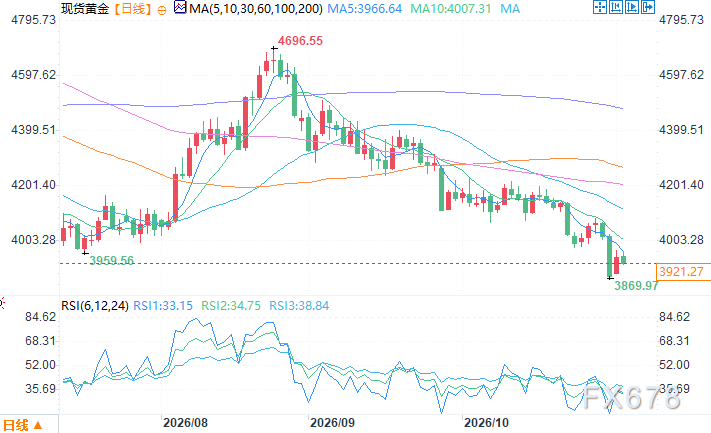
Spot gold daily chart Source: FXEasy
East 8 Zone, November 3, 14:59 Spot Gold quoted at $3,912.27/oz
Disclaimer: The content of this article solely reflects the author's opinion and does not represent the platform in any capacity. This article is not intended to serve as a reference for making investment decisions.
You may also like
Ethereum Is The ‘Toll Road To Tokenization’: Joseph Chalom’s Bull Case For ETH

Crypto’s Quiet Accumulation Phase May Be Ending: 5 Altcoins to Hold Before the Market Turns Chaotic
Trump Faces a Critical Midterm Election Test: 5 Altcoins to Hold Before the Next Crypto Market Shake-Up
Crypto prices
More


