
Down 60%, surging 23% after hours! Was this AI advertising company unjustly punished?

If a stock has dropped about 60% this year, you might think its business is really struggling.
But this company just posted the following results: quarterly revenue grew 55%, net profit increased 72%, and free cash flow was approximately $1.4 billion.

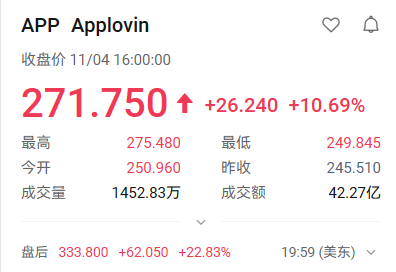
The company is the AI advertising platform AppLovin (APP). After the earnings report was released post-market on November 4, the stock price surged nearly 23%. Previously heavily sold, this stock became the target of capital chasing overnight.
While the market is worried that AI investments may never pay off, AppLovin is already turning AI into profits and cash. So, was the 60% drop a market misjudgment, or were investors paying too high a price in the past?
This earnings report is worth looking at through this lens.
1. The Most Substantial Indicator Is Cash
In Q3, AppLovin posted revenue of $2.185 billion, net profit of $1.439 billion, and a net margin of around 66%. Both operating cash flow and free cash flow were about $1.4 billion.
Many people will first be attracted by the 84% adjusted EBITDA margin, but that's an indicator that eliminates certain expenses and shouldn't be taken as $84 net profit for every $100 in revenue.
In comparison, I value the simultaneous strength of both net profit and cash flow more. At least this quarter, the growth wasn't just on paper. The company actually collected a large amount of cash.
This is especially important for current AI investments.
Investors have seen too many massive plans for computing power, long-term revenue targets, and procurement commitments. AppLovin provides a different perspective: Can AI investment improve existing business, making customers willing to spend more while allowing the company to keep more profits?
This time, AppLovin’s answer is compelling.
But to understand these results, we must see how the money is made.
2. Why Are Advertisers Willing to Spend More?
AppLovin focuses on performance ads. Whether advertisers will keep investing depends on whether the customers and revenue brought in by the ads can cover the advertising costs.
No matter how advanced AppLovin’s AI models are, they must pass the advertiser’s test.
Management stated on the conference call that after part of the new generation model went online in the third quarter, advertisers were able to expand their advertising budgets while achieving their target ad returns.
Game business revenue grew nearly 50% year-on-year, and this was also the main driver for the quarter’s outperformance. At the same time, even with increased investments in model training, the proportion of data center costs relative to revenue actually declined.
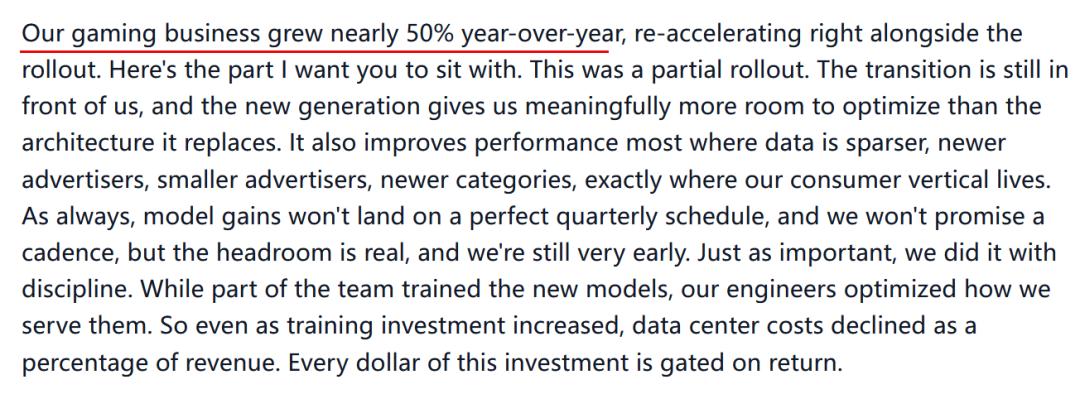
Translating this into a judgment useful to investors: The model improved ad performance, advertisers were willing to increase budgets, and the company’s service costs did not rise proportionately.
This is the reason profit can outpace revenue.
Of course, this is management’s explanation of the business. If the increased budgets can be sustained, that’s a firmer test.
I believe this is the real competitive edge worth studying in AppLovin: Can it continuously help advertisers acquire better-value customers? As long as it delivers, clients will continue to advertise; if effectiveness drops, even the shiniest AI label can’t keep budgets flowing in.
3. If the Business Is So Good, Why Is the Stock Falling?
Because the price investors pay reflects expectations for the future.
AppLovin’s previous decline wasn’t without reason. Q2 and Q3 revenue guidance was below market expectations, and after the August earnings report, the stock once dropped almost 20%.
What changed with this earnings report?
Based on company disclosures, Q2 revenue grew about 4.4% quarter-on-quarter, while Q3 growth jumped to about 13.6%. The lackluster growth previously feared by the market did not worsen this quarter—instead, there was marked improvement.
But don’t rush to call it an “across-the-board re-acceleration.”
The company forecasts Q4 revenue of $2.365 to $2.395 billion. At the midpoint, that’s about 9% quarter-on-quarter growth and about 44% year-on-year, lower than Q3’s 55% YoY growth.
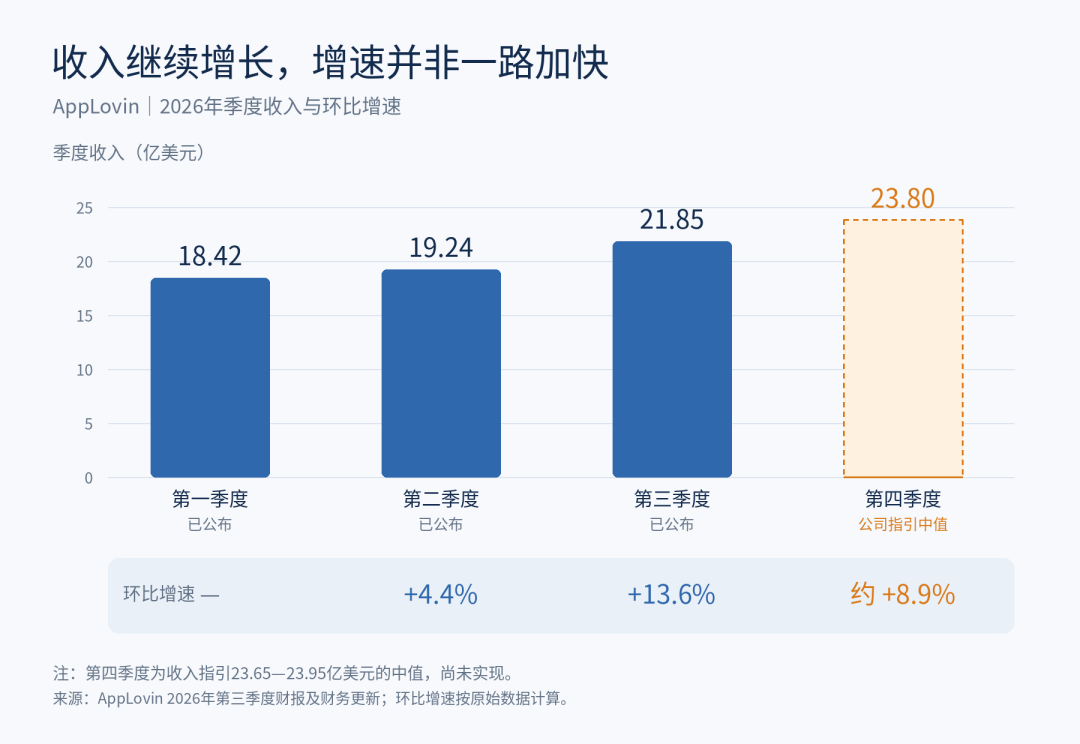
This earnings report shows AppLovin’s growth is better than previously feared by the market. But its Q4 guidance doesn’t indicate continued acceleration, so you can’t conclude from one quarterly beat that things will only get faster from here.
This also explains why a good earnings report can spark a rally but isn’t enough to justify all the previously lofty valuations.
4. What’s My View After the Rebound?
According to U.S. Stocks Investment Network, this earnings report is enough for me to regain confidence in AppLovin’s operational performance. Revenue growth is supported by profits, and profits are further backed by cash flow, which is more meaningful than just raising long-term targets.
But after this post-market rally, the reasons for buying in must also be updated. You can’t keep relying on “it’s already dropped 60%” as the main argument after the rebound.
Going forward, two things matter most to me.
First, will the new models’ effectiveness keep advertisers increasing budgets, instead of just boosting one quarter’s results?
Second, as AppLovin expands to more consumer and e-commerce clients, can it keep generating strong cash flow?
One more thing that’s easily overlooked: with a net margin already at 66%, future profit growth can’t always rely on further margin expansion. The company will need more revenue to support the next phase of profit expansion.
My judgment is that this rally is supported by operational improvement and deserves serious consideration. For those preparing to participate, I would first wait for prices and earnings expectations to stabilize after the report, then evaluate if it’s worth buying.
If advertisers keep increasing budgets, revenue growth holds up, and cash flow remains strong, I’d be willing to pay a certain premium for such a business. But if optimism returns to the share price before the business keeps up, the impulse to chase highs should be curbed.
AppLovin has proven that AI really can make money. Next, investors need to avoid paying another premium for what is already a visibly good business.
Join U.S. Stocks Investment Network VIP
Get first-hand Wall Street news and exclusive quantitative research tools


Disclaimer: The content of this article solely reflects the author's opinion and does not represent the platform in any capacity. This article is not intended to serve as a reference for making investment decisions.
You may also like
Bernstein: ASIC CPU Brings Additional Incremental Demand, Raises Target Price for TSMC (TSM.US) to $600
Bernstein stated that Amazon and Google’s self-developed ASIC CPUs are driving demand for TSMC, with CPU revenue expected to double to $50 billion by 2028. The target price has been raised to $600.
AI investment continues to increase, cost control pressure rises, Google (GOOGL.US) expands scope of voluntary employee buyout program
Facing massive spending in the artificial intelligence (AI) sector, Google is seeking to control rising costs and has expanded its employee buyout program to several countries this year.

CrowdStrike (CRWD.US) spends nearly $500 million to secure a position in AI security, Morgan Stanley turns bullish immediately: $308 bull market target price is closer
Morgan Stanley maintains its "Overweight" rating on CrowdStrike, with a base case price target of $254, and has further increased confidence in the bull case price target of $308.
Bernstein comments on Apple (AAPL.US) Q4 earnings: It's an option for avoiding AI trades, but not necessarily a clear AI winner.
Bernstein maintains an "Outperform" rating on Apple with a target price of $380.

Crypto prices
More


