
French Bonds: The "Eye of the Storm" in the Market

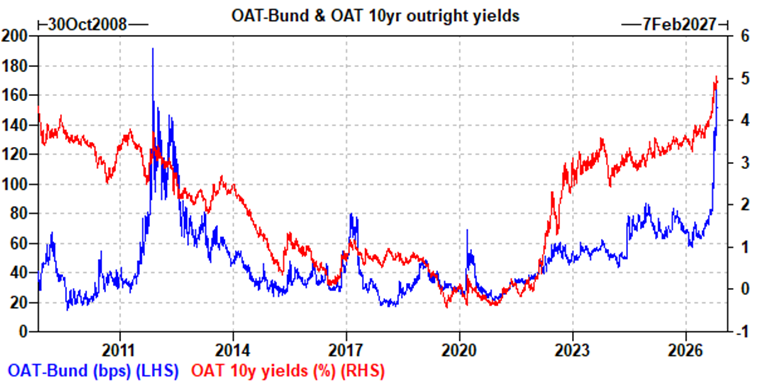
Recently, the European bond market has continued to experience pressure, with the French bond market becoming the "eye of the storm." Since October, the yield on French 10-year government bonds has at one point approached 5%, and the France-Germany yield spread has widened to about 159 basis points. Financing costs have even surpassed those of previously high-risk countries such as Greece and Italy, breaking the traditional risk stratification pattern of eurozone bond markets.
France-Germany yield spread (blue, left) vs. 10Y French bonds (red, right) comparison
France faces persistently high deficits and debt, with around 340 billion euros in bond issuance and refinancing pressure expected in 2027; the government plans to roll out a 54 billion euro restructuring package, aiming to reduce the deficit to 5%, but there is uncertainty over policy implementation due to parliamentary composition and upcoming elections.
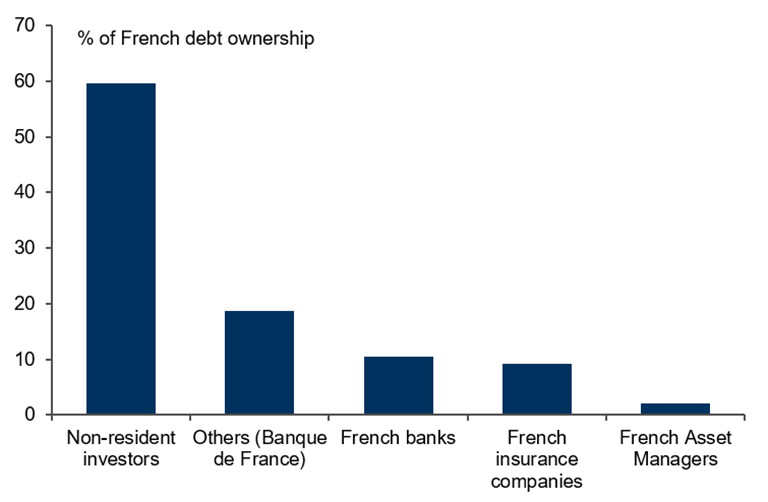
Moreover, the high proportion of French bonds held by foreign investors makes them risk sensitive, and further foreign selling would exacerbate volatility. International investors hold 55% of all French government bonds, with domestic banks and non-banking institutions holding 29%, and the French central bank holding 16%. On the whole, whether domestic or foreign funds, reducing holdings of French bonds and diversifying allocation is one of the main trading strategies. Simultaneous surges in EURJPY and French bond trading volumes illustrate Japan's clear selling signal. Coupled with the sharp widening of sovereign bond yield spreads since September, foreign selling has become a key driver behind the recent price weakness.
Breakdown of French government bond holders
In contrast, the yield spreads of Spanish and Portuguese bonds have widened only slightly, while German and Dutch government bonds have outperformed their swap counterparts, indicating that capital is being reallocated at least within the eurozone.
Is there a possibility of a rally in French government bonds before the 2027 presidential election? Whether French bonds enter a bull run depends on three major potential driving factors:
First: If the centrist and center-right factions nominate a unified candidate at home, this is most likely the most positive fundamental change for French bonds ahead of the election. Currently, the market expects Philippe/Attal to nominate a joint candidate. If the centrist camp (Philippe, Attal) and the center-right camp (Retailleau, Lisnard) can present a single candidate, the baseline scenario in the market will change. At present, Attal, Retailleau, and Lisnard have all expressed support for a joint primary, but Philippe, who is currently leading in the polls, opposes this approach.
Second: The 2027 budget needs to get as close as possible to the 5% deficit target. According to models by Goldman Sachs, even after factoring in the non-linear pricing of debt indicators in the market, the current France-Germany yield spread is still about 60 basis points above its fair value. Therefore, if rate volatility falls and credible deficit reduction commitments are made, there may be room for the France-Germany spread to narrow.
Third: An improvement in the global macro environment. Goldman Sachs estimates that energy has an impact of as much as 20–30 basis points on the volatility of the France-Germany yield spread. In the coming months, Europe's energy uncertainty is expected to remain high; but if winter weather is mild or geopolitical tensions ease, improved global risk appetite could bring a market recovery before the 2027 presidential election.
Overall, the trend of French government bonds prior to the 2027 presidential election will be a "game of hope and risk." While current market sentiment remains fragile and foreign capital continues to exit, potential reshaping of the domestic political landscape, substantive progress in fiscal consolidation, and marginal improvement in the global macro environment could usher in a notable rebound in the bond market. It is advisable to closely monitor developments in French domestic politics, the legislative process for the budget, and fluctuations in energy prices to capture potential investment opportunities.
BFC Forex Talk
Together with you in 2026
Welcome to leave us a message
Discuss with us
Disclaimer: The content of this article solely reflects the author's opinion and does not represent the platform in any capacity. This article is not intended to serve as a reference for making investment decisions.
You may also like
BUZZ-Texas Roadhouse shares fall as third-quarter profit misses expectations
Nasdaq and Semiconductors: Reasons for the Plunge and Where It Might Stall 261106

Crypto prices
More


