Quant (QNT) is consolidating after a spectacular run, yet the foundations for an extraordinary re-rating may already be in place. Elon Musk’s Grok AI predicts that while the broader crypto market has faced pressure and QNT has pulled back from its late-September peak, a highly unlikely but transformative catalyst could still propel it into a new valuation paradigm.
Imagine a scenario in which The Clearing House’s On-Chain Money Initiative, having already selected Quant’s Overledger technology, expands to become a de facto global standard.
In this hypothetical situation, major central banks, the Bank for International Settlements, and a consortium of the world’s largest commercial banks formally designate Quant’s interoperability layer as the preferred, or even required, technology for cross-border tokenized deposits, wholesale central bank digital currency (CBDC) bridges, and regulated real-world asset (RWA) settlements.
New capital and liquidity rules could incentivize or mandate institutions to hold QNT as a necessary asset for network access and collateral, creating structural, multi-year demand that far exceeds current circulating supply dynamics.
QNT Crypto Technical Analysis: Can Quant Hold Above $200 Amid Market-Wide Dip
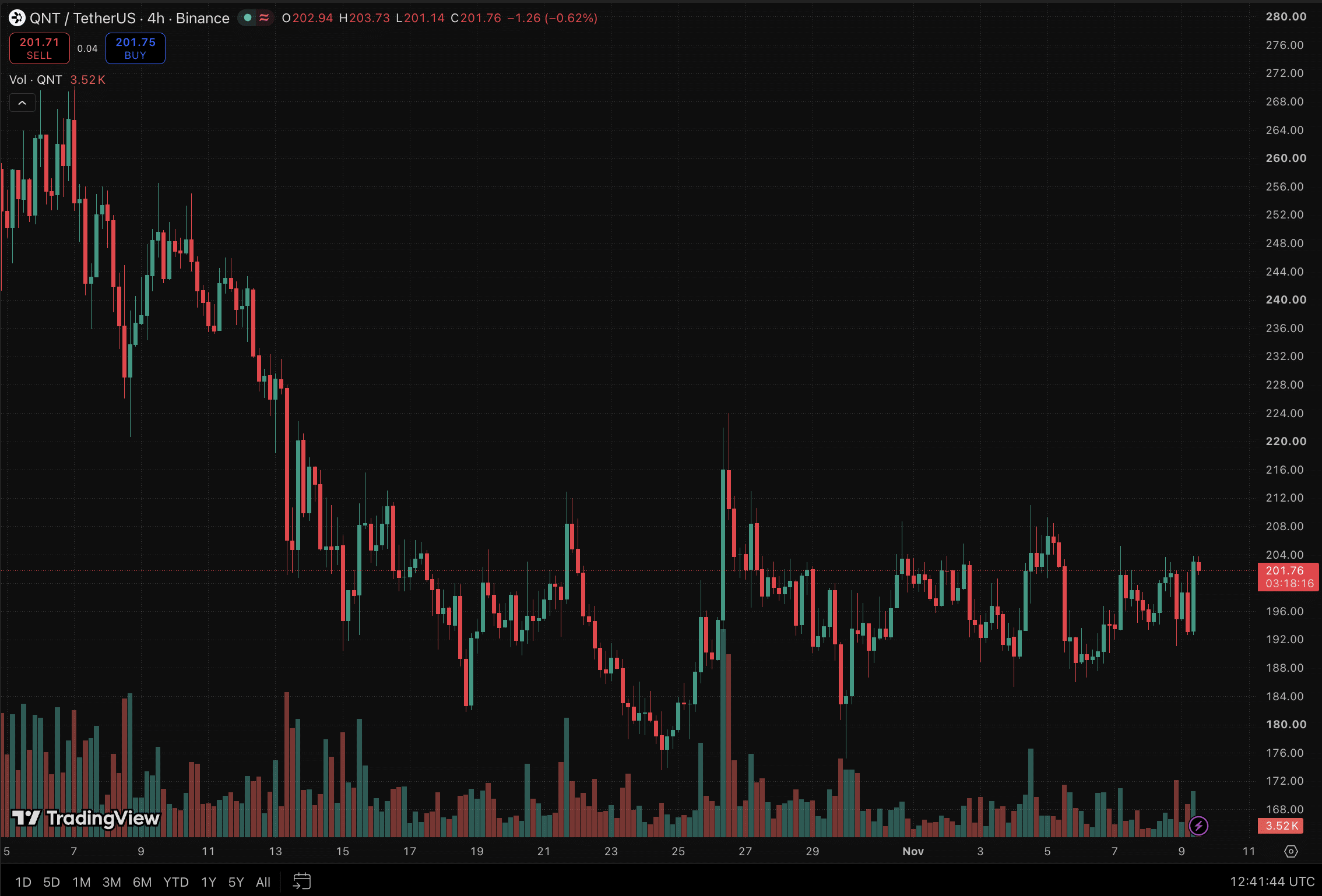
QNT currently trades in the $195–$205 zone after a powerful rally that took it from the $60–$70 area to highs above $300–$350 in weeks.
The subsequent pullback has found support in the $185–$195 region on multiple tests, with higher lows beginning to form relative to the deeper summer base.
Volume expanded dramatically during the initial breakout and remains elevated on up days, suggesting accumulation rather than pure distribution.
A sustained reclaim and hold above the $220–$240 resistance cluster would confirm the next leg higher and open the path toward a retest of the prior peak.
In an extreme institutional-adoption scenario, measured-move extensions and multi-cycle Fibonacci projections from the multi-year base could theoretically support far higher targets once the market fully prices in structural demand for the token.
Even as price has cooled from its parabolic spike, the underlying institutional progress offers a constructive counter-narrative. Real bank infrastructure deals of this scale are rare in crypto.
If the broader market stabilizes and the 2027 launch timeline for The Clearing House initiative approaches with positive updates, Quant is well-placed to reassert itself as one of the purest plays on regulated, interoperable tokenized finance.
What Other Bullish Catalysts Could Spark a Parabolic Run for Quant?
Despite recent price digestion, Quant has secured some of the most concrete institutional traction in the entire crypto sector. In late September 2026, The Clearing House, the bank-owned operator of the RTP and CHIPS networks that clear and settle more than $2 trillion daily, selected Quant to provide the interoperability, orchestration, and transaction-management layer for its On-Chain Money Initiative.
The network is targeted to be available to financial institutions in the first half of 2027. At the same time, Quant’s technology underpinned live customer transactions in the UK’s Great British Tokenized Deposit pilot involving major banks.
These are not vague partnerships; they are production-oriented selections by systemically important institutions. Additional visibility at industry events such as Sibos and continued progress on Overledger and Fusion rollup technology keep Quant positioned at the center of the tokenized-money narrative, exactly the kind of real-world infrastructure story that can reignite once broader market sentiment improves.
Elon Musk Grok AI Predicts a QNT Crypto Explosion: How High Could it Go?
By January 1, 2027, in this over-the-top bullish scenario, Quant could reach $1,800 – $2,800, with a stretch target above $3,500 if the technology becomes embedded as critical financial-market infrastructure.
However, this is purely speculation and should be viewed as entertainment rather than a realistic forecast. Achieving this target would require extraordinary coordination among various governments and development partners, which is highly unlikely at this time.