
Ethereum Updates: Treasury's Staking Safe Harbor Redefines Institutional Approaches to Crypto
- U.S. Treasury and IRS issued 2025 guidance allowing crypto ETFs to stake assets, accelerating adoption of proof-of-stake blockchains like Ethereum and Solana . - Solana ETFs (BSOL, GSOL) attracted $659M in inflows, contrasting with $2.7B outflows from Bitcoin and Ethereum funds amid bearish price trends. - Institutional staking yields ($100M+ annualized for Ethereum) and ETF inflows signal maturing crypto markets, with technical indicators hinting at potential Q4 recovery. - Regulatory clarity on staking
On November 10, 2025, the U.S. Treasury and IRS released landmark guidance that allows crypto products traded on Wall Street to distribute staking rewards to investors. This development is anticipated to speed up the acceptance of proof-of-stake blockchains such as
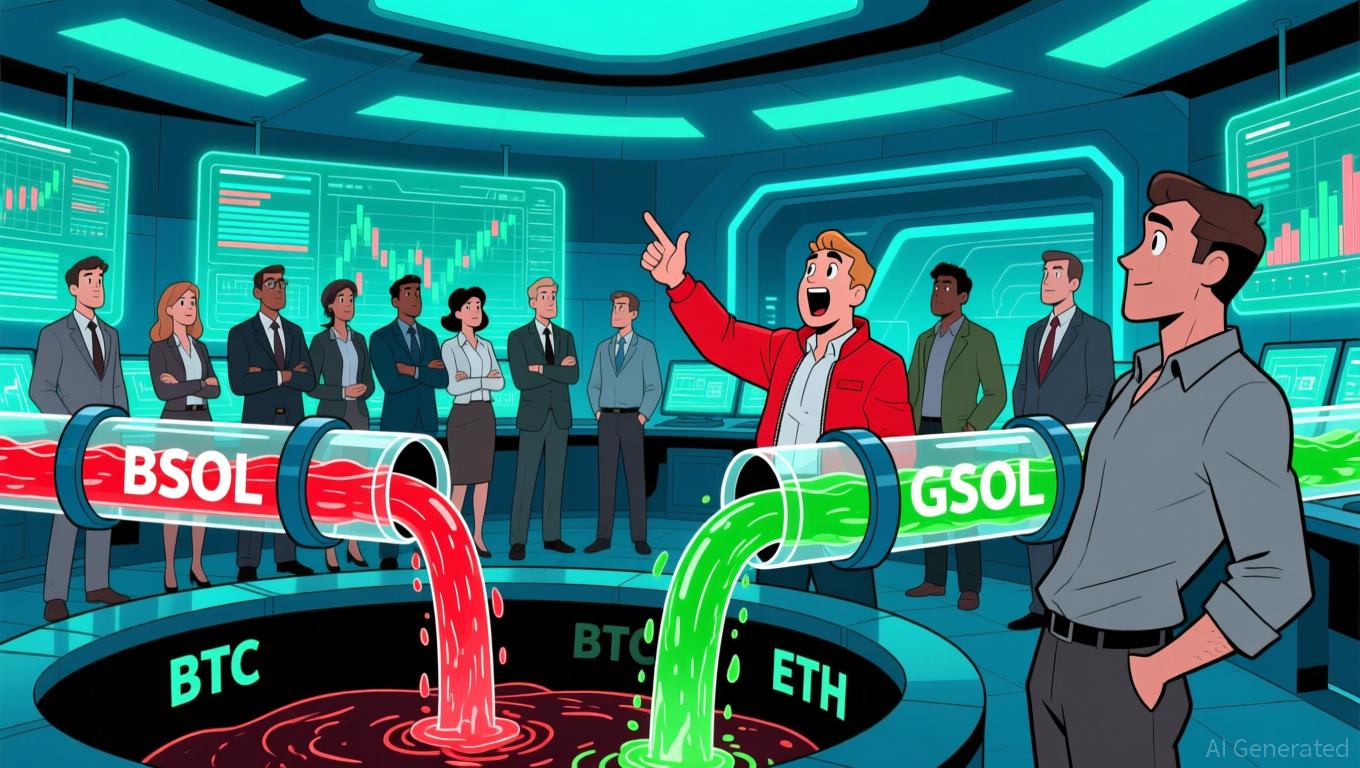
This announcement comes as interest in Solana-based exchange-traded funds (ETFs) is rapidly increasing.
Despite Ethereum experiencing a 25% price drop this quarter, staking-enabled products have sparked renewed interest. Institutions like SharpLink have generated $100 million in annualized returns from Ethereum staking, highlighting its value as a yield-generating treasury asset
Technical analysis points to possible rebounds for both blockchains. Solana, currently trading near $159, is showing bearish indicators such as an oversold RSI and negative Chaikin Money Flow, but analysts note that ETF inflows often precede longer-term accumulation phases
With clearer regulations and rising inflows, the crypto market is showing signs of maturity, as staking returns and ETFs begin to reshape institutional approaches. As more funds move into proof-of-stake networks, the relationship between regulatory policies and market trends is set to shape the future of crypto adoption.
Disclaimer: The content of this article solely reflects the author's opinion and does not represent the platform in any capacity. This article is not intended to serve as a reference for making investment decisions.
You may also like
Big Week Ahead: Ripple Heads to NYC With Wall Street Heavyweights

 VIPOil Risk Premiums and rToken Dividend Arbitrage Strategies
1. This week we focus on cross-asset positioning under an energy shock and arbitrage opportunities in tokenized-stock cash dividends. We recommend assessing market direction separately from income sources. Higher oil can weigh on growth valuations, lift inflation expectations, and spark expectations of Fed rate hikes, putting pressure on equities and crypto. 2. rToken net cash dividends can be distributed separately, but buying spot, shorting a perpetual, and holding across the record date does not automatically create an arbitrage. First confirm ex-dividend eligibility, platform snapshots, after-tax amounts, and the corporate-action rules for the short leg. Then compare funding fees, spreads, and execution costs. A dividend arbitrage strategy can be applied to STRC. 3. Next week's Fed decision and major technology earnings are key. Lower policy uncertainty can help restore risk appetite, but a sustained rebound still needs confirmation from rates, cloud growth, capital expenditure, and free cash flow. Our base case is a monthly-timeframe rebound in risk assets and crypto as earnings season, the Fed meeting, and the midterm elections pass and uncertainty recedes. Assets in focus: BTC, ETH, SOL, WTI, ASML, MSFT, GOOG, AMZN, CAT, and STRC

Goldman Sachs Names One Trade to Hedge an AI Market Shock

Big Tech Earnings Are a No-Win Test as Investors Punish Both Capex Cuts and Hikes

Crypto prices
More


