
Bitcoin Updates: Despite ETF Outflows, Institutional Investors Reinforce $100K Support for Bitcoin
- Bitcoin stabilizes above $100,000 as corporate buyers (MicroStrategy, American Bitcoin) offset ETF outflows and whale selling. - U.S.-India trade deal prospects and government shutdown resolution boost risk appetite, supporting crypto markets. - XRP declines despite RLUSD growth, while Solana ETFs extend inflow streak; NFT sales drop 14% to $84M. - Proposed CFTC crypto oversight bill and technical analysis highlight regulatory and market uncertainty amid institutional buying.
Bitcoin remains stable around $105,000 as global risk factors ease and supportive policies emerge
On November 11, 2025, Bitcoin (BTC) stayed above the $100,000 mark in early trading, with institutional interest and corporate treasury acquisitions balancing out profit-taking by major holders, according to figures from Coinglass and SoSoValue
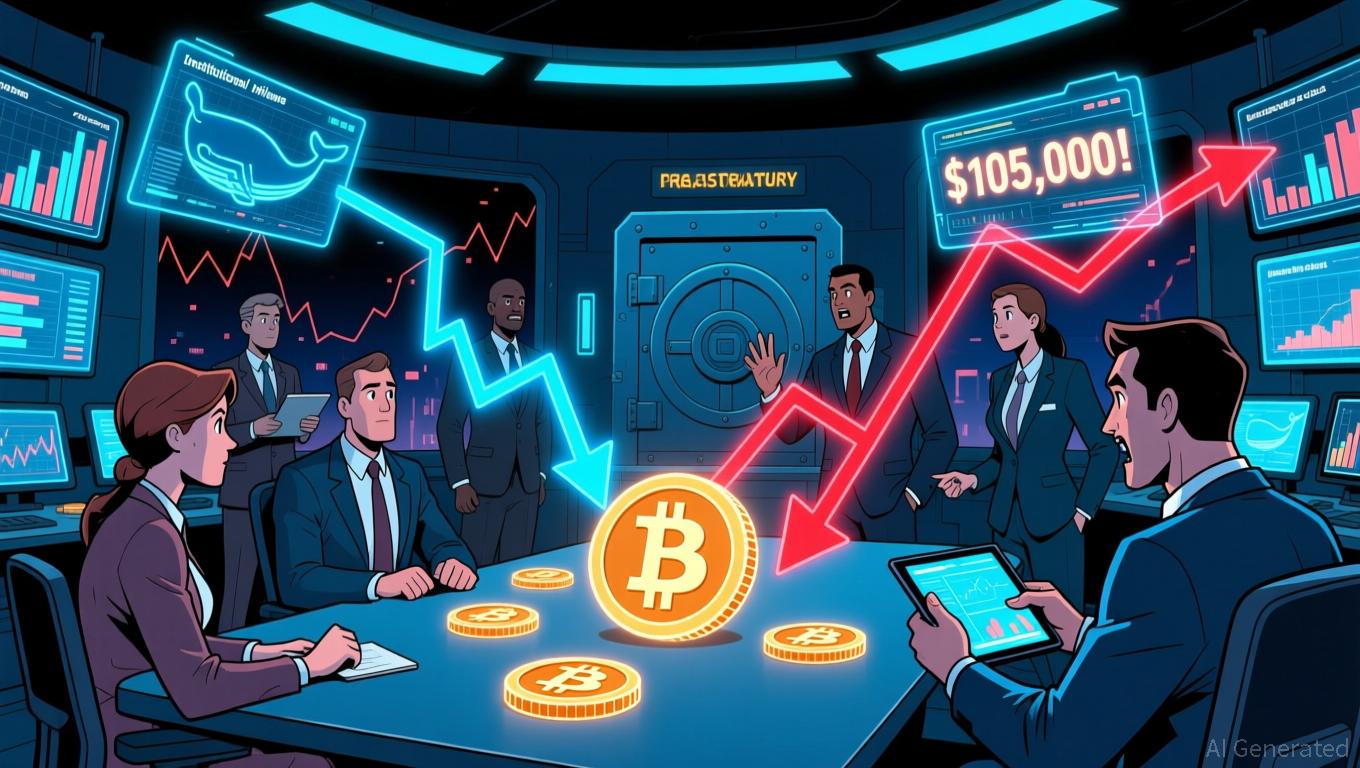
Macroeconomic factors also contributed to market steadiness. The possibility of a U.S.-India trade agreement, which may lower tariffs on Indian exports from 50% to 15–16%, has reduced global trade uncertainty and encouraged risk-taking, according to
Nonetheless, some obstacles remain.
NFT sales continued to struggle, with weekly volume dropping 14% to $84 million for the week ending November 7, as noted in
Regulatory changes have added further complexity. A new Senate bill proposes making the Commodity Futures Trading Commission (CFTC) the main regulator for crypto, bypassing contentious DeFi debates to simplify oversight, as reported by
Technical analysis of Bitcoin’s price has produced mixed signals. Glassnode analysts suggest that the $100,000 level could serve as a "speed bump" on the way to the 48-month average of $56,000, as mentioned in
The Trump-endorsed American Bitcoin (ABTC) has further strengthened its position as the 25th largest Bitcoin holder, growing its treasury to 4,004 BTC ($415 million) through a combination of mining and market purchases, as reported by
As these trends unfold, market participants remain divided. While ETF inflows and corporate buying have provided a cushion against large-scale selling, a decrease in institutional activity or negative macroeconomic developments—such as rising U.S. Treasury yields—could revive bearish sentiment, according to Coinglass. For now, Bitcoin’s ability to remain above $100,000 highlights its evolution from a retail-driven asset to one increasingly shaped by institutional investors, as discussed in the
---
Disclaimer: The content of this article solely reflects the author's opinion and does not represent the platform in any capacity. This article is not intended to serve as a reference for making investment decisions.
You may also like
 VIPOil Risk Premiums and rToken Dividend Arbitrage Strategies
1. This week we focus on cross-asset positioning under an energy shock and arbitrage opportunities in tokenized-stock cash dividends. We recommend assessing market direction separately from income sources. Higher oil can weigh on growth valuations, lift inflation expectations, and spark expectations of Fed rate hikes, putting pressure on equities and crypto. 2. rToken net cash dividends can be distributed separately, but buying spot, shorting a perpetual, and holding across the record date does not automatically create an arbitrage. First confirm ex-dividend eligibility, platform snapshots, after-tax amounts, and the corporate-action rules for the short leg. Then compare funding fees, spreads, and execution costs. A dividend arbitrage strategy can be applied to STRC. 3. Next week's Fed decision and major technology earnings are key. Lower policy uncertainty can help restore risk appetite, but a sustained rebound still needs confirmation from rates, cloud growth, capital expenditure, and free cash flow. Our base case is a monthly-timeframe rebound in risk assets and crypto as earnings season, the Fed meeting, and the midterm elections pass and uncertainty recedes. Assets in focus: BTC, ETH, SOL, WTI, ASML, MSFT, GOOG, AMZN, CAT, and STRC

Goldman Sachs Names One Trade to Hedge an AI Market Shock

Big Tech Earnings Are a No-Win Test as Investors Punish Both Capex Cuts and Hikes

Crypto prices
More


