
Solana ETFs recover after 21-day losing streak, but SOL price breaks below $140

Solana spot ETFs recorded $5.37 million in net inflows on November 28, breaking a 21-day losing streak.
- Solana ETFs saw $5.37M inflows after 21 days of outflows, led by Grayscale and Fidelity.
- SOL price stayed below $140 despite ETF recovery, continuing its 30-day decline.
- Cumulative SOL ETF inflows hit $618.59M.
The recovery comes as Solana’s ( SOL ) price fell below $140, dropping to $137 amid broader market weakness.
Grayscale’s GSOL led the inflows with $4.33 million, while Fidelity’s FSOL attracted $2.42 million.
21Shares’ TSOL saw $1.38 million in outflows, partially offsetting the gains. Bitwise’s BSOL, VanEck’s VSOL, and Canary’s SOLC posted zero flow activity.
ETF recovery fails to lift Solana above $140
Solana price has dropped 2% over the past 24 hours and 30% over the past 30 days. The token traded as high as $143 in the last 24 hours before falling to its current level. SOL has gained 8% over the past seven days.
The November 28 inflows ended three weeks of consistent ETF outflows. November 26 posted the most recent withdrawal at $8.10 million.
Prior to that, SOL ETFs attracted $53.08 million on November 25 and $57.99 million on November 24.
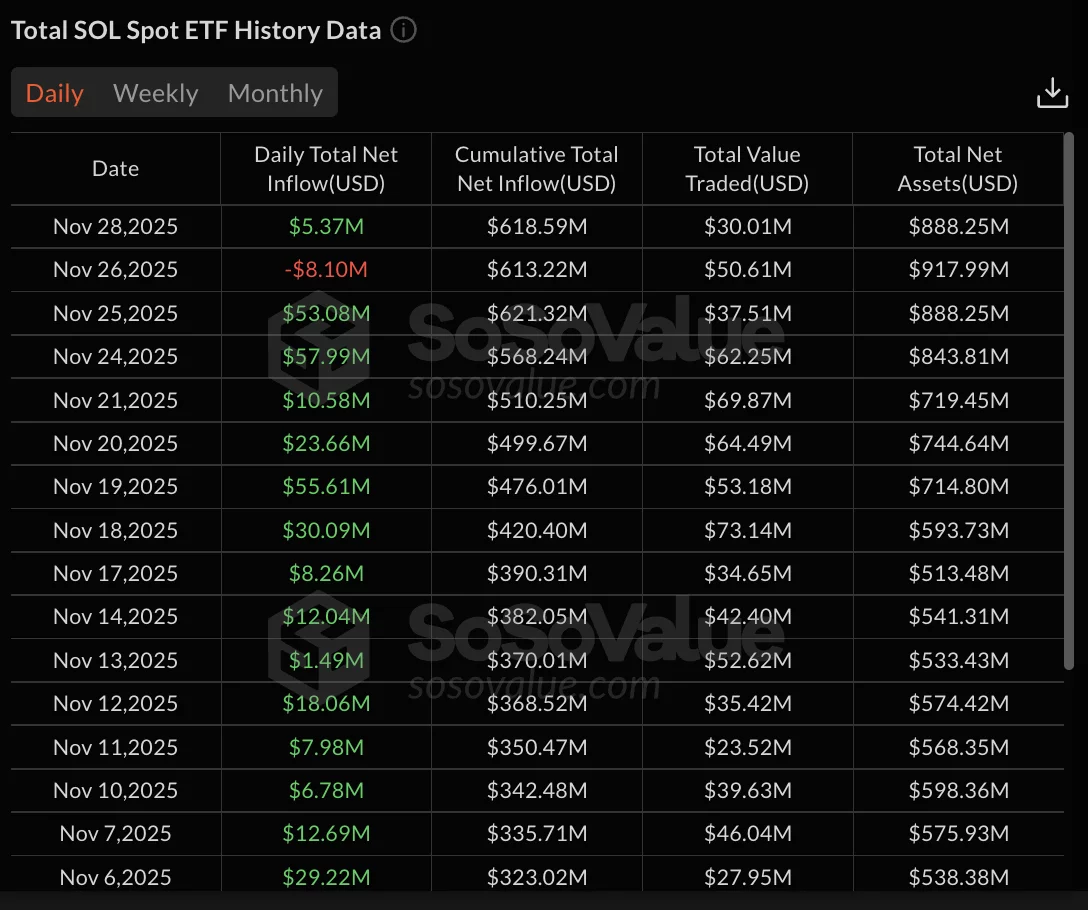 SOL ETF data: SoSo Value
Cumulative total net inflow across all Solana ETFs reached $618.59 million as of November 28.
Total net assets under management stood at $888.25 million. Total value traded hit $30.01 million on November 28.
Grayscale and Fidelity dominate November flows
Grayscale’s GSOL has accumulated $77.83 million in cumulative net inflows. Bitwise’s BSOL leads all Solana ETFs with $527.79 million in total inflows. Fidelity’s FSOL holds $32.30 million in cumulative assets.
21Shares’ TSOL has seen net outflows of $27.60 million since launch. VanEck’s VSOL and Canary’s SOLC maintain smaller asset bases.
The disconnect between ETF inflows and price action suggests institutional accumulation at lower levels.
While SOL ETFs attracted capital on November 28, the token continued its 30-day decline. SOL failed to reclaim $140 following the inflow recovery.
Disclaimer: The content of this article solely reflects the author's opinion and does not represent the platform in any capacity. This article is not intended to serve as a reference for making investment decisions.
You may also like
Big Week Ahead: Ripple Heads to NYC With Wall Street Heavyweights

 VIPOil Risk Premiums and rToken Dividend Arbitrage Strategies
1. This week we focus on cross-asset positioning under an energy shock and arbitrage opportunities in tokenized-stock cash dividends. We recommend assessing market direction separately from income sources. Higher oil can weigh on growth valuations, lift inflation expectations, and spark expectations of Fed rate hikes, putting pressure on equities and crypto. 2. rToken net cash dividends can be distributed separately, but buying spot, shorting a perpetual, and holding across the record date does not automatically create an arbitrage. First confirm ex-dividend eligibility, platform snapshots, after-tax amounts, and the corporate-action rules for the short leg. Then compare funding fees, spreads, and execution costs. A dividend arbitrage strategy can be applied to STRC. 3. Next week's Fed decision and major technology earnings are key. Lower policy uncertainty can help restore risk appetite, but a sustained rebound still needs confirmation from rates, cloud growth, capital expenditure, and free cash flow. Our base case is a monthly-timeframe rebound in risk assets and crypto as earnings season, the Fed meeting, and the midterm elections pass and uncertainty recedes. Assets in focus: BTC, ETH, SOL, WTI, ASML, MSFT, GOOG, AMZN, CAT, and STRC

Goldman Sachs Names One Trade to Hedge an AI Market Shock

Big Tech Earnings Are a No-Win Test as Investors Punish Both Capex Cuts and Hikes

Crypto prices
More


