
ECB reveals Appia roadmap for central bank money in tokenized markets

The European Central Bank (ECB) on Wednesday published its Appia roadmap, setting out a long-term plan for building tokenized wholesale financial markets in Europe anchored in central bank money.
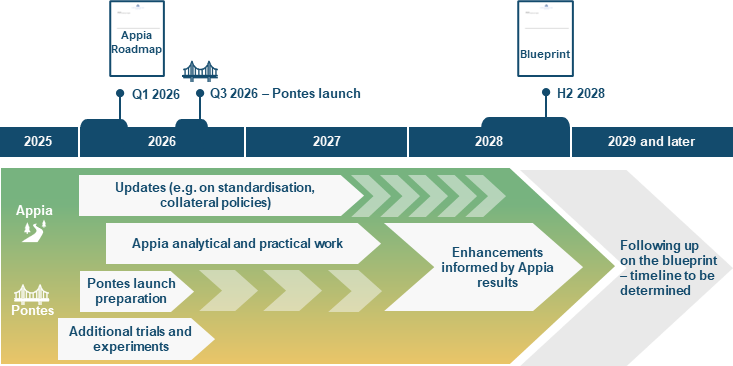
The roadmap is built around two linked initiatives. Pontes is the Eurosystem’s distributed ledger technology settlement solution, while Appia is the broader strategic framework for developing a future tokenized financial ecosystem. The ECB said Pontes is scheduled to launch in the third quarter of 2026.
“With Appia, we are building a road from today’s financial system to tomorrow’s tokenized markets, firmly grounded in central bank money,” ECB executive board member Piero Cipollone said.
Pontes is the Eurosystem’s DLT solution, while Appia is a strategic roadmap
Pontes, a key component of the Appia roadmap, introduces the Eurosystem’s distributed ledger technology (DLT) solution, designed to enable central bank money settlement for market transactions through interoperable networks.
The Eurosystem is the monetary authority of the euro area, comprising the ECB and the national central banks of the EU member states that have adopted the euro.
By the end of the third quarter of 2026, Pontes aims to bridge market DLT infrastructures with the Eurosystem’s “TARGET” Services, which stands for Trans-European Automated Real-time Gross settlement Express Transfer system.
TARGET Services are a set of Eurosystem-operated payment and settlement systems that support euro-denominated transactions across Europe. They include three main types: TARGET2 for large-value payments, T2S for securities settlement and TIPS for instant payments.
ECB invites public and private sector stakeholder feedback
Alongside the launch, the ECB opened a public consultation and invited both public- and private-sector participants to comment on the roadmap and express interest in contributing to its implementation.
The consultation is divided into two parts: Part one collects feedback on specific chapters of the roadmap, which may be published with the respondent’s name, while part two allows stakeholders to submit proposals to actively contribute to Appia’s building blocks, with responses treated confidentially.
Responses will help shape the long-term blueprint for Europe’s tokenized financial ecosystem. All feedback must be submitted via the online survey by April 22.
The Appia rollout also comes as the ECB continues work on the digital euro. Earlier this month, the central bank said it planned to begin selecting payment service providers in 2026 ahead of a 12-month pilot scheduled to start in the second half of 2027.
Disclaimer: The content of this article solely reflects the author's opinion and does not represent the platform in any capacity. This article is not intended to serve as a reference for making investment decisions.
You may also like
Q3 results exceed expectations + full-year guidance raised! Grab (GRAB.US) receives bullish rating from Citigroup after earnings: Stock price can still rise over 92%
Citi has given Grab a "Buy" rating with a target price of $5.50. This target represents a potential upside of over 92% compared to Monday's closing price of $2.86.
From "Powering AI" to "Powering Everything"! Morgan Stanley: The electricity "super cycle" is underestimated by the market
Morgan Stanley believes that the drivers of electricity demand have expanded from AI to three major forces: industrial migration and air conditioning refrigeration. Global electricity consumption is projected to reach 36 trillion kWh by 2030, with an annual growth rate of 4.2%. Asia will absorb 64% of the newly generated electricity demand. Fossil fuels have unexpectedly regained market share and are expected to still account for about 50% of the global power structure in 2030. Pricing power is shifting from equipment manufacturers to power generation operators, with wholesale electricity prices in major markets expected to rise by about 20% year-over-year in 2026. These trends will create $500 billion in wealth, driving related companies’ earnings per share forecasts up by 14% by 2028, while the market has yet to fully price in these changes.
Crypto prices
More


