
Is the US stock market rally just a "local boom"? Goldman Sachs says that 75% of earnings upward revisions come from three companies

Wall Street analysts have recently raised their earnings expectations for the S&P 500 index, which is typically seen as a bullish signal for the stock market. However, Goldman Sachs has noted that the latest improvement in earnings expectations is actually being driven by a small number of individual stocks, rather than broad-based corporate earnings recovery.
After a period of intense volatility triggered by the Iran war, the S&P 500 has now returned to pre-war levels and is near its historical highs. One of the major factors driving US equities to fresh records is the market's upward revision of first-quarter corporate earnings forecasts, which has, to some extent, helped investors temporarily ignore the shocks caused by the war.
However, in a report released last Friday, Goldman Sachs pointed out that just three companies accounted for 75% of the positive earnings revisions within the entire S&P 500: Micron, Exxon, and Chevron.

(Image source: Goldman Sachs, Business Insider)
Goldman Sachs analysts wrote in the report: "The rise in S&P 500 earnings expectations in market consensus is mainly driven by a small number of locally strong sectors."
Structurally, the technology sector remains one of the major sources boosting earnings revisions, mainly thanks to the continued support from demand related to artificial intelligence (AI). However, Goldman Sachs also points out that the improvement within the technology sector itself is not balanced; the real driver of earnings upgrades is concentrated in hardware, especially among storage chip stocks.
Of note, Micron alone contributed 51% of the upward earnings revision for the S&P 500 index, becoming the central driving force in this round of improvement. SanDisk also ranks among the top contributors, though it only accounts for 3% of the overall revision; chip manufacturer Broadcom contributed 10%.
Goldman Sachs further noted that energy and technology have contributed nearly all of the positive earnings revisions for the S&P 500, while on a broader level, the earnings outlook for the median S&P 500 company for 2026 has hardly changed.
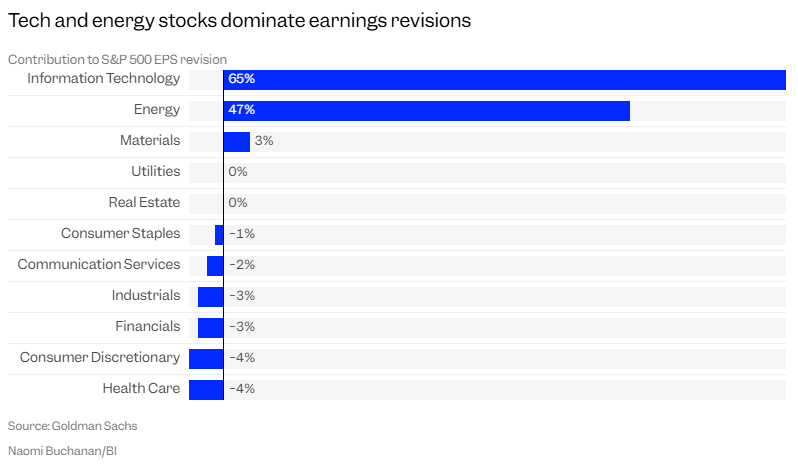
(Image source: Goldman Sachs, Business Insider)
The report states: "The recent upward revision in overall S&P 500 earnings expectations has been almost entirely driven by the energy and technology sectors. Of the 11 sectors, eight saw no upward adjustment in earnings per share expectations."
Analysts explained that earnings estimates for the energy sector were raised mainly due to oil price movements. Following the outbreak of the Iran war, geopolitical tensions pushed oil prices sharply higher, thereby improving energy firms’ earnings outlook. Since the onset of the Iran conflict, six of the top ten contributors to the S&P 500 index's positive earnings revisions have come from the energy sector.
These companies include Exxon, Chevron, ConocoPhillips, Valero Energy, EOG Resources, and Occidental Petroleum. Collectively, these companies accounted for more than a third of the overall earnings revisions.
The energy sector has clearly benefited from the latest Middle East conflict, as soaring oil prices triggered by the war have lifted market expectations for the sector's profitability. Market consensus expects energy producers to report stronger performance during the war as a result of higher oil prices.
However, despite the improvement in earnings expectations, energy stocks themselves have mostly peaked and retreated in recent weeks. This suggests that investors may already be pricing in a potential decline in oil prices ahead of time and are beginning to reposition for the post-war market environment.
Disclaimer: The content of this article solely reflects the author's opinion and does not represent the platform in any capacity. This article is not intended to serve as a reference for making investment decisions.
You may also like
The UK plans to issue more short-term bonds, which may lower gilt yields, and investors are also watching closely to see if the Autumn Budget can maintain fiscal discipline.
The UK is set to increase its use of short-term debt. This shift could lower yields on UK government bonds and alleviate the country's increasingly strained public finances. Meanwhile, the potential market reaction to the upcoming autumn budget remains a risk factor for the British bond market.
Tech Earnings Week Arrives: US Stock Market Pre-Market - SK Hynix Rises Over 1%, Petrobras Falls Over 20%, Oil Prices Retreat, US Treasury Bonds Strengthen
Before the U.S. market opens, SK Hynix rises over 1%. The company plans to distribute a special dividend of $12.1 billion, using proceeds from the sale of its Kioxia equity to reward shareholders. U.S.-listed Neocloud companies generally fell before market open: Nebius dropped 4.5%, CoreWeave fell 4.4%, and Iren decreased 4.1%. Petrobras ADRs dropped over 20% before market open, while Itaú Unibanco fell more than 27%. Brent crude retreated 1.5% from a six-month high, currently trading at around $114.95 per barrel.
Cybercab goes viral, Berlin factory achieves record production! Behind the Tesla (TSLA.US) buzz, Phillip Securities still sees a 38% downside
Tesla (TSLA.US) rose nearly 1% in pre-market trading on Monday, following a series of events including the intensive debut of the Cybercab at the Austin F1 circuit, a production milestone at the Berlin factory, and the release of new details about the Roadster.

Crypto prices
More


