
Musk announces dissolution of xAI and leases the entire data center to his disliked Anthropic

On May 6th local time, Elon Musk announced two things on the same day:xAI will no longer exist as an independent company and will be merged into SpaceX, renamed as SpaceXAI;SpaceX has fully leased the Colossus 1 data center to Anthropic, with 220,000 Nvidia GPUs and 300MW of computing power, to be delivered within this month.
However, just three months ago, Musk called Anthropic "misanthropic and evil" on X, yet this week he changed his tune to "no one set off my evil detector," explaining that SpaceXAI’s training had already been migrated to Colossus 2, so renting out Colossus 1 in full to Anthropic poses no problem.
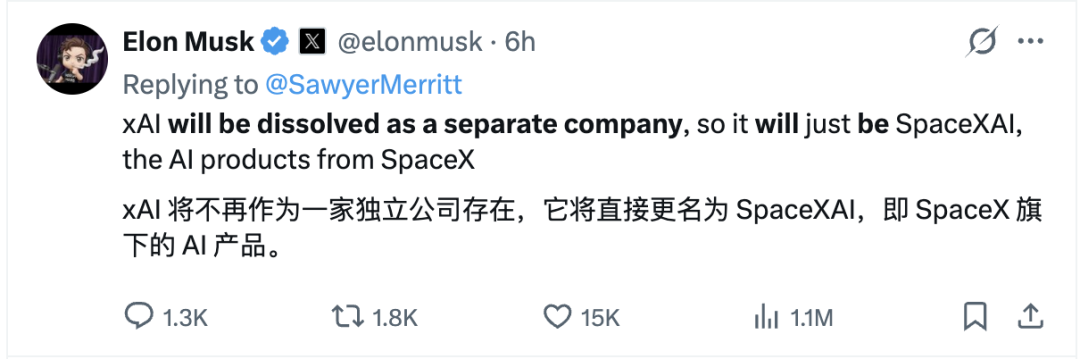
Image: Related Tweet (Source: X)
At this moment, there are 33 days until the start of SpaceX's IPO roadshow on June 8th.
WIRED’s headline used “Gets in Bed With”—the dramatic reversal from enemies to friends is an obvious angle. But the more structural question is: Why did Musk choose to announce the dissolution of xAI and the leasing of Colossus 1 simultaneously, 33 days before the SpaceX roadshow?
The SpaceX IPO timeline is public:Secret S-1 (IPO registration statement) submission on April 1, roadshow starts June 8th,listing at the end of June or early July.The target valuation is $1.75 trillion, with a fundraising scale of $75 billion, more than double Saudi Aramco’s 2019 record.
The public version of the S-1, according to SEC regulations, must be disclosed 15 days before the start of the roadshow. In other words, during the week of May 18th to 22nd, the SpaceX prospectus will be unveiled to everyone. The announcements of "xAI dissolution" and "Colossus 1 fully leased to Anthropic" were pressed onto the same day, less than two weeks before the prospectus is made public.
Yet, xAI’s fate had long been sealed; over the past three months, it had been dismembered step by step.In February 2026, SpaceX and xAI completed a “merger” at a valuation of $1 trillion and $250 billion, respectively, for a combined post-merger valuation of $1.25 trillion.Musk gave “orbital data centers” as the merger’s rationale in the announcement, moving AI training into space.At that time, xAI still existed in name only as a SpaceX subsidiary, retaining its own brand, product, and valuation status.
In March, Colossus 2 was launched and xAI’s training gradually migrated. The Colossus 1 data center, which had been built in 122 days and repeatedly used by Musk as proof of xAI’s strength, started to have excess capacity. In April, SpaceX signed an unconventional agreement with Cursor, exchanging computing power for a $6 billion purchase option. This deal exposed SpaceX’s attitude toward xAI’s idle computing power—it can be rented, mortgaged, or packaged and sold. Compute power is SpaceX’s asset, not xAI’s moat. In May, xAI died and Colossus 1 was fully leased to Anthropic.
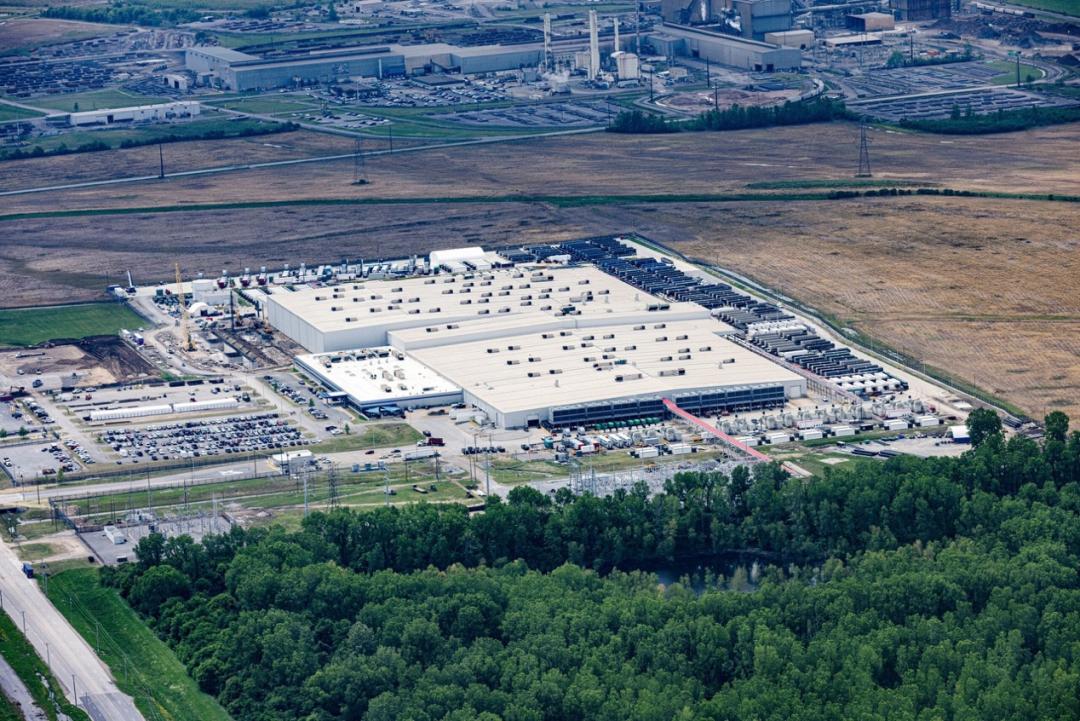
Image: Colossus 2 (Source: Substack)
Musk wrote in the comments on X:“xAI will no longer exist as an independent company; it will be directly renamed SpaceXAI, i.e. SpaceX’s AI product.”
The merged valuation was $1.25 trillion, but for the IPO, it’s $1.75 trillion—with the $500 billion gap needing to be filled by storytelling. SpaceX’s 2025 revenue is about $16 billion, and just over $20 billion combined with xAI. That makes for a Price-to-Sales ratio of about 87 times for a $1.75 trillion valuation.
This multiple cannot be explained by current businesses—Starlink subscriptions, Falcon rocket launch contracts, and Grok’s membership proceeds are all already included in that $20 billion. The additional $500 billion only exists in investors’ imaginations of the future.
When xAI existed independently, its highest valuation reached $23 billion, corresponding to the logic of a “cutting-edge AI model company," to be compared with OpenAI ($852 billion in March 2026), Anthropic ($380 billion in February 2026), all placed in the same group for model capability comparison.
However, Grok doesn't hold much competitive advantage in this group. The biggest topics surrounding Grok have been, to a large degree, not about performance but about “adult” content and being briefly banned in multiple countries for generating deepfake images of women. For an advanced model company lagging behind in usage and surrounded by ongoing content controversies, the independent valuation ceiling is clear.
After merging into SpaceX, xAI is no longer an independent valuation entity.SpaceXAI is a compound of “Aerospace + Satellite Internet + AI + Social Platform,” with no single company on the market to compare directly against.No comparable company means no valuation anchor, no reference means no valuation cap—this is the environment Musk prefers. He played the same trick with Tesla, putting an electric car company inside the “energy company” narrative. This time, the container is called “Orbital AI Compute.”
SpaceX’s official statement on Wednesday read:“The compute needed to train and operate the next generation of AI systems now exceeds what can be provided by terrestrial electricity, land, and cooling within critical timeframes.”This story needs a named, cutting-edge AI lab for endorsement. In Anthropic’s announcement, the line “expressed interest in co-developing multi-GW level orbital AI compute with SpaceX” holds little practical but vast roadshow value.
The dissolution of xAI is the final step in this valuation shell game. An independent, cutting-edge AI lab would continually require funding, be under valuation pressure of being outperformed by competitors, and make it hard for an IPO narrative focused on “Aerospace + AI compound” to remain focused. Downgrading it to "SpaceX’s AI product" removes valuation pressure and purifies the storyline.
When xAI was founded in 2023, it was a Public Benefit Corporation (PBC) in Nevada, promising to put societal benefit above shareholder profit. xAI quietly dropped its PBC status (Sacra) on May 9, 2024, just after reaching its 14-month anniversary. From then on, xAI moved steadily towards a “form better suited to capital markets”—first shedding its PBC legal shell, then its independent existence. What’s left is a product name and Musk’s shares in SpaceX.
Anthropic, on the other hand, got what it needed. 220,000 GPUs sounds huge, but in its total deals it’s just a drop in the bucket—Anthropic has recently signed numerous contracts with other cloud giants that together far exceed 300MW. The difference is, Amazon’s 1GW new capacity won’t be online until the end of 2026, and Google plus Broadcom’s 5GW won’t start until 2027. Colossus 1 will be "delivered this month," quenching Anthropic’s immediate thirst for compute.
Since Claude Code’s breakout and continued user growth for the Claude model, complaints in the community about Claude’s throttling, outages, and speed reductions during Pro user peak hours have been mounting, even causing many people to return to ChatGPT and Codex.
After this transaction, Anthropic simultaneously raised quotas:Claude Code's five-hour limit doubled, Pro/Max peak-hour slowdowns removed, and Opus API rate limiting raised by an order of magnitude across the board.The physical foundation behind these moves is Colossus 1. As for “orbital AI compute,” Anthropic’s statement is only “expressed interest”—the softest expression in business negotiations, but sufficient as roadshow material.
Musk has now secured an endorsement for his IPO narrative: a cutting-edge AI lab with a well-known name confirming alignment with his vision for orbital compute. Anthropic gains 300MW of immediate, real compute—exactly what Claude Code needs most right now. The death of xAI is the premise for this deal to exist: if an independent advanced AI company were to fully lease its flagship data center to its biggest rival, that would be awkward; but if xAI is no longer independent, Colossus 1 turns from “our AI training base” into “SpaceX’s compute asset”—the latter is available for leasing.
There are still 33 days until the IPO roadshow starts. Under the new name SpaceXAI, the role of the AI business has been redefined. It no longer aims to produce the next advanced model, but rather to supply computing scale to SpaceX’s valuation story. Grok is still there and will keep evolving, but it is no longer Musk’s tool to prove himself on the AI track.
Operations/Typesetting: He Chenlong
Note: Cover/Main image AI assisted generated
Disclaimer: The content of this article solely reflects the author's opinion and does not represent the platform in any capacity. This article is not intended to serve as a reference for making investment decisions.
You may also like
AI Capital Rush! Global Bond Issuance Hits Historic Record
This year, global bond financing has reached $6.61 trillion, a 15% year-on-year increase, breaking the 2025 historical record two months early. The main driving force is the AI arms race—cloud computing providers and data centers have issued nearly $368 billion in bonds this year, six times more than last year, accounting for one third of the overall increase. Amazon has become the fourth largest bond issuer in the world, surpassing France and the UK. Citibank has warned that the capital demand from AI is pushing up the global neutral interest rate, which may structurally raise the long-term interest rate benchmark.
While Meta and Alphabet raise concerns in the market over AI cash burn, Microsoft (MSFT.US) counters with over $10 billion in cash flow and leads AI commercialization from story to profit.
Microsoft released its financial results for the first quarter of fiscal year 2027 (ending September 30, 2026) after the U.S. stock market closed on Wednesday Eastern Time. Revenue, earnings per share, and Azure growth all exceeded market expectations.
Wall Street "ponders" Walsh's speech: suggests further rate hikes, but not by much
At a press conference, Walsh, backed by strong economic data (GDP over 3%, double-digit investment growth), refused to characterize current financial conditions as "tight," which the market interpreted as an indication that further rate hikes are still needed, although likely to a limited extent. Despite two internal dissenting votes, a hawkish committee member voted in favor, suggesting that most expect a catch-up hike in December. The futures market has already priced in one rate increase each in December and next March.
Six years of inflation pressure and two dissenting votes: Is the Federal Reserve poised for a December rate hike, with another possible in March next year?
The Federal Reserve holds rates steady; Waller hints at another possible rate hike in December, with additional hikes possible in early 2027. Inflation has failed to meet the target for six years, and futures have already priced in rate hikes for December and March.
Crypto prices
More


