
The market completely rules out Fed rate cuts! Gold struggles below 4550, is the current situation more favorable for bears?

On Tuesday (May 19), the international gold price fell, hovering near the one-and-a-half-month low reached in the previous trading session, mainly suppressed by inflation concerns and expectations of rising US interest rates. In addition, market expectations of a more hawkish stance from the Federal Reserve helped the US dollar regain upward momentum, which also put pressure on the non-yielding gold.
As of publication, spot gold declined by 0.5% to $4,542.07. On Monday, gold prices once dropped to $4,479.54, the lowest level since March 30.
The benchmark 10-year US Treasury yield remained near its highest level in over a year. The Middle East war has pushed up energy prices, exacerbating inflation concerns and increasing market bets on interest rate hikes. Higher US Treasury yields raise the opportunity cost of holding non-yielding assets such as gold.
In terms of geopolitics, US President Donald Trump decided to delay a planned attack on Iran to buy more time for negotiations, which provided some support for gold prices. However, since the outbreak of the war, gold prices have fallen by more than 13% cumulatively.
Trump stated on Monday that after Tehran submitted a peace proposal to Washington, he had suspended a planned attack against Iran. Trump also said that it is now "very likely" that a deal restricting Iran's nuclear program can be reached.
However, so far, the market reaction has been relatively limited, as the signals remain mixed. Iranian President Masoud Pezeshkian, in response to Trump's warning that "time is running out," said Iran would not yield to any force and that Tehran was participating in talks on the basis of dignity, authority, and defending national rights.
On the other hand, Trump stated that he has instructed the US military to remain ready to launch a full-scale attack against Iran if an agreement cannot be reached. This means geopolitical risks still exist and support the reserve currency status of the US dollar.
Saxo Bank analysts stated: "Traders remain focused on the Middle East crisis and the inflationary impact driven by persistently high energy prices. Escalating tensions could suppress gold by pushing up yields and strengthening the US dollar; while any credible de-escalation or peace path could ultimately support gold prices."
Brent crude prices fell on Tuesday but remained above $110 per barrel, as the conflict has effectively led to the closure of the key Strait of Hormuz.
ActivTrades analyst Ricardo Evangelista said: "The long-term standoff in the Persian Gulf is fueling inflation concerns and driving the market to expect a more hawkish Fed, which is weighing on precious metals."
He added: "Investors will continue to closely monitor developments in the US-Iran standoff. Any new developments could affect market expectations for the Fed's monetary policy path, and in turn, impact gold prices."
The market has fully priced out any possibility of a Fed rate cut for the remainder of 2026. On the contrary, amid rising energy prices and consumer inflation concerns, the market is currently betting on at least one rate hike by the Fed before year-end. According to CME's FedWatch tool, there is nearly a 40% probability of the Fed raising rates by 25 basis points at its December policy meeting.
Although gold is usually seen as a hedge against inflation, high interest rates often suppress the performance of this non-yielding asset.
Investors are also awaiting the minutes from the Fed's latest policy meeting, which will be released on Wednesday. Before establishing a clear directional bet on gold, the market will wait for the Fed meeting minutes to look for more clues about the Fed's interest rate path.
Meanwhile, market focus will remain on subsequent developments in the Middle East crisis. Related dynamics may trigger volatility in global financial markets and provide some directional guidance for precious metals. Nevertheless, the overall fundamental backdrop remains more favorable to bears, suggesting the path of least resistance for gold prices may still be downward.
Gold Technical Analysis
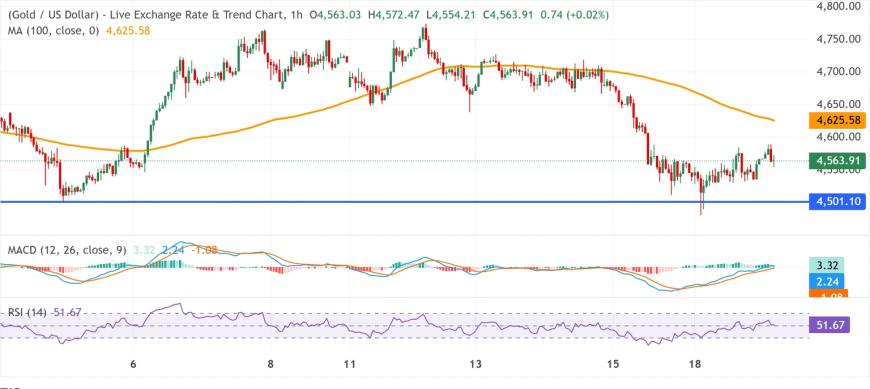
From a technical perspective, gold remains below its 100-hour moving average. Although gold has recently rebounded from low levels, the short-term bias remains bearish. In addition, the MACD is still in positive territory, but the latest reading is 3.32, indicating that upward momentum is waning. Meanwhile, the Relative Strength Index (RSI) is near 51.7, indicating only moderate bullish pressure and not a clear upward trend.
(Source: FXStreet)
Therefore, unless gold effectively breaks below the psychological $4,500 level and further breaks below the overnight low of around $4,480, investors should continue to wait for more confirmation signals before betting on a deeper decline.
On the upside, initial resistance is at the 100-hour moving average, near $4,625.58. Gold prices need to break through this resistance level before they can ease the current downward bias and open up more constructive rebound space.
Disclaimer: The content of this article solely reflects the author's opinion and does not represent the platform in any capacity. This article is not intended to serve as a reference for making investment decisions.
You may also like
SanDisk Q1 Revenue Soared Nearly 4x Year-Over-Year, Q2 Revenue Guidance Exceeds Expectations Again, Data Centers Remain the Core Growth Driver for Next Year | Earnings Report Insights
SanDisk released its financial report for the first quarter of fiscal year 2027, with revenue reaching $11.031 billion, a year-on-year increase of 378%. Among this, revenue from the data center business in the first quarter was $4.8 billion, up 61% quarter-on-quarter and 1682% year-on-year, significantly outpacing overall revenue growth. Management expects that in calendar year 2027, the data center segment will remain the core driver of growth in the NAND market, accounting for over 55% of the market share. Revenue for the second quarter is projected to be between $12.2 billion and $12.6 billion, exceeding analysts' expectation of $12.1 billion.
Best Crypto to Buy Now: BTC Holds Near $80K After Hawkish Fed, Zcash Keeps Its Top-10 Spot

Intel Plunges! Q4 Guidance Far Below Expectations, Israel Factory Explosion, Weak PC Demand, AI Chip Supply Constraints | Earnings Report Insights
Intel expects fourth-quarter revenue to be between $15 billion and $16 billion, compared to the market expectation of $17 billion, with optimistic forecasts exceeding $18 billion. Adjusted earnings per share are projected at $0.25, far below the market expectation of $0.43 to $0.45. Production at the Israel factory was interrupted by an explosion in October, and the CFO stated this is expected to reduce fourth-quarter revenue by $300 million and lower gross margin by about 200 basis points. Third-quarter revenue reached $16.5 billion, up 21% year-over-year. PC chip revenue declined by 5%, and Intel expects weakness in the PC market to persist at least until the first half of 2027. Data center business grew 78%, but the CEO noted that shortage of AI chips has constrained performance.
Crypto prices
More


