
Bitcoin’s Worst Week Since FTX Raises The Question Traders Don’t Want To Ask

By:Newsbtc
Bitget offers one-stop trading for cryptocurrencies, stocks, and gold. Trade now!
A welcome pack worth 6200 USDT for new users! Sign up now!
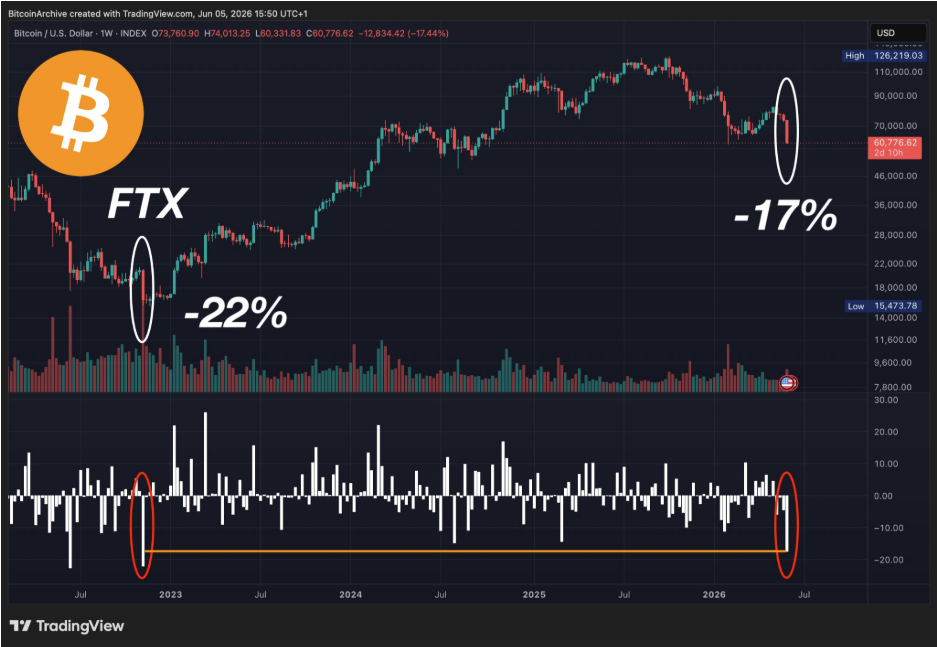
Bitcoin closed the week of June 5, 2026 down by almost 20%, its highest single-week percentage decline since the collapse of FTX in November 2022. The last time the market saw a candle this red, it was during the cycle bottom.
the current setup is more complicated, as Bitcoin is reacting to a combination of institutional selling pressure, ETF weakness, and fading confidence after a failed recovery attempt above $82,000.

Bitcoin’s Drop Brings Back The FTX Comparison
Bitcoin’s price action in the first week of June was one of its most notable weeks in history. BTC opened the week around $73,760, briefly pushed as high as $74,092, and then fell to a low of about $59,130, according to data from TradingView.
var rnd = window.rnd || Math.floor(Math.random()*10e6); var pid607465 = window.pid607465 || rnd; var plc607465 = window.plc607465 || 0; var abkw = window.abkw || ''; var absrc = 'https://servedbyadbutler.com/adserve/;ID=172179;size=0x0;setID=607465;type=js;sw='+screen.width+';sh='+screen.height+';spr='+window.devicePixelRatio+';kw='+abkw+';pid='+pid607465+';place='+(plc607465++)+';rnd='+rnd+';click=CLICK_MACRO_PLACEHOLDER'; document.write('
');
if (!window.AdButler){(function(){var s = document.createElement("script"); s.async = true; s.type = "text/javascript";s.src = "https://servedbyadbutler.com/app.js";var n = document.getElementsByTagName("script")[0]; n.parentNode.insertBefore(s, n);}());}
var AdButler = AdButler || {}; AdButler.ads = AdButler.ads || []; var abkw = window.abkw || ""; var plc366606 = window.plc366606 || 0; (function(){ var divs = document.querySelectorAll(".plc366606:not([id])"); var div = divs[divs.length-1]; div.id = "placement_366606_"+plc366606; AdButler.ads.push({handler: function(opt){ AdButler.register(172179, 366606, [728,90], "placement_366606_"+opt.place, opt); }, opt: { place: plc366606++, keywords: abkw, domain: "servedbyadbutler.com", click:"CLICK_MACRO_PLACEHOLDER" }}); })();
The move translates to a decline of about 19.5% from the weekly open to the low and 20.1% from the high to the low, making it Bitcoin’s worst weekly percentage drop since the FTX crash in 2022, when the price fell by roughly 22% in a single week.
However, there is also a note about where the candle is showing up in the market structure. During the FTX collapse, the violent weekly move came after months of selling pressure and ended up happening close to the final bear-market bottom. The current decline is also appearing after Bitcoin has already lost a major portion of its value from the October 2025 all-time high above $126,000.
var rnd = window.rnd || Math.floor(Math.random()*10e6); var pid607472 = window.pid607472 || rnd; var plc607472 = window.plc607472 || 0; var abkw = window.abkw || ''; var absrc = 'https://servedbyadbutler.com/adserve/;ID=172179;size=0x0;setID=607472;type=js;sw='+screen.width+';sh='+screen.height+';spr='+window.devicePixelRatio+';kw='+abkw+';pid='+pid607472+';place='+(plc607472++)+';rnd='+rnd+';click=CLICK_MACRO_PLACEHOLDER'; document.write('
');
if (!window.AdButler){(function(){var s = document.createElement("script"); s.async = true; s.type = "text/javascript";s.src = "https://servedbyadbutler.com/app.js";var n = document.getElementsByTagName("script")[0]; n.parentNode.insertBefore(s, n);}());}
var AdButler = AdButler || {}; AdButler.ads = AdButler.ads || []; var abkw = window.abkw || ""; var plc452518 = window.plc452518 || 0; (function(){ var divs = document.querySelectorAll(".plc452518:not([id])"); var div = divs[divs.length-1]; div.id = "placement_452518_"+plc452518; AdButler.ads.push({handler: function(opt){ AdButler.register(172179, 452518, [728,90], "placement_452518_"+opt.place, opt); }, opt: { place: plc452518++, keywords: abkw, domain: "servedbyadbutler.com", click:"CLICK_MACRO_PLACEHOLDER" }}); })();
Bitcoin Price Chart.
At the time of writing, Bitcoin is trading at $62,150, placing it about 50.7% below that peak. The similarity does not guarantee that the market has reached a bottom, but it does raise the possibility that the latest weekly price crash is moving into the kind of final-washout zone that followed FTX’s crash. That angle is being overlooked by many analysts, especially as several forecasts still point to a prolonged bear market that could stretch into at least Q4 2026
Bitcoin Enters Extreme Undervaluation
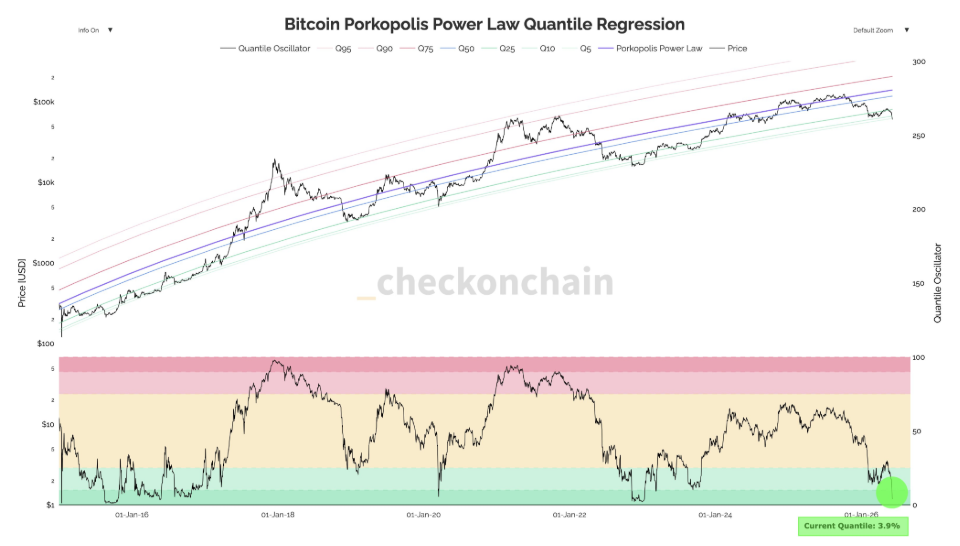
Crypto analyst Darkfost noted that Bitcoin has now fallen below the 4% quantile on the Bitcoin Porkopolis Power Law Quantile Regression model. The chart places Bitcoin’s current quantile around 3.9%, meaning the asset is trading in a zone that has appeared during less than 4% of its historical price action relative to its long-term growth curve.
var rnd = window.rnd || Math.floor(Math.random()*10e6); var pid607473 = window.pid607473 || rnd; var plc607473 = window.plc607473 || 0; var abkw = window.abkw || ''; var absrc = 'https://servedbyadbutler.com/adserve/;ID=172179;size=0x0;setID=607473;type=js;sw='+screen.width+';sh='+screen.height+';spr='+window.devicePixelRatio+';kw='+abkw+';pid='+pid607473+';place='+(plc607473++)+';rnd='+rnd+';click=CLICK_MACRO_PLACEHOLDER'; document.write('
');
if (!window.AdButler){(function(){var s = document.createElement("script"); s.async = true; s.type = "text/javascript";s.src = 'https://servedbyadbutler.com/app.js';var n = document.getElementsByTagName("script")[0]; n.parentNode.insertBefore(s, n);}());}
var AdButler = AdButler || {}; AdButler.ads = AdButler.ads || []; var abkw = window.abkw || ''; var plc452519 = window.plc452519 || 0; (function(){ var divs = document.querySelectorAll(".plc452519:not([id])"); var div = divs[divs.length-1]; div.id = "placement_452519_"+plc452519; AdButler.ads.push({handler: function(opt){ AdButler.register(172179, 452519, [728,90], 'placement_452519_'+opt.place, opt); }, opt: { place: plc452519++, keywords: abkw, domain: 'servedbyadbutler.com', click:'CLICK_MACRO_PLACEHOLDER' }}); })();
BTCUSD currently trading at $62,594. Chart:
TradingView
The Power Law model is a long-term valuation model that can also be used for a reversal signal. Every prior instance in which the quantile oscillator reached this level, visible in the chart across 2015, 2018/2019, and the 2022 bottom, preceded notable multi-year recoveries.
Bitcoin Power Law Regression. Source: @Darkfost_Coc On X

Bitcoin Price Plunges To $59K, Sparking Fears Of Deeper Decline
Bitcoin can stay undervalued for longer than traders expect, especially if the momentum is weak and there’s forced selling. Still, the metric does show that Bitcoin is now much closer to the lower regression bands than the overheated upper bands in previous cycle peaks.
Featured image from Pexels, chart from TradingView
0
0
Disclaimer: The content of this article solely reflects the author's opinion and does not represent the platform in any capacity. This article is not intended to serve as a reference for making investment decisions.
Understand the market, then trade.
Bitget offers one-stop trading for cryptocurrencies, stocks, and gold.
Trade now!
You may also like
Amazon (AMZN.US) begins a new round of small-scale layoffs, with the retail division hit hardest
Amazon confirmed on Wednesday that the company has laid off a small number of employees, mainly involving its Stores division, which is responsible for its main e-commerce website.
智通财经•2026/10/08 03:21
The US stock Q3 earnings season kicks off: Profit growth expected to approach 30%. Can this boost the S&P 500 to new highs?
The AI engine is running at full speed, with S&P 500 profit growth approaching 30%. However, the deterioration in market breadth and high U.S. Treasury yields remain concerns.
智通财经•2026/10/08 02:16
Where is Muse's commercialization stuck? Barred from two-thirds of websites
Meta AI agent Muse faces commercialization difficulties: According to Jefferies' tests on hundreds of e-commerce, airline, and hotel websites, about one-third directly block Muse, another third set up access obstacles, and the core technical challenge has shifted from "Is the model good enough?" to "Can it even get in?" This friction in access will prolong the monetization timeline and objectively reinforce Google’s structural moat.
华尔街见闻•2026/10/08 02:01
Crypto prices
More
Bitcoin
BTC
$82,726.04
-1.63%

Ethereum
ETH
$2,564.56
-1.77%

Tether USDt
USDT
$0.9993
-0.04%

BNB
BNB
$769.7
+0.34%

XRP
XRP
$1.41
-3.40%

USDC
USDC
$0.9998
-0.01%

Solana
SOL
$115.56
-2.22%

TRON
TRX
$0.3356
+0.96%

Hyperliquid
HYPE
$87.64
-3.15%

Zcash
ZEC
$1,296.2
-1.89%
How to buy BTC
Bitget lists BTC – Buy or sell BTC quickly on Bitget!
Trade now
Become a trader now?A welcome pack worth 6200 USDT for new users!
Sign up now