
Bitcoin’s "Electrical Cost" Suggests Possible Bear Market Floor Near $50,000 — Analyst Explains Why

By:Newsbtc
Bitget offers one-stop trading for cryptocurrencies, stocks, and gold. Trade now!
A welcome pack worth 6200 USDT for new users! Sign up now!
Bitcoin’s bearish structure over the past few weeks has raised clear concerns about the flagship cryptocurrency’s future. Amid these concerns are speculations concerning its trajectory, some of which point to bottoms as low as $25,000. However, an on-chain analyst recently took to the social media platform X to explain why Bitcoin’s fall to $25,000 is an unlikely scenario in its current cycle.
Electrical Cost Model Points To Potential Bitcoin Bottom
In a June 6 post on X, crypto analyst Ted Pillows implied that the Bitcoin price might see further declines before a definitive bear market bottom is established. This conjecture is based on the Bitcoin Electrical Cost model.
For context, the model estimates Bitcoin’s fundamental production costs by measuring the electricity required to mine new BTC. Because mining operations tend to consume substantial amounts of energy, the metric is often used as a proxy for Bitcoin’s inherent value. This is because it represents the minimum price at which miners can sustainably operate over the long term.
var rnd = window.rnd || Math.floor(Math.random()*10e6); var pid607465 = window.pid607465 || rnd; var plc607465 = window.plc607465 || 0; var abkw = window.abkw || ''; var absrc = 'https://servedbyadbutler.com/adserve/;ID=172179;size=0x0;setID=607465;type=js;sw='+screen.width+';sh='+screen.height+';spr='+window.devicePixelRatio+';kw='+abkw+';pid='+pid607465+';place='+(plc607465++)+';rnd='+rnd+';click=CLICK_MACRO_PLACEHOLDER'; document.write('
');
if (!window.AdButler){(function(){var s = document.createElement("script"); s.async = true; s.type = "text/javascript";s.src = "https://servedbyadbutler.com/app.js";var n = document.getElementsByTagName("script")[0]; n.parentNode.insertBefore(s, n);}());}
var AdButler = AdButler || {}; AdButler.ads = AdButler.ads || []; var abkw = window.abkw || ""; var plc366606 = window.plc366606 || 0; (function(){ var divs = document.querySelectorAll(".plc366606:not([id])"); var div = divs[divs.length-1]; div.id = "placement_366606_"+plc366606; AdButler.ads.push({handler: function(opt){ AdButler.register(172179, 366606, [728,90], "placement_366606_"+opt.place, opt); }, opt: { place: plc366606++, keywords: abkw, domain: "servedbyadbutler.com", click:"CLICK_MACRO_PLACEHOLDER" }}); })();

In line with historical data, Pillows explained that Bitcoin bear markets have never fallen below this Electrical Cost, despite the severe drawdowns seen during these periods. On the contrary, bear markets have often found bottoms near this crucial price level.
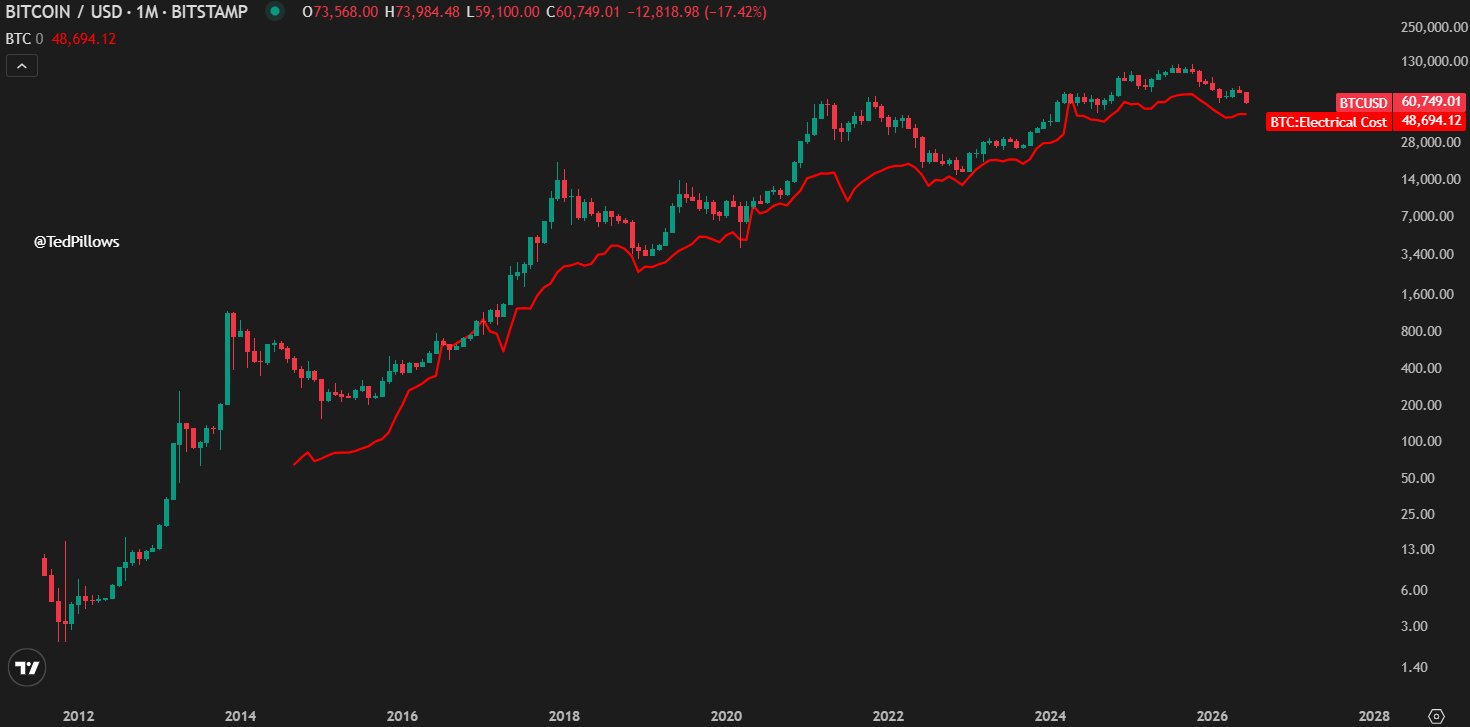 Source: @TedPillows on X
Pillows pointed out that Bitcoin’s current Electrical Cost sits at approximately $48,694 — a threshold still somewhat far from Bitcoin’s current market price. According to the analyst, this suggests that the BTC price could find support near $50,000 if the current downturn continues.
However, Pillows highlighted a caveat in this analysis, stating that it would take an extraordinary global event for this support zone to be broken. In the event that the world is hit by a recession or a pandemic as severe as COVID, the Bitcoin price could temporarily fall below its estimated production cost due to panic-driven sales.
var rnd = window.rnd || Math.floor(Math.random()*10e6); var pid607472 = window.pid607472 || rnd; var plc607472 = window.plc607472 || 0; var abkw = window.abkw || ''; var absrc = 'https://servedbyadbutler.com/adserve/;ID=172179;size=0x0;setID=607472;type=js;sw='+screen.width+';sh='+screen.height+';spr='+window.devicePixelRatio+';kw='+abkw+';pid='+pid607472+';place='+(plc607472++)+';rnd='+rnd+';click=CLICK_MACRO_PLACEHOLDER'; document.write('
');
if (!window.AdButler){(function(){var s = document.createElement("script"); s.async = true; s.type = "text/javascript";s.src = "https://servedbyadbutler.com/app.js";var n = document.getElementsByTagName("script")[0]; n.parentNode.insertBefore(s, n);}());}
var AdButler = AdButler || {}; AdButler.ads = AdButler.ads || []; var abkw = window.abkw || ""; var plc452518 = window.plc452518 || 0; (function(){ var divs = document.querySelectorAll(".plc452518:not([id])"); var div = divs[divs.length-1]; div.id = "placement_452518_"+plc452518; AdButler.ads.push({handler: function(opt){ AdButler.register(172179, 452518, [728,90], "placement_452518_"+opt.place, opt); }, opt: { place: plc452518++, keywords: abkw, domain: "servedbyadbutler.com", click:"CLICK_MACRO_PLACEHOLDER" }}); })();
Silent BTC Accumulation On Binance Underway As Outflows Steadily Climb
In a Quicktake post on CryptoQuant, analyst CryptoOnchain highlighted an interesting contradiction ongoing within the Bitcoin market. According to the on-chain analyst, BTC accumulation events have been underway on Binance.
The analyst noted that technical indicators — notably, the RSI (14) and the EMA50/200 — are telling a clearly bearish story. RSI readings, for example, have fallen to extreme levels near 6.4, and the EMA50/200 currently displays a “Death Cross” pattern.
At the same time, Binance’s Exchange Netflows reads as negative (-0.58σ), indicating that Bitcoin is leaving Binance consistently—an event that further suggests its holders are accumulating BTC rather than simply panic-selling. But then CryptoOnchain explained that the unignorable threat of a long squeeze still looms, given the high Open Interest.
var rnd = window.rnd || Math.floor(Math.random()*10e6); var pid607473 = window.pid607473 || rnd; var plc607473 = window.plc607473 || 0; var abkw = window.abkw || ''; var absrc = 'https://servedbyadbutler.com/adserve/;ID=172179;size=0x0;setID=607473;type=js;sw='+screen.width+';sh='+screen.height+';spr='+window.devicePixelRatio+';kw='+abkw+';pid='+pid607473+';place='+(plc607473++)+';rnd='+rnd+';click=CLICK_MACRO_PLACEHOLDER'; document.write('
');
if (!window.AdButler){(function(){var s = document.createElement("script"); s.async = true; s.type = "text/javascript";s.src = 'https://servedbyadbutler.com/app.js';var n = document.getElementsByTagName("script")[0]; n.parentNode.insertBefore(s, n);}());}
var AdButler = AdButler || {}; AdButler.ads = AdButler.ads || []; var abkw = window.abkw || ''; var plc452519 = window.plc452519 || 0; (function(){ var divs = document.querySelectorAll(".plc452519:not([id])"); var div = divs[divs.length-1]; div.id = "placement_452519_"+plc452519; AdButler.ads.push({handler: function(opt){ AdButler.register(172179, 452519, [728,90], 'placement_452519_'+opt.place, opt); }, opt: { place: plc452519++, keywords: abkw, domain: 'servedbyadbutler.com', click:'CLICK_MACRO_PLACEHOLDER' }}); })();
As of this writing, the price of BTC stands at around $602,388, reflecting an almost 3% jump in the past 24 hours.

Bitcoin Testing A Critical Support After Sharp Market-Wide Selloff
The price of BTC on the daily timeframe | Source: BTCUSDT chart on
TradingView
0
0
Disclaimer: The content of this article solely reflects the author's opinion and does not represent the platform in any capacity. This article is not intended to serve as a reference for making investment decisions.
Understand the market, then trade.
Bitget offers one-stop trading for cryptocurrencies, stocks, and gold.
Trade now!
You may also like
Amazon (AMZN.US) begins a new round of small-scale layoffs, with the retail division hit hardest
Amazon confirmed on Wednesday that the company has laid off a small number of employees, mainly involving its Stores division, which is responsible for its main e-commerce website.
智通财经•2026/10/08 03:21
The US stock Q3 earnings season kicks off: Profit growth expected to approach 30%. Can this boost the S&P 500 to new highs?
The AI engine is running at full speed, with S&P 500 profit growth approaching 30%. However, the deterioration in market breadth and high U.S. Treasury yields remain concerns.
智通财经•2026/10/08 02:16
Where is Muse's commercialization stuck? Barred from two-thirds of websites
Meta AI agent Muse faces commercialization difficulties: According to Jefferies' tests on hundreds of e-commerce, airline, and hotel websites, about one-third directly block Muse, another third set up access obstacles, and the core technical challenge has shifted from "Is the model good enough?" to "Can it even get in?" This friction in access will prolong the monetization timeline and objectively reinforce Google’s structural moat.
华尔街见闻•2026/10/08 02:01
Crypto prices
More
Bitcoin
BTC
$82,726.04
-1.63%

Ethereum
ETH
$2,564.56
-1.77%

Tether USDt
USDT
$0.9993
-0.04%

BNB
BNB
$769.7
+0.34%

XRP
XRP
$1.41
-3.40%

USDC
USDC
$0.9998
-0.01%

Solana
SOL
$115.56
-2.22%

TRON
TRX
$0.3356
+0.96%

Hyperliquid
HYPE
$87.64
-3.15%

Zcash
ZEC
$1,296.2
-1.89%
How to buy BTC
Bitget lists BTC – Buy or sell BTC quickly on Bitget!
Trade now
Become a trader now?A welcome pack worth 6200 USDT for new users!
Sign up now