
Sui launches privacy feature that keeps regulators in the loop

Sui has opened public testing for a new privacy system that hides token balances and transfer amounts while preserving access for auditors and compliance teams, introducing a model that differs sharply from traditional privacy-focused cryptocurrencies.
- Sui has launched public testing for confidential transfers, encrypting balances and transfer amounts while keeping auditor access available.
- The privacy feature uses zero-knowledge proofs and issuer-controlled audit tools, offering a compliance-focused alternative to privacy coins such as Monero.
- SUI rose nearly 5% following the announcement, though the token remains below key resistance levels on higher-timeframe charts.
According to an announcement published on June 8, confidential transfers are now available in public beta on Sui’s Devnet, with a Testnet release planned later this year. The feature encrypts transaction values and wallet balances onchain but leaves sender addresses, receiver addresses, token types, and transaction timestamps visible.
The rollout arrives as blockchain developers continue searching for ways to offer transaction privacy without removing the transparency requirements relied upon by regulators, exchanges, and institutional users.
Sui keeps transaction data private while preserving oversight
Under Sui’s design, token issuers can activate a confidential mode that conceals balances and transfer amounts from public view. The network uses Twisted ElGamal cryptography on Ristretto255 together with zero-knowledge proofs to verify transactions without exposing the underlying values.
Mysten Labs, the company behind Sui, said the system allows the network to confirm that transfers remain valid while preventing overdrafts and unauthorized token creation. The company has also released the code as open source on GitHub, although it noted that the implementation remains unaudited and should be treated as a work in progress.
Additional controls distinguish the feature from privacy coins that attempt to hide every aspect of a transaction. Authorized entities can be granted auditor keys that allow them to decrypt balances when required, while issuers retain the ability to freeze or seize assets under specific circumstances.
Users are also able to prove ownership of balances or verify transaction amounts without revealing private keys, according to Mysten Labs.
Institutions test the model as Sui seeks adoption
The structure contrasts with Monero, which conceals transaction senders, recipients, and amounts through a combination of ring signatures, stealth addresses, and Ring Confidential Transactions. Because outside parties cannot access that information, Monero has faced repeated exchange delistings linked to compliance concerns.
Rather than removing visibility entirely, Sui’s approach is being tested by firms that need privacy around financial activity while remaining capable of meeting regulatory obligations. Bridge is evaluating the technology for stablecoin and payment use cases, while TRM Labs and Merkle Science are examining how transaction monitoring, investigations, and risk assessment tools function within the encrypted framework.
Payment companies, treasury departments, and stablecoin issuers often avoid exposing transaction sizes and wallet balances because those details can reveal commercial relationships, hedging activity, or operational strategies. Sui’s confidential transfers are designed to address those concerns without eliminating audit capabilities.
The launch comes during a difficult period for the network. Sui experienced three mainnet outages in late May, raising questions about operational reliability as the blockchain pursues more institutional users.
SUI rally meets resistance below key moving averages
Market participants responded positively to the privacy rollout. SUI (SUI) rose nearly 5% on June 9 following the announcement and traded around $0.76 at the time of writing.
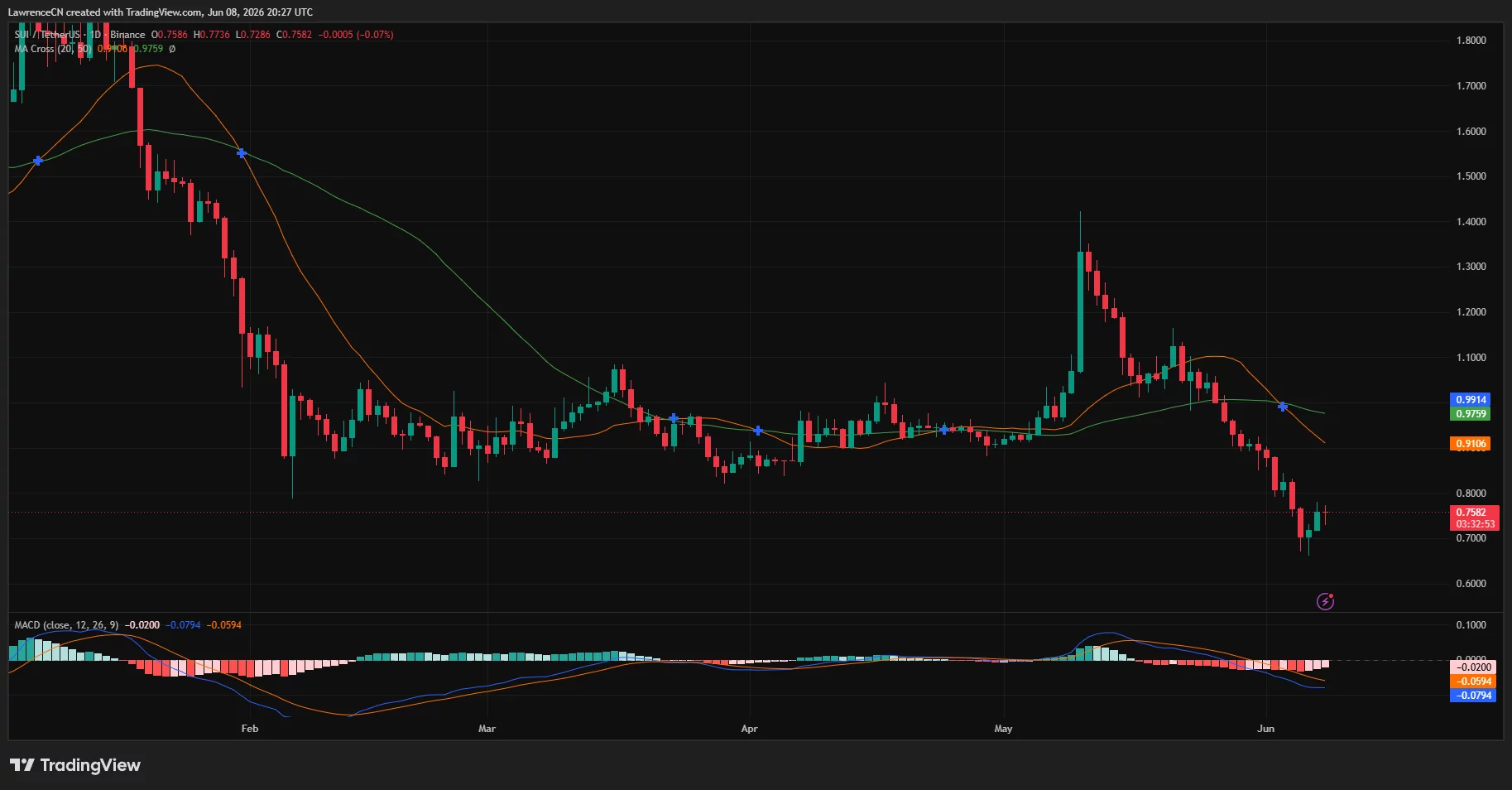
Despite the rebound, the technical picture remains mixed. On the daily chart, SUI continues to trade below its 20-day and 50-day moving averages near $0.91 and $0.98, indicating that sellers still control the broader trend after the token’s decline from the May peak near $1.40.
 SUI daily price chart — June 8 | Source:
The bearish moving-average structure remains intact, while the MACD indicator continues to sit below the zero line despite showing signs that downside momentum is beginning to ease.
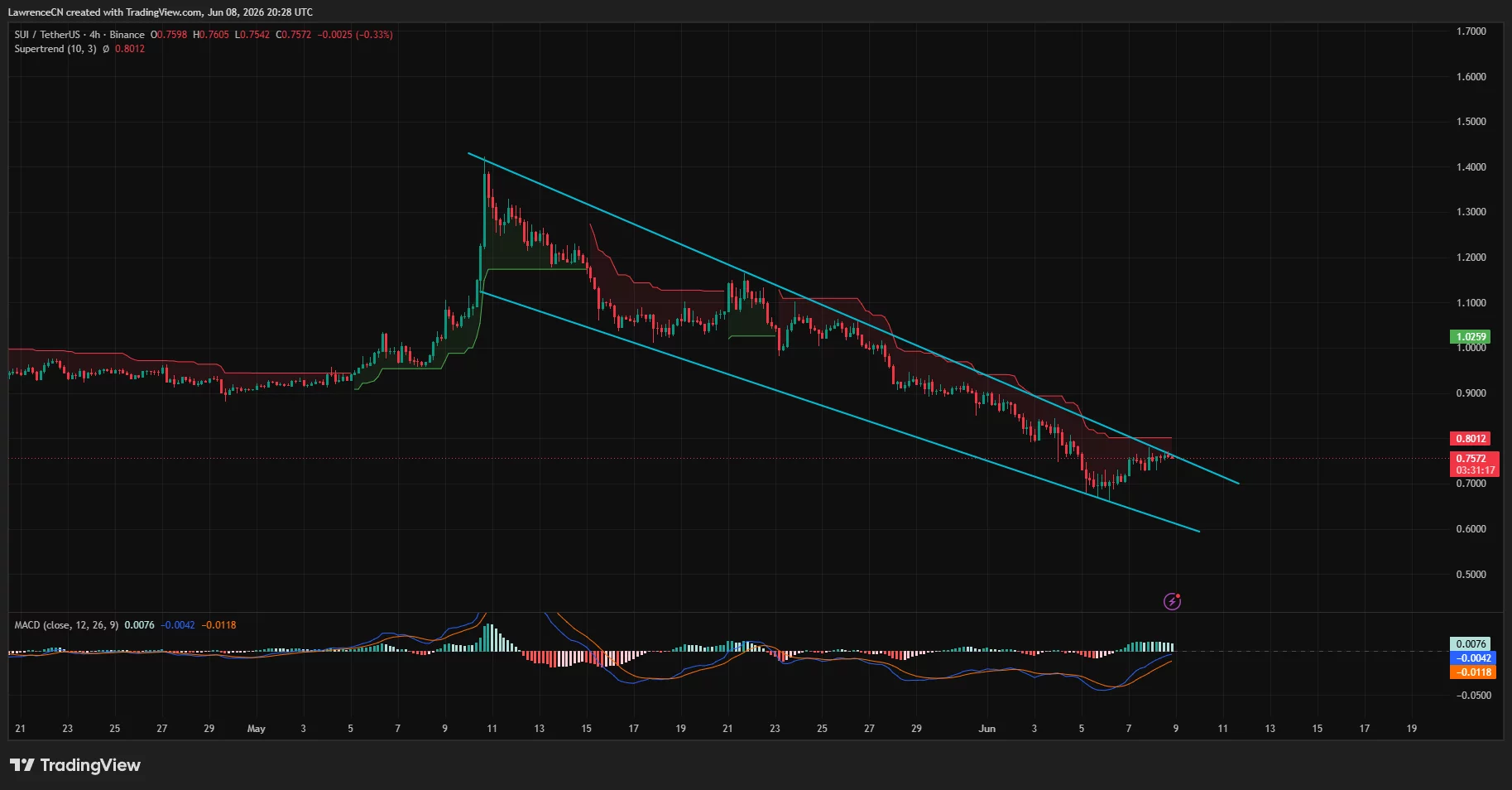
Shorter-term charts show a more constructive setup. On the 4-hour timeframe, SUI has rebounded from support around $0.68-$0.70 and is attempting to break above the upper boundary of a descending channel that has guided price action lower for nearly a month. A bullish MACD crossover has emerged on the same timeframe, suggesting buying pressure has strengthened since last week’s market-wide selloff.
 SUI 4-hour price chart — June 8 | Source:
The area around $0.80 remains the first major test for bulls because it aligns with both the channel resistance and the Supertrend indicator. A successful breakout could expose the 20-day moving average near $0.91, followed by the 50-day moving average and psychological resistance around $1.00.
On the downside, failure to clear overhead resistance could leave SUI trapped within the broader bearish structure. In that scenario, traders may look toward support near $0.70, with the recent swing low around $0.68 serving as the next key level to watch.
Disclaimer: The content of this article solely reflects the author's opinion and does not represent the platform in any capacity. This article is not intended to serve as a reference for making investment decisions.
You may also like
WTI posts modest gains above $88.50 on unexpected EIA draw, Middle East conflicts in focus

Betting on 'U.S. Treasury yields plunging', bullish options trading volume for long-term U.S. Treasury and utility sector U.S. stock ETFs surges
The increasing activity in long-term U.S. Treasury options “very directly” reflects traders’ expectations for a decline in long-term interest rates. Utility stocks have added a new logic due to rising power demand from AI data centers. Historically, whenever U.S. Treasury yields retreat, these two sectors are often the first to benefit and see sharp rebounds. Analysts believe that the battle between high interest rates and the AI frenzy has become the core narrative in the current market.
Impact of Surging US Treasury Yields: US Stock PE Ratio Shrinks Significantly, Mag 7 Dominates Small Caps
The 10-year US Treasury yield has reached a 24-year high, quietly reshaping the landscape of the US stock market. The S&P 500 forward price-to-earnings ratio has compressed from 22.2 times at the beginning of the year to 19.3 times, marking a “three-tier decline in valuation.” Meanwhile, the Russell 2000 Index is approaching technical correction territory, while Mag 7 stocks like Microsoft and Nvidia continue to support the broader market with the AI narrative and strong earnings. Market concentration is nearing historic extremes.
Has the "only buyer" of Korean stocks left early?
Over the past two months, Samsung and SK Hynix have alone absorbed over $25 billion in sell pressure. Now, Samsung Electronics has completed its buybacks ahead of schedule, and SK Hynix is left with only about $500 million to finish up. On their "exit" day, the KOSPI instantly dropped by 2%. More dangerously, Samsung's Q3 results missed expectations for both revenue and profit. Coupled with ETF rebalancing and options expiry, a "liquidity vacuum" has become a reality, leaving the question of who will step in as the biggest mystery.
Crypto prices
More


