
Banking giant warns: Global stock markets are in the most "bubble-like" state since the 2008 financial crisis

U.S. multinational investment bank Citi has warned that global stock markets are currently in the most “bubble-like” state since the 2008 financial crisis.
In an investor report released on June 5, Citi analyst Beata Manthey pointed out that Citi’s proprietary “Bear Market Checklist” currently has 10 out of 18 indicators triggered worldwide.
Specifically, the U.S. market scores 11.5/18, while the European market scores 5/18. Manthey said that historically, when this indicator exceeds 10, it tends to accelerate. For comparison, during the dot-com bubble in 2000, this indicator reached as high as 17.5 warning signals.
Manthey wrote: “However, we note that once the number of warning signals hits double digits, historically they often increase faster, meaning risk may be accumulating at an accelerating pace. If more indicators are triggered in the future, whether it's worth buying the dip when the market falls will become more and more questionable.”
Nevertheless, Manthey also acknowledged that the current market conditions have not yet reached an “overexuberant” level. Therefore, while the indicator does reflect rising risks, Citi as a whole still maintains a relatively positive outlook on the market.
The stock market is in the most bubble-like phase since 2008
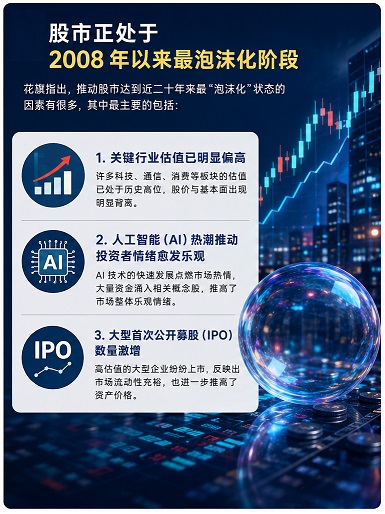
There are numerous factors driving stock markets to the most “bubble-like” state of the past two decades. The main reasons include:
Key sector valuations have become significantly overextended;
The artificial intelligence (AI) boom has led to increasingly optimistic investor sentiment;
A surge in the number of large initial public offerings (IPOs).
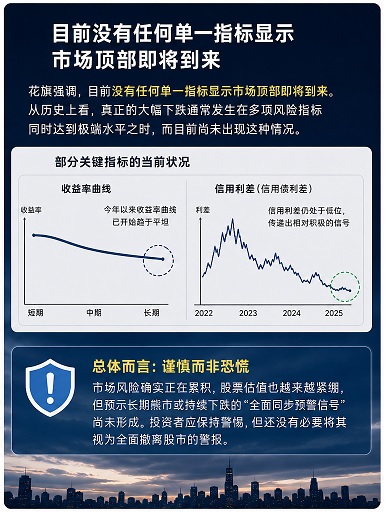
Citi emphasized that currently, no single indicator suggests the market top is imminent. Historically, significant downturns tend to occur when multiple risk indicators reach extreme levels simultaneously—a scenario not present at this time.
The Citi report stated: “Although the yield curve has started to flatten since the start of this year, some more responsive indicators, such as credit spreads, remain at low levels, sending relatively positive signals.”
Overall, Citi’s message leans more toward caution than panic.
In other words, market risks are indeed accumulating and stock valuations are becoming increasingly stretched, but the “broadly synchronized warning signal” that would foreshadow a prolonged bear market or sustained downturn has yet to materialize. At this stage, investors should remain vigilant but do not yet need to view this as a call for a full-scale exit from the stock market.
Disclaimer: The content of this article solely reflects the author's opinion and does not represent the platform in any capacity. This article is not intended to serve as a reference for making investment decisions.
You may also like
WTI posts modest gains above $88.50 on unexpected EIA draw, Middle East conflicts in focus

Betting on 'U.S. Treasury yields plunging', bullish options trading volume for long-term U.S. Treasury and utility sector U.S. stock ETFs surges
The increasing activity in long-term U.S. Treasury options “very directly” reflects traders’ expectations for a decline in long-term interest rates. Utility stocks have added a new logic due to rising power demand from AI data centers. Historically, whenever U.S. Treasury yields retreat, these two sectors are often the first to benefit and see sharp rebounds. Analysts believe that the battle between high interest rates and the AI frenzy has become the core narrative in the current market.
Impact of Surging US Treasury Yields: US Stock PE Ratio Shrinks Significantly, Mag 7 Dominates Small Caps
The 10-year US Treasury yield has reached a 24-year high, quietly reshaping the landscape of the US stock market. The S&P 500 forward price-to-earnings ratio has compressed from 22.2 times at the beginning of the year to 19.3 times, marking a “three-tier decline in valuation.” Meanwhile, the Russell 2000 Index is approaching technical correction territory, while Mag 7 stocks like Microsoft and Nvidia continue to support the broader market with the AI narrative and strong earnings. Market concentration is nearing historic extremes.
Has the "only buyer" of Korean stocks left early?
Over the past two months, Samsung and SK Hynix have alone absorbed over $25 billion in sell pressure. Now, Samsung Electronics has completed its buybacks ahead of schedule, and SK Hynix is left with only about $500 million to finish up. On their "exit" day, the KOSPI instantly dropped by 2%. More dangerously, Samsung's Q3 results missed expectations for both revenue and profit. Coupled with ETF rebalancing and options expiry, a "liquidity vacuum" has become a reality, leaving the question of who will step in as the biggest mystery.
Crypto prices
More


