
Meta hires Oasis founder Dawn Song for AI safety push

UC Berkeley professor and Oasis Labs founder Dawn Song has joined Meta Superintelligence Labs as vice president of AI research.
- Dawn Song joins Meta, bringing Oasis privacy experience to frontier AI safety and security work.
- Virtue AI members are joining Meta as MSL builds safety tools for agentic AI systems.
- ROSE remains near record lows, showing Song’s AI move has not revived Oasis token demand.
She said she will help lead Meta’s AI safety and AI security efforts. Song announced the move in a post on X. She said several members of the Virtue AI team will also join Meta. Axios also reported that Virtue AI co-founders Bo Li and Sanmi Koyejo are among the hires.
Song said her work at Meta will focus on frontier AI models and agentic AI systems. She wrote that AI must be “secure, trustworthy, and beneficial” if it is to reach its full use.
The move gives Meta more senior talent in AI security. It also brings a well-known blockchain privacy researcher into one of the world’s largest AI labs.
Virtue AI team moves to MSL
Virtue AI was founded in 2024 to build tools for trustworthy AI. Song said the team worked on AI security, agent security, benchmarks and open platforms before the Meta move.
Meta is hiring several Virtue AI leaders and team members. The report said the group worked on automated red teaming, runtime guardrails and AI governance.
Meta’s interest comes as AI labs put more attention on agent safety. AI agents can take actions, use tools and handle tasks across software systems. That makes security more important because errors or misuse can spread across real products.
Meta has been building a superintelligence AI team after its large Scale AI deal. The company wants to improve its AI models and ship them across Facebook, Instagram, WhatsApp and other products.
Oasis background adds crypto angle
Song is also known in crypto as the founder of Oasis Labs. The company raised $45m in 2018 to build privacy-first cloud computing on blockchain. Its backers included a16zcrypto, Accel and Binance Labs.
The Oasis project later became tied to the Oasis Network and the ROSE token. The network focuses on confidential computing, data privacy and privacy-preserving applications.
Oasis Protocol’s verifiable AI agents for crypto trading used trusted execution environments to keep strategies private while giving users proof of how agents behave.
Pontus-X, a platform built around privacy and data control, offered Oasis-based AI and data services. Song’s Meta role connects that same privacy and security theme to a much larger AI platform.
ROSE remains near record lows
The hiring news has not changed ROSE’s weak market setup. Oasis traded near $0.0059 on June 26, close to its intraday low. That is about 99% below its all-time high near $0.596.
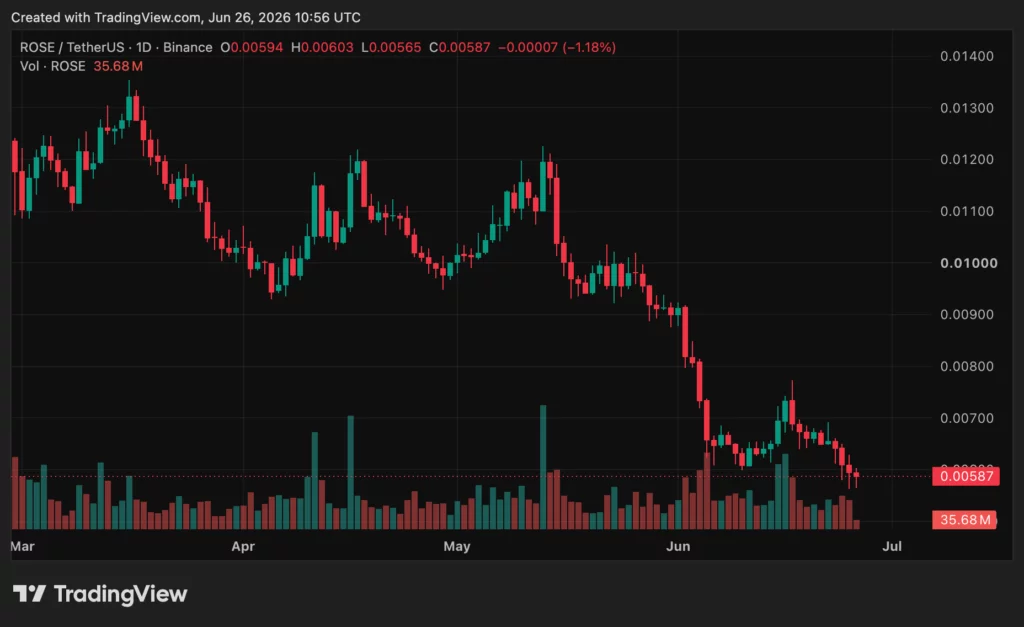 Oasis Network (ROSE) price chart, source: crypto.news
ROSE has also struggled with the broader crypto market selloff. Its market value remains far below peak-cycle levels, even as AI and privacy remain active themes in the sector.
The move is still notable for the Oasis community because Song helped shape the project’s early research identity. Her work linked blockchain, privacy and security before AI safety became a major mainstream topic.
For Meta, the hire adds academic and startup experience to its AI safety push. For crypto, it shows how privacy and security talent from blockchain continues to move into frontier AI.
Disclaimer: The content of this article solely reflects the author's opinion and does not represent the platform in any capacity. This article is not intended to serve as a reference for making investment decisions.
You may also like
New Federal Reserve News Agency: Waller Hints "High Interest Rates Suppress AI Boom", Rate Hike Path Faces Two-way Dilemma
Timiraos believes that the Federal Reserve is caught in a dilemma of "needing two different interest rates." Waller openly questioned the "AI immunity theory," stating that interest rates would "find their way into every crevice," breaking the market consensus that the AI boom is unaffected by monetary policy. However, he also said strong growth does not necessarily lead to higher inflation or require rate hikes. These two contradictory signals have left Wall Street confused, and Bank of America strategists bluntly criticized the response as "neither clear nor convincing."
Google Cloud approaching Microsoft Azure, but Microsoft wins the "earnings day challenge"
Google and Microsoft released their quarterly reports on the same day, signaling a shift in the competitive landscape of cloud computing. Google Cloud's revenue surpassed $30 billion, approaching Microsoft Azure's $33 billion. However, with slower growth in search advertising, insufficient monetization of AI models, and free cash flow turning negative, Google’s stock price plunged 10% after hours. In contrast, Microsoft’s overall revenue grew 19% year-on-year to $92.3 billion, exceeding expectations and pushing its stock price up about 3%. In this round of "earnings season tests," Microsoft has temporarily taken the lead with a more stable AI commercialization strategy.
$12.9 billion acquisition of Hugging Face draws attention from the Department of Justice: Is Nvidia (NVDA.US) aiming to control the "distribution throat" of AI?
The US Department of Justice is inquiring into Nvidia's (NVDA.US) $12.9 billion acquisition of Hugging Face, including issues related to the acquisition, sales, and exerting pressure on customers, with the investigation spanning two administrations.

Crypto prices
More


