
Meta Q2 2026 Earnings Highlights: Revenue Beats Expectations at $60.8 Billion with 28% Growth, Strong Advertising Performance, but Profit Declines, Free Cash Flow Hits Four-Year Low, and Q3 Guidance Disappoints
 Bitget2026/07/30 04:28
Core View
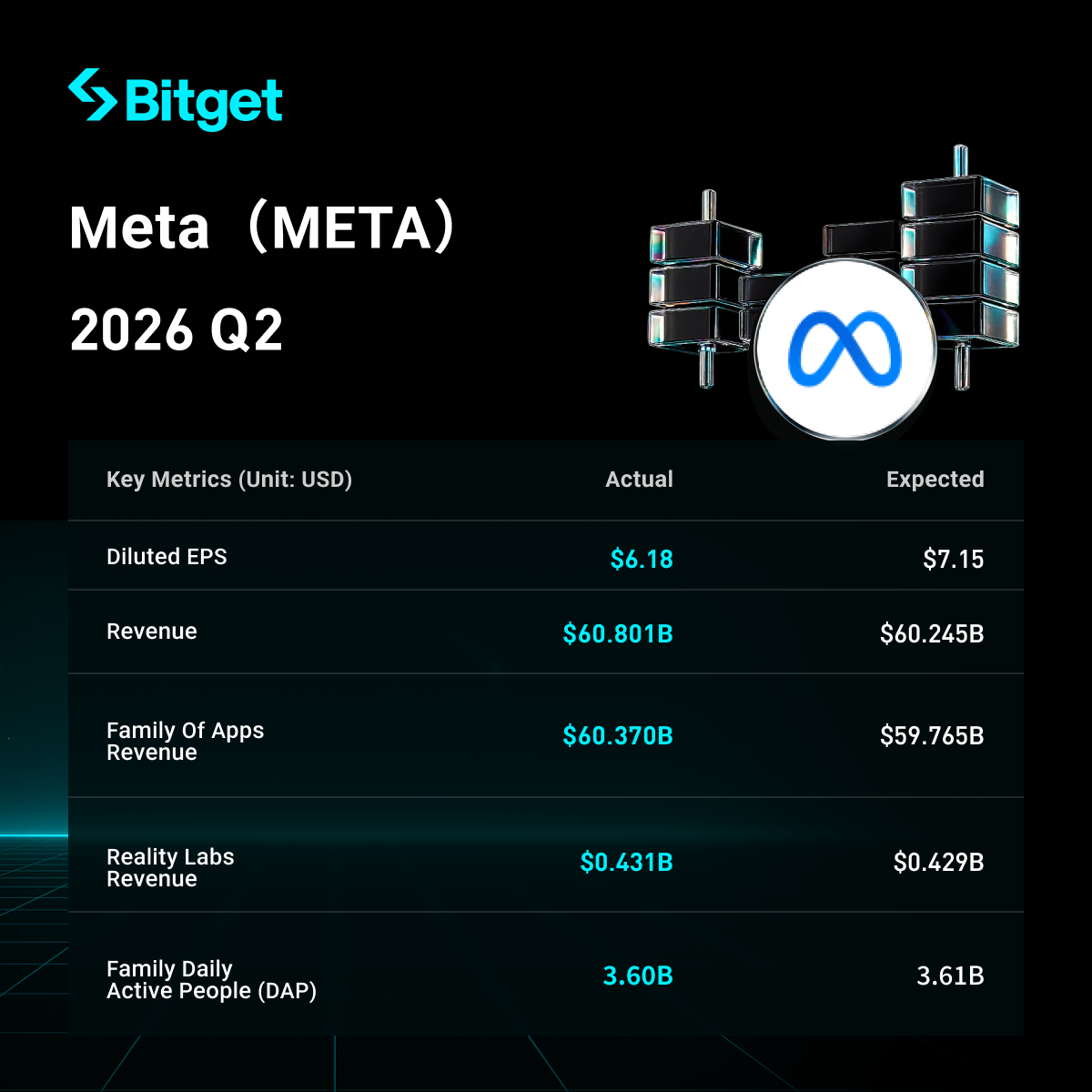
Meta reported second-quarter 2026 results with revenue of $60.8 billion, up 28% year-over-year (27% on a constant-currency basis), slightly above market expectations of approximately $60.3 billion. Advertising continued to drive growth. However, operating income fell 8% year-over-year, net income declined 14%, and diluted EPS of $6.18 dropped 13% and missed expectations, primarily due to $2.4 billion in legal proceedings charges, $1.18 billion in severance costs, and a sharp rise in R&D spending. Free cash flow was only $784 million, down sharply from $8.549 billion a year earlier and the lowest in nearly four years. The company’s Q3 revenue guidance midpoint came in below consensus, while full-year capital expenditures remain elevated. Shares fell more than 10% in after-hours trading. Investors remain concerned about the return timeline and commercialization path of Meta’s large-scale AI investments.
Detailed Breakdown
- Overall Revenue and Profit Performance
- Quarterly revenue: $60.801 billion, up 28% year-over-year (27% constant currency), slightly above market expectations of ~$60.3 billion.
- Diluted earnings per share: $6.18, down 13% year-over-year and below market expectations.
- Operating income: $18.775 billion, down 8% year-over-year; operating margin fell from 43% a year earlier to 31%.
- Net income: $15.848 billion, down 14% year-over-year.
- Total costs and expenses: $42.026 billion, up 55% year-over-year. This included R&D expenses of $21.656 billion (up 67% year-over-year, exceeding one-third of revenue), $2.4 billion related to legal proceedings, and $1.18 billion in severance expenses.
- Operating cash flow: $31.862 billion; capital expenditures (including principal payments on finance leases): $31.08 billion; free cash flow: only $784 million, down sharply from $8.549 billion in the prior-year period and the lowest level in nearly four years.
- Advertising Business Performance
- Advertising revenue: $59.363 billion, up 27% year-over-year, slightly above market expectations.
- Ad impressions grew 14% year-over-year.
- Average price per ad rose 12% year-over-year.
- Advertising remains the dominant revenue driver. AI continues to improve ad performance and user experience, supporting strong top-line growth.
- Other Business Segments and User Metrics
- Family of Apps remains the primary revenue contributor, with advertising accounting for the vast majority.
- Family daily active people (DAP): averaged 3.60 billion in June, up 3% year-over-year.
- Reality Labs revenue was approximately $431 million (slightly above some estimates) and remains in investment mode.
- Overall user and engagement metrics stayed solid, supporting the volume and pricing growth in advertising.
- Capital Expenditure and Expense Plans
- Full-year 2026 capital expenditures guidance: $130–145 billion (prior range $125–145 billion; lower end raised and range narrowed).
- Full-year total expenses guidance: $165–169 billion (already incorporating the $2.4 billion legal charge from Q2).
- Primary investment areas: servers, data centers, and network infrastructure to support AI compute demand. The company continues aggressive build-out of AI infrastructure.
- Q2 capital expenditures already reached $31.08 billion, reflecting sustained high levels of AI-related spending.
- Next-Quarter Guidance (Q3 2026)
- Revenue expected in the range of $61–64 billion, with a midpoint of $62.5 billion.
- This midpoint is below the market consensus of approximately $63.2 billion.
- Foreign exchange is expected to create an approximately 1 percentage point headwind to year-over-year revenue growth.
- Market Context and Investor Concerns
- Core tension: Advertising revenue and user growth remain strong, yet elevated AI capital spending, legal charges, and severance costs have significantly pressured profits and free cash flow, with near-term returns still unclear.
- Investor reaction: Shares fell more than 10% in after-hours trading as the market focused on the softer-than-expected Q3 guidance and the ongoing impact of high capital expenditures on cash flow.
- Analyst perspective: Even without a further material increase in capital expenditure expectations, investors are seeking greater clarity on Meta’s AI compute business plans and the commercialization pathway for AI. Ongoing legal and regulatory matters (particularly those related to child safety) could still have a significant impact on future results.
Disclaimer This content is for reference only and does not constitute any investment advice.
Disclaimer: The content of this article solely reflects the author's opinion and does not represent the platform in any capacity. This article is not intended to serve as a reference for making investment decisions.
You may also like
As AI controversies escalate, hedge funds buy tech stocks at the fastest pace in 15 months
Hedge funds have recorded net purchases of US TMT stocks on 10 out of the past 11 trading days, rebuilding tech long positions at the fastest pace in 15 months. However, an AI policy storm has struck at the "worst possible time"—calls by AI giants to slow down development have been rejected, and regulatory uncertainty has directly hit Asian tech stocks such as Softbank. As the tech sector's bullish run coincides with Super Central Bank Week, the sector now faces a severe test.
Apple Pre-sale Tracker: iPhone 18 Pro Series Shows Weak Overseas Demand Signals, Duo Review Positive but Hardware Lags Behind
According to a survey by Jefferies, after the launch of the iPhone 18 Pro, delivery wait times in the four major markets—the US, UK, Germany, and Japan—have shortened by 5 to 11 days compared to last year, with no wait time in the US. Given stable production capacity, this is a clear sign of weak demand. Although the China and Hong Kong markets have performed better against the trend, there are still suspicions of speculative stockpiling. The new foldable Duo has been praised for its software experience, but its $2,000 price tag comes with a 254-gram body and dual-camera setup, leaving its hardware lagging significantly behind Android competitors. Jefferies maintains an "underperform" rating, with a target price implying a 21% downside from the current level.
SUI holds $0.71 support as analysts cite key buy signal, eyes on possible recovery
UBS Health Benefit Survey: Elevance Health (ELV.US) Leads, U.S. Employers Prepare for Rising Medical Costs
In the annual survey by UBS for employee benefits management institutions, Elevance Health (ELV.US) emerged as the highest-rated US health insurance company.

Crypto prices
More


