
Super Micro Computer (SMCI.US) Q1 Earnings Call: Gross margin declined quarter-on-quarter does not mean AI business is unprofitable, accounts receivable turnover days decreased

Super Micro Computer released its fiscal year 2027 first quarter results after the market close on Tuesday and held an earnings conference call.
According to Zheshang Finance APP, Super Micro Computer (SMCI.US) announced its fiscal year 2027 Q1 earnings after market close on Tuesday, along with hosting its earnings conference call.
Q1 revenue was $19.95 billion, up 298% year-on-year, surpassing FactSet’s consensus estimate of $17.53 billion; non-GAAP diluted EPS was $1.81, forecasted at $1.23, and GAAP diluted EPS was $1.75. Non-GAAP gross margin was 12.8%, beating the company’s previous estimate of 12.0%–12.5%, but falling 4.8 percentage points from 17.6% in the last quarter, becoming a key focus during the call. After the report, shares initially rose over 7% after hours, later expanding to around 10%.
CFO Mark Long responded that the quarter-over-quarter drop in gross margin “is not evidence that AI platform revenue lacks profitability,” but reflects which customers took delivery in which quarter. Observing Q4 combined with Q1, total revenue was about $31.1 billion and non-GAAP gross margin was approximately 14.5%, a year-on-year improvement of about 5 percentage points. The company raised its full-year fiscal 2027 revenue target from $65–72 billion to $72–82 billion, but also expects the second-half gross margin to be lower than the first half.
The call’s most focused inquiry was the sharp quarterly fluctuation in gross margins. Non-GAAP gross margin in Q1 was 12.8%, down by 4.8 percentage points from 17.6% in the previous quarter, while AI solutions revenue mix climbed from 59% to 71%. As such, the market questioned whether large AI orders are diluting profitability. CFO Mark Long rebutted this directly: “Quarter-over-quarter declines do not prove that AI platform revenue lacks margin, it reflects which clients take delivery in which quarters.” He suggested looking at two quarters combined: aggregated revenue for Q4 and Q1 is about $31.1 billion, with a corresponding non-GAAP gross margin of around 14.5%, compared to $10.8 billion and around 9.5% a year ago—almost triple the revenue and a roughly 5 percentage point increase in margin. He also admitted that the full-year gross margin guidance implies the second half will be lower than the first, as AI revenue share will move toward the upper bound of 70–80%. JP Morgan noted after the preliminary announcement that this quarter’s gross margin fell sharply from last quarter’s 17.6%, raising questions about margin sustainability. Shares fell 27% in the previous month due to concerns over AI capital expenditure efficiency.
Mark Long stated in his opening remarks that about $2.3 billion in Q1 revenue was related to deployments originally scheduled for earlier periods but postponed due to customer and data center readiness, with core revenue excluding this at about $17.6 billion. He emphasized that the full-year revenue range does not assume these catch-up revenues will recur; the range reflects sustained sequential growth in base demand and much-improved visibility into customer deployment timelines compared with 90 days ago.
This quarter, a major data center customer contributed 44% of total revenue, compared to 28% for all of fiscal 2026; the 10-Q also reveals that two customers accounted for 49% and 17% of quarter-end receivables, respectively. Mark Long explained that this concentration reflects the current scale of AI infrastructure build-out, “Today, a single deployment can exceed our quarterly revenue from a year ago,” and that concentration is expected to remain high during the build phase and decline as enterprise and sovereign business expands. He added that deferred revenue increased by about $3.1 billion in the quarter, mostly customer prepayments; days sales outstanding fell from 59 days to 36 days, and there were no significant credit losses in the quarter.
Operating Cash Flow Still Negative, Cash Conversion Cycle Shortened by 52 Days
Net cash outflows from operating activities in the first quarter were $434 million, with capital expenditures of $47 million, resulting in negative free cash flow of $481 million; for full fiscal 2026, operating cash flow was negative $6.8 billion. The company’s cash conversion cycle shrank from 149 days to 97 days, a single-quarter improvement of 52 days, equivalent to about $10 billion less working capital tied up based on Q1’s revenue level. Inventory days improved by 45 to 74, receivables improved by 23 to 36 days, while payables days decreased from 29 to 13, consuming about $3 billion in cash. End-of-quarter cash and equivalents stood at $6.9 billion, while bank debt and convertibles totaled $8.6 billion, net debt at $1.7 billion, and inventory at $15.05 billion. The company stated it was in compliance with all debt covenants at quarter-end.
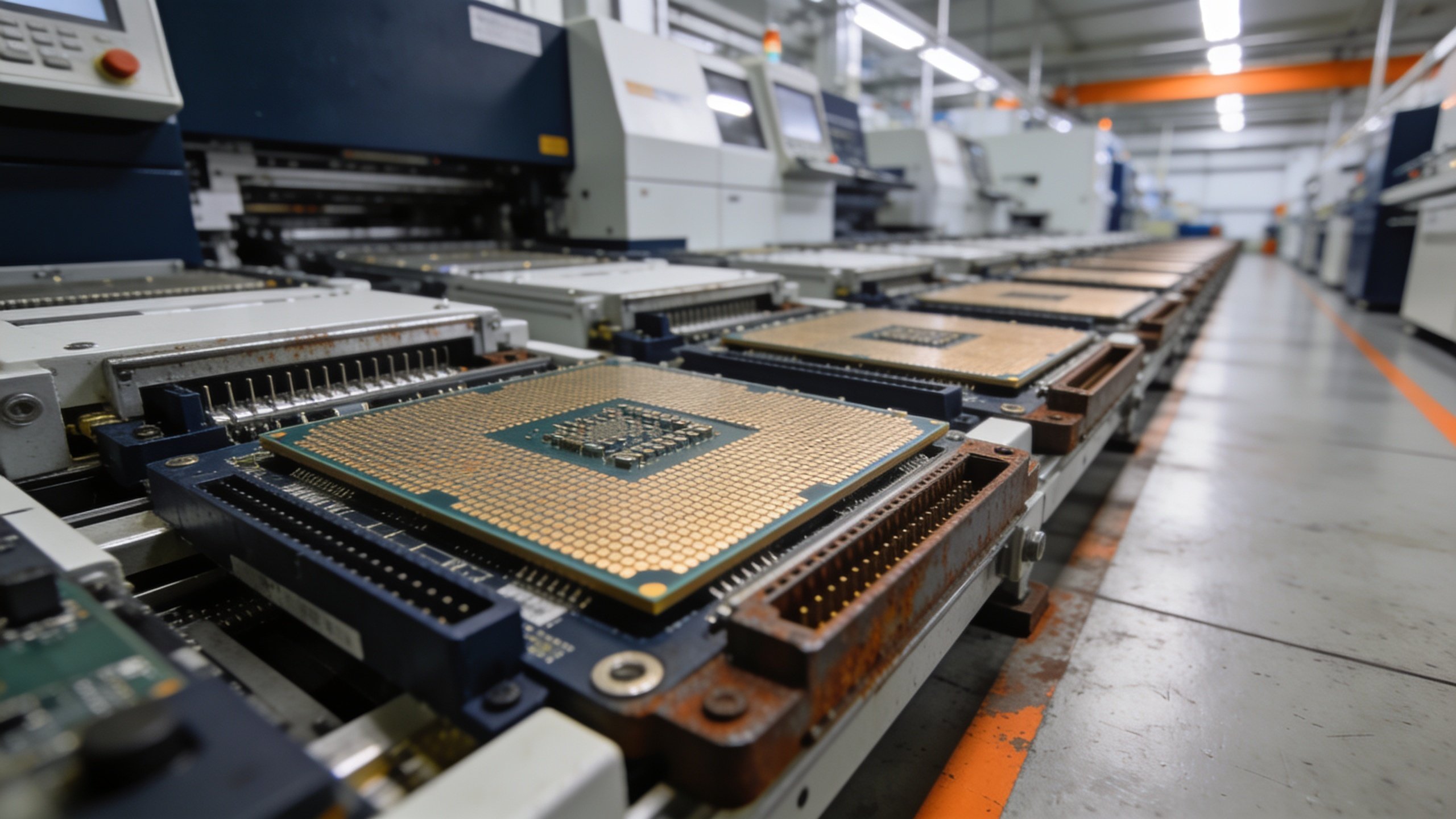
More than 8,000 racks produced monthly before December, DCBBS and software drive profitability. Charles Liang stated that the company is expanding fully automated capacity in both Silicon Valley and Taiwan and expediting containerized data center production in Asia and the US. The target is to produce over 8,000 racks per month by December, with over 4,000 of these being liquid-cooled. He repeatedly emphasized the business value of DCBBS (Data Center Building Block Solutions): covering deployments from gigawatt-class AI plants to single-container PODs, combined with SuperCloud Composer, Supermicro Datacenter Manager, and Supermicro Operations Manager software, as well as the newly expanded global field service organization, binding together hardware, software, and service. He sees this portfolio as the path to maintaining double-digit margins; in Q&A he added that DCBBS is not just hardware modules but includes software and services, becoming a business model for the company.
The company forecasts Q2 revenue of $19.5–21.5 billion, gross margin of 12.0–12.5%, GAAP diluted EPS of $1.59–1.83, and non-GAAP diluted EPS of $1.66–1.90. Full-year revenue targets were raised from $65–72 billion to $72–82 billion (midpoint $77 billion, about 12% above the prior midpoint); annual gross margin guidance is 11.8–12.2%, implying the back half is lower than the front half. Mark Long clarified that the constraint on guidance is not demand or capacity, but the speed at which client data centers are ready to accept produced equipment and key component supply, “The hard constraints on AI build-out industry-wide are land, power, and data center shells.”
Responding to Concerns Over AI Capex Efficiency, Charles Liang Says the Company Can Directly Solve Customers’ ROI Problems
Responding to recent skepticism among investors and market experts over AI capital expenditure intensity and ROI, Charles Liang noted that the company has more than 30 years of experience making servers and storage in the US and possesses local engineering and manufacturing capabilities unmatched by competitors. Coupled with DCBBS’s hardware, software, and services, the company can compress TTD, TTO, and improve system uptime and energy efficiency, “Converting customers’ capital investments into revenue faster and more cost-effectively than anyone else.” He also disclosed that inventory and production cycle time has been reduced from around 100 days to 74 days, with plans to further reduce it to 50 days over the coming quarters.
New CFO Debut, Pledges to Focus on Financial Discipline and Transparency
This was Mark Long’s first earnings call as CFO. He stated he’s spent much of his career in financial roles in the technology infrastructure industry and joined Super Micro “because the hardest parts are already built” — engineering advantages, leading liquid cooling and rack-level integration, and strong positions in the largest infrastructure cycle ever seen. The company now needs financial talent to match engineering and operational capability. He outlined his priorities: financial discipline, transparency, deeper shareholder engagement, working capital management, and capital structure optimization, with quarterly discussions on dilution, maturities and available lines of credit. In response to a Bank of America question, he said the company currently has no plans for equity financing and would consider debt markets depending on terms and desired leverage.
Full Meeting Minutes
Opening and Management Remarks
Moderator: Welcome to the Super Micro Computer fiscal 2027 Q1 earnings conference call. Today we are joined by founder, chairman, and CEO Charles Liang, CFO Mark Long, former CFO David Weigand, and SVP of Corporate Development Michael Steig.
Michael Steig (SVP, Corporate Development): Thank you, good afternoon, and welcome to Super Micro Computer’s fiscal 2027 Q1 call. Joining me are founder, chairman, and CEO Charles Liang, CFO Mark Long, and former CFO David Weigand.
All of you should have received the press release published after the close of regular trading hours, also available on our website. This call is being broadcast live on the company’s investor relations site and will be archived until the fiscal 2027 Q2 earnings call. The content of this call is proprietary to Super Micro Computer and may not be reproduced or transcribed without prior written consent from the company.
In our call today, we may make forward-looking statements based on current expectations, including business plans and performance, ongoing market trends, and future financial results. These statements are subject to significant risks and uncertainties, and actual results may differ materially. For factors that may affect future performance and business, refer to today’s earnings announcement, our most recent 10-K and 10-Q, and any 8-Ks and other filings submitted to the SEC.
All our statements are as of today, November 3, 2026, based on information currently available to us. Except as required by law, we undertake no duty to update these statements. We will also discuss non-GAAP financial measures, reconciliations of which are available in the webcast materials on our website.
Our quiet period for fiscal 2027 Q2 begins at the close of business on Friday, December 11, 2026. I’ll now turn the call over to Charles Liang.
Charles Liang (Founder, Chairman, and CEO): Thank you, Michael, and thank you all for joining today.
After nearly doubling annual revenue in fiscal 2026, fiscal year 2027 is off to a record start. First-quarter revenue reached $19.9 billion, exceeding the top end of our pre-announced range and well above the initial outlook of $15 billion. This is a remarkable achievement, showing more customers favoring our AI and IT total solutions. Most importantly, our Data Center Building Block Solutions (DCBBS) are central to this growth, bringing strong customer trust and preference, enhancing profitability, and creating sustainable long-term shareholder value.
For over thirty years, Super Micro Computer has focused on delivering optimized total solution value to customers. We will continue to accelerate customer deployments with engineering expertise, global resources, and high-yield manufacturing capabilities. I am also encouraged that not only large and new cloud providers, but also enterprises, storage, IoT, and organizations and agencies in “sovereign” verticals now rely on and adopt Super Micro integrated solutions daily.
In Q1, we delivered on our commitment to improve bottom line profitability. Non-GAAP gross margin increased 330 basis points year-on-year to 12.8%. This improvement reflects optimization of our enterprise AI and IT customer mix, a diversified product line based on system modules, and a greater portion of profit-rich DCBBS — hardware, software, and unique services — directly aligned with our strategic roadmap: delivering technology innovation, faster time to market (TTM) and time to operation (TTO), and total solution value, to build a sustainable double-digit gross margin model.
DCBBS has proven, over two years of real customer deployments, to deliver four core values that traditional server OEMs and overseas ODMs cannot match:
First, optimized Time to Delivery (TTD): pre-validated, plug-and-play rack-level systems and DCBBS modules (including comprehensive data center management software) are shipped directly to the customer site.
Second, optimized Time to Operation (TTO): reducing system go-live from quarters to months, and further down to weeks.
Third, DCBBS maximizes system uptime by eliminating thermal, power, software, and service bottlenecks with a modular design.
Fourth, lower Total Cost of Ownership (TCO): greatly reducing energy and facility downtime, accelerating data center profitability.
Whether building gigawatt-class AI plants or rapid-deployment container PODs, Super Micro’s DCBBS helps customers build AI infrastructure faster, better, greener, and at lower cost.
Efficiently operating high-performance AI data centers requires more than just optimized hardware; managing thousands of liquid-cooled GPU racks needs intelligent, real-time software orchestration. SuperCloud Composer (SCM) provides seamless rack-level management and full-stack hardware-facility integration. Supermicro Datacenter Manager (SDM) provides comprehensive power and thermal management from a single node to an entire building, enabling end-to-end hardware lifecycle management; Supermicro Operations Manager (SOM) offers Director and Developer Console modules for bare-metal, model- and token-as-a-service for LLMs and agent AI workloads.
By attaching SCM, SDM, and SOM to the DCBBS product suite, we eliminate software fragmentation and increase bundled adoption of high-value software. SCM’s AI-driven automated root cause diagnostics now significantly improve data center availability, providing customers with full operational confidence.
Equally important is our newly expanded global data center service organization. Our in-field teams, supported by R&D engineers and well-trained post-delivery staff, directly collaborate with customer teams through layered services to maximize cluster uptime. With automated telemetry, our team continuously monitors thermal, power and node health, resolving issues before causing outages. Dedicated on-site engineers handle deployment validation and instant hardware maintenance. This proactive, high-touch service model builds deep customer trust, brings high-value recurring service revenue, and fulfills our highest promise: delivering a worry-free experience with high-quality integrated infrastructure solutions.
To enable this unmatched solution breadth, our global manufacturing footprint and scale continue to ramp rapidly.
We are aggressively expanding physical capacity, with major projects underway in Silicon Valley and Taiwan, adding millions of square feet of automated production space and service capacity. In addition, we are accelerating container data center production in Asia and the US. All told, our global manufacturing and service network positions us to produce over 8,000 of the world’s most advanced racks per month, including more than 4,000 DLC racks by December.
On the technology side, Super Micro continues to lead on major chip platforms:
We are one of the first to ship NVIDIA Vera Rubin NVL-72 racks with DCBBS and DLC-2 cooling stacks. We have also launched NVIDIA Rubin and Vera CPU racks, and an optimized DSX-POD solution is coming soon. On AMD, demand for MI350 and MI355X platforms is strong as we advance toward Helios and MI-450 solutions. We are progressing on Intel Xeon 6+ and new ARM AGI CPU solutions for agent AI markets. Meanwhile, we continue to expand edge and IoT product lines as well as storage, bringing real-time, full-featured inference capability to the intelligent edge.
These new products have accelerated our enterprise strategy— as enterprises scale up agent models, data governance, and high-throughput inference. We have recently announced major strategic partnerships combining Super Micro DCBBS with global tech leaders like Cisco, NetApp, and Nutanix. More partnerships will be announced soon as Super Micro DCBBS becomes deeply embedded in the world’s most trusted enterprises.
I know some investors and experts have recently questioned AI capex efficiency and ROI.
I want to be clear: Super Micro has unique advantages in this climate. For over three decades, we have focused on US-based servers and storage, longer than almost any competitor, building sophisticated, comprehensive local manufacturing and engineering that others cannot match.
This strong US foundation, combined with our DCBBS total hardware, software, and service solutions, directly solves customers’ ROI challenges by optimizing TTD, TTO, availability, and energy efficiency. Whether for hyperscale AI plants or enterprise agent AI workloads, Super Micro enables the fastest, most cost-effective revenue conversion of capital investment we know.
With ongoing operational optimization, factory automation, process improvement, and upskilling through training, we have enforced strict internal discipline. Over the past two quarters, we have reduced inventory turns from about 100 to 74 days. Looking ahead, our goal is to compress inventory and production cycles to 50 days in coming quarters. This persistent efficiency drive will further strengthen Super Micro’s cash flow and working capital cycle and lift bottom-line profitability. Regardless of competitive intensity, more customers will prefer Super Micro DCBBS—complete end-to-end data center hardware, management software, and services.
Now for the outlook for fiscal 2027:
Though overall demand and growth across the board are very strong, we must acknowledge that shortages of key components still impact IT lead times, even GPUs. New customer projects and strategic partnerships are ramping strongly, but we want to be cautious on availability and pricing volatility of some key parts. Based on what we see now, we expect FY27 revenue of $72–82 billion, about 12% above last quarter’s target.
Before I hand off the call, a few important personnel changes:
First, we welcome industry tech leader Shesha Krishnapura to the board; his deep experience in data center operations will support our scaling. Second, sincere thanks to David Weigand for his leadership as CFO during our rapid growth phase, and I look forward to his continued support as we scale further. Finally, I am proud to introduce Mark Long as new CFO—his decades’ experience in tech and finance will be a strong asset for our next stage of growth.
With that, I’ll turn the call over to Mark.
Mark Long (Chief Financial Officer): Thank you, Charles, and good afternoon, everyone.
This is my first time on an earnings call, so let me speak for two minutes before we get into the numbers.
I have spent most of my career in finance roles across tech infrastructure, including as CFO of a public company in the sector. What attracted me to Super Micro is that the hardest parts are already built—deep engineering strengths, genuine leadership in liquid cooling and rack integration, and critical positioning in the largest infrastructure cycle we have seen.
Now the company needs finance to match engineering and operations. I am excited to join Super Micro at this inflection point, to help Charles and the team continue delivering constantly expanding innovative solutions to a growing global customer base, including some of the largest and most demanding AI clients shaping the future. To do this will require ongoing financial discipline, transparency, deeper stakeholder communications, working capital, and capital structure optimization—all my priorities.
Now to this quarter.
Total revenue was $19.9 billion, up 298% year-on-year, 79% quarter-on-quarter. This beat our guidance range of $14.5–15.5 billion and our October 20 estimate of $18.5–19.5 billion. As Charles mentioned, about $2.3 billion came from deployments rescheduled from earlier periods, excluding which core revenue was about $17.6 billion.
AI solutions contributed roughly 71% of revenue, up from 59% in the previous quarter. Based on current order book, we expect AI solutions to be about 70–80% of revenue in FY27.
Enterprise and channel revenue was $4.9 billion, 25% of revenue, up 229% YoY and down 12% QoQ. OEM and large data center made up $14.7 billion, 74% of revenue, up 321% YoY and up 167% QoQ, driven by volume ramp from multiple large AI data center designs. 5G, telecom, and edge are still smaller in size but grew strongly both YoY and QoQ.
By geography, the US was 80% of revenue, Europe 11%, Asia 6%, other regions 3%. US revenue grew 771% YoY and 103% QoQ. While the US remains the largest AI data center market, we’re seeing momentum in other regions—large customers are expanding globally, and governments and enterprises are investing in large AI data centers in Europe, Asia, and the Middle East.
This quarter, one large data center client represented 44% of revenue, compared to 28% for all of fiscal 2026. As seen in the 10-Q, two customers accounted for 49% and 17% of quarter-end receivables. Some background here.
This level of concentration is a result of the current scale of AI infrastructure build-out. Today, a single deployment can exceed our quarterly revenue from a year ago. We expect this concentration to remain high during the build-out phase, declining as enterprise and sovereign business scales up.
Equally important as concentration is the quality of risk exposure. This quarter, deferred revenue increased by about $3.1 billion, mainly as customer prepayments. DSO improved from 59 to 36 days. We had no major credit losses. For large deployments, we often require deposits and invoice by delivery milestones; we assess counterparty credit before committing production or key components; and we have $1.8 billion in receivables purchase authority, providing flexibility for cash and credit risk.
We’ve refused deals with unacceptable terms, and I expect we will continue to do so in the current climate.
Non-GAAP gross margin was 12.8%, 200–240 basis points above our guidance range of 10.4–10.8% and 330 basis points above a year ago; GAAP margin was 12.7%.
It was also 480 basis points lower than our Q4’s 17.6%; let me break this down, as any single-factor explanation is misleading.
The key factor is that Q1 AI revenue share rose from 59% in Q4 to 71%. Customer and product mix in Q1 leaned toward large AI deployments, where margins are lower than in diverse enterprise and channel businesses. Tariff relief and reduced inventory write-downs were largely offset by some lower-margin deferred revenue recognized this quarter.
I want to be precise here, as I know how structural data might be interpreted. The sequential drop does not prove AI platform revenue lack of margin; it reflects which clients took delivery in which quarters. The clearest way to see the core trend is to combine the recent two quarters, thus normalizing timing effects for deferred items. Q4 and Q1 combined: about $31.1 billion revenue and 14.5% non-GAAP gross margin. The same two quarters a year ago: about $10.8 billion and 9.5% margin. So nearly triple the revenue and a roughly 500 basis-point margin increase.
We continue to show significant operating leverage. Revenue was up 298% y/y; non-GAAP opex rose 89%.
GAAP opex was $477 million, up 67% y/y and 5% q/q; non-GAAP opex was $384 million, up 89% y/y and 8% q/q. Sequential growth reflects personnel costs and R&D for multiple new platforms for AI data center and enterprise. Non-GAAP operating margin was 10.9% vs 14.3% last quarter.
Again, the two-quarter perspective is more useful. Q4 and Q1 combined: non-GAAP opex $741 million, about 2.4% of revenue, with a non-GAAP operating margin of 12.1%. Last year’s two quarters: about 5.4%. We intend to continue investing in R&D, field service, and global footprint, and expect opex growth will still lag revenue growth.
Other income and expense was net negative $34 million, including $49 million in interest and other income offset by $83 million in expense from convertibles and revolver lines.
Tax provisions were $435 million GAAP and $455 million non-GAAP, both with effective rates of 21.4%.
Let me add to last call’s comments on EPS, as our capital structure now includes a potentially misunderstood variable. We compute EPS by two-class method, reflecting the mandatory convertible preferreds issued in Q4. These pay about $75 million fixed dividend per quarter and convert to common in June 2029. Until then, both the dividend and allocable profit reduce net income available to common—about $312 million this quarter.
GAAP diluted EPS was $1.75 (guide: $0.89–0.98), non-GAAP diluted EPS $1.81 (guide: $1.01–1.10). GAAP basic EPS: $1.92.
GAAP diluted shares rose from 705 million to 749 million; non-GAAP from 721 million to 764 million.
Now to working capital, which helps explain keys to how we run the business.
Our cash conversion cycle improved from 149 to 97 days, a 52-day improvement in one quarter. Based on Q1 revenue, that equates to about $10 billion less working capital otherwise requiring additional financing.
Cash flow statements reflect this. On $19.9 billion in revenue, we used $434 million cash in operations. In FY26, on $39.1 billion in revenue, we used $6.8 billion. This quarter’s capex: $47 million, so free cash flow was negative $481 million versus negative $7 billion in FY26.
Breaking down the 52-day improvement, with remaining upside as well: inventory days improved 45 to 74, DSO rose 23 to 36 due to faster collections and prepayments, while DPO (payables days) worsened for us, down from 29 to 13 days, spending about $3 billion more on supplier payments due to tight supply chains.
The biggest driver was customer prepayments. Deferred revenue increased by about $3.1 billion this quarter. Receivables up $3.6 billion and inventories up $2.5 billion support expected future revenue, with prepayments funding most of this.
We expect next quarter’s cash conversion cycle to range within plus/minus 10% of Q1, allowing solid management of working capital while seizing attractive market opportunities.
We ended the quarter with $6.9 billion in cash and equivalents. Bank and convertible debt totaled $8.6 billion, net debt $1.7 billion, versus $1.2 billion last quarter. Inventory was $15.1 billion, up from $12.9 billion, built to support revenue in the coming quarters. All covenants were met at quarter end.
More broadly, on capital structure: our starting point is solid. The $5.6 billion we raised in June was specifically for current backlog and working capital needs.
As high-quality growth opportunities emerge, we’ll optimize capital structure accordingly—reinforcing the balance sheet without unnecessary cost. That means matching funding terms and forms to the working capital or assets it supports, and being thoughtful about when (and if) we tap capital markets. I’ll be open every quarter about dilution, maturities, and available lines.
We ended the quarter with a record backlog, supporting visibility for this and the rest of the year.
Turning to guidance.
For fiscal 2027 Q2, we expect net sales of $19.5–21.5 billion and gross margin of 12.0–12.5%. We expect GAAP diluted EPS of $1.59–1.83 and non-GAAP of $1.66–1.90.
The guidance assumes about $455 million in GAAP opex, including roughly $102 million in stock comp (excluded from non-GAAP). We expect other income/expense (including interest) net outflow of about $58 million, both tax rates at about 21%, GAAP diluted shares at about 753 million, non-GAAP at 769 million, preferred dividend about $75 million, and capex $70–80 million.
For the full year, we are raising revenue guidance from $65–72 billion to $72–82 billion. We expect gross margin to be 11.8–12.2% for the year.
Let me connect this to just reported Q1. Q1 included about $2.3 billion in catch-up from prior periods, so base revenue was about $17.6 billion. Our annual targets do not assume more catch-up income. They assume continued sequential growth in base demand, and reflect far better visibility into client deployment schedules than 90 days ago. The business is strengthening, momentum is building for FY27, but we are constrained by supply and data center readiness; we remain focused on disciplined execution, creditworthy counterparties, and expanding higher-margin revenue streams.
On margin, let me be clear about what the annual range implies. Q1 was 12.8%, Q2 guide is 12.0–12.5%, and the annual range midpoint implies H2 margin below H1. That’s a structural effect: as large-deployment orders ship, we expect AI solution share to move to the upper half of the 70–80% range, where margin is lower than in enterprise and channel verticals. Within each segment, we expect margins to hold or improve.
The constraint isn’t demand or our manufacturing ability, but how fast customer facilities can accept our products, and key component availability. The AI build-out industry-wide is now hard-capped by land, power, and shells. Visibility is better than before, and we’ll update through the year.
To sum up.
This was a strong growth quarter with high-quality customers. Revenue nearly tripled, margin well above guidance, and customer prepayments funded most working capital needs. These results were backed by a broad and innovative portfolio—from DCBBS with rack- and liquid-cooling to enterprise, storage, edge, and software—enabling us to tackle the toughest AI workloads and widest use cases.
My focus going forward is as at the outset: financial discipline for profitable growth; transparency so you can track the business quarter by quarter, including timing effects on the numbers; deeper stakeholder engagement; continuing working capital management after a better conversion cycle; and capital structure optimization to support quality growth from a sound base.
I look forward to connecting with many of you in the coming months.
Michael, let’s take questions.
Q&A Session
Moderator: Thank you. We’ll now start the Q&A. The first question is from Katherine Murphy of Goldman Sachs Research. Please go ahead.
Katherine Murphy (Goldman Sachs Research): Thanks for taking the question; great to connect with all of you. My first question is on the updated revenue outlook. I understand land, power, and shells are currently the hard constraints, but in your full-year outlook and backlog, for what proportion can you see the off-taker and committed volumes? I have a follow-up next.
Charles Liang: Yes, as you know, there are shortages in power and some components like GPU. But because our solution is better than the industry—especially DCBBS, which doesn't just provide hardware modules but also software and services, helping clients build data centers faster and keep compute more available—we keep gaining more clients and market share. We're quite optimistic about ongoing share gain.
Katherine Murphy (Goldman Sachs Research): As a follow-up, could you talk about customer prepayments this quarter, and how we should view its ongoing support for your working capital efficiency? Is this something we can expect to continue, and does it relate to DCBBS and your share-gain strategy?
Charles Liang: Yes. As you know, many companies are seeing a cash crunch, but at Super Micro, we attract a lot of clients with our better total solution—again, DCBBS. Signals look good; most clients are paying on time, and we feel solid about continued growth. Mark, feel free to add.
Mark Long: Yes, I think the advantage as Charles mentioned is really client quality. Very large, creditworthy customers pay quickly, providing strong cash flow, and the broader client base is supplying more prepayments. This discipline funds more working capital. You should expect this to continue. We’re in a very good position. Since the summer capital raise and improvement in the cash conversion cycle, operating efficiency has greatly improved.
Charles Liang: Yes. As we just said, we've improved two areas of cash flow: first, reducing inventory and production cycle times from around 100 to now about 70 days, with further improvements ahead; and second, improved customer quality is resulting in quicker payments. So, we’re solid here.
Moderator: Next question comes from Ananda Baruah of Loop Capital. Please go ahead.
Ananda Baruah (Loop Capital): Thank you, and congrats on the progress, Mark—welcome to the team. Two questions: First, on gross margin, and how to interpret its trajectory for the rest of the year. If I’m wrong, please correct me: to hit your midpoint guidance, even with a decline in the back-half Y/Y, the next three quarters should be roughly steady near 12%, right? Please correct me if not. The real question is, you note higher AI mix is one factor—can you discuss within your AI customer base what gross margin variables exist? Charles has talked before about AI margin improvement; beyond mix, what are the dynamics for the rest of the year? I have a brief follow-up. Thanks.
Charles Liang: Yes, as I just shared, in the past three or four quarters, our production timing, quality, and yields have all improved significantly, enabling faster turnaround and more satisfied clients, thanks to better TTM and TTO. DCBBS software and services also help. And with higher-quality customers, we keep gaining more, especially enterprise agent AI clients. All this positively impacts the business.
Mark Long: Yes, let me add to what Charles said. For the full-year guidance, what you see is we have good visibility; the business is stabilizing and developing a foundation near this 12% range, and as we further diversify clients and products, there’s more room to expand margins. Your base assumption on modeling is pretty close. Our visibility is strong.
As Charles said, all client segments are seeing margin improvement. That’s key. It reflects great engineering, products, and team execution. We feel well positioned at this scale, with enormous future opportunity.
Charles Liang: Yes, DCBBS is not just hardware, but includes software and helps clients with availability. This is our business model now, and more clients love our product and solution.
Ananda Baruah (Loop Capital): That’s helpful. Brief follow-up: Considering all structural tailwinds this year, what are reasonable expectations for the CPU business? Thanks.
Charles Liang: Yes, as you know, agent AI is getting very popular, so we are gaining a lot of enterprise clients. They’re buying our CPU-based solutions—Intel-based, AMD-based, and NVIDIA Vera, right? Our NVIDIA Vera solution is now available, including ARM. We see CPU demand notably stronger now and in the future.
Moderator: Next question from Joseph Cardoso of JP Morgan Research. Please go ahead.
Joseph Cardoso (JP Morgan Research): Hi, thanks for taking the question—and Mark, I look forward to working with you. My first question is: from your comments, it appears there’s no additional catch-up or deferred delivery in your guide, but can you confirm, is there still deferred revenue not in the outlook? Second, after adjusting for this, you still guide slower H2 growth than H1. Can you outline the dynamics here? And is this also tied to major customer concentration dropping as you move into H2?
Mark Long: Yes. The key on deferred revenue is that, historically, there was a group of delayed deliveries and deployments rolling over from past quarters. In a typical quarter, you recognize some delivery-based revenue, maybe a couple of deployments slip out, but in that period, deferred amounts were unusually large. Their release has a big effect.
Revenue rises, but it diluted gross margin in total. Going forward, we don’t expect a similar repeat of large delayed deployments. Most deferred items now are customer prepayments or multi-period deferred software and service revenues.
Charles Liang: Yes. The good thing is, since we launched DCBBS, some clients and even some internally were in the learning curve. There were debates about revenue recognition, but now DCBBS is much more mature—internally and with customers, there's clarity how much service is purchased. So, deferrals are now clearer and more mature.
Mark Long: Yes. On the H2 guide—it simply reflects, as you hear us say, supply-constrained expectations and trying to judge data center readiness for large deployments. However, as we noted, demand remains extremely strong, especially for DCBBS.
Joseph Cardoso (JP Morgan Research): Understood, very clear. Second, you mention ecosystem-wide supply constraints in H2. For Q2 and H2, what is the tightest constraint? Just GPU, or other parts? Also, with shortages, price is important—how does your FY27 guidance break down between volume growth and price/cost effect? Thanks.
Charles Liang: Yes, great question. The conservative $72–82 billion annual guidance reflects worries about part shortages and macroeconomics. If these are not issues, H2 will clearly be much stronger than H1. We hope for that, which is why $72–82 billion is conservative if all goes well.
Mark Long: Yes, your ASP question is on point—key component costs are driving ASP growth, sometimes quarter by quarter. We have not included significant ASP growth in our back-half guide, so our approach is conservative. We're closely watching what customers need, product mix, capacity, and supply management. As Charles said, demand far outstrips component availability.
Moderator: Next question from Ruplu Bhattacharya at Bank of America Research. Please go ahead.
Ruplu Bhattacharya (Bank of America Research): Hi, thank you for taking my question. Mark, congrats and look forward to working with you. Looking ahead twelve months, does Super Micro have sufficient cash/flow to fund investments for the strong growth you’re seeing? What would drive further financing—and do you prefer debt or equity? I have a follow-up.
Charles Liang: Good question. As you know, we had $6 billion cash at last quarter-end.
Mark Long: Yes.
Charles Liang: This is the highest cash balance we’ve ever had. Frankly, cash flow is not a worry; even if H2 grows strongly and macro is good, we’re stronger than ever on cash flow.
Mark Long: Right. As Charles highlighted, we start with $6.9 billion, in a great position. Our working capital efficiency is better, and our ability to fund working capital via high-quality customers and some prepayments keeps improving. We’re very well positioned to optimize capital structure. Should a high-quality, attractive opportunity require added capital, we’ll evaluate. We have $1.8 billion in credit lines and the option to tap other markets—including credit and equity, as you said.
Currently, we have no plans for equity financing. For debt, we'll look at what terms are available and what fits the company’s success and leverage targets.
Moderator: Due to time, last question from George Notter at Wolfe Research. Please go ahead.
Brendan Rogers (Wolfe Research, for George Notter): Hi all, Brendan Rogers here on behalf of George Notter. I wanted to ask: In the past 90 days, what changed in your client communications to improve visibility? Is it that clients extended their forecast windows, or did you change management processes?
Charles Liang: Yes, as mentioned, we have strong backlog, so we can choose healthy clients and orders. Customer quality matters a lot; we can be selective.
Mark Long: Yes. As Charles said, we’re getting greater visibility from many clients—some huge, some medium sized, across regions.
Charles Liang: And enterprise clients.
Mark Long: Yes, enterprise business growth is another element; it will bring greater visibility and stability to the overall revenue stream.
Moderator: That concludes the Q&A. Today’s call is now over. Thank you for joining; you may now disconnect.
Disclaimer: The content of this article solely reflects the author's opinion and does not represent the platform in any capacity. This article is not intended to serve as a reference for making investment decisions.
You may also like
JPMorgan: Storage fundamentals remain solid, still optimistic about SK Hynix (SKHY.US), Samsung, and Kioxia
J.P. Morgan believes that storage fundamentals are solid, and prices are expected to remain high in 2027; however, there is a lack of short-term catalysts.
Arista Networks (ANET.US) Q3 Conference Call: CEO Says There Are Over 100 Ethernet AI Clients Entering the AI Supercycle, First Guidance for 2027 Revenue at $18.5 Billion
Arista Networks released its financial results for the third quarter of 2026 ended September 30 and held a conference call after the market closed on the same day.
Democrats lead strongly in the midterms; US stock futures plunge, the US dollar falls, US Treasuries rise, and Asian stock markets come under pressure.
Preliminary vote counts for the 2026 U.S. midterm elections show strong momentum for the Democratic Party, with market bets on a "blue wave" sweeping both chambers of Congress increasing sharply.

Crypto prices
More


