FXStreet, Nov 9—— During Monday's Asian session, spot gold rebounded from its lows to around $4,130. The Democratic Party's win in both houses, its opposition to the $1.5 trillion defense budget and inclination to cut it to about $1 trillion, and expectations of the end of the US-Iran conflict boosted gold prices; however, the much stronger-than-expected October nonfarm payrolls of 165,000 and a higher probability of a December rate hike at 79.6%, along with a stronger dollar and rising US Treasury yields, limited the upside.
During Monday's Asian session, spot gold rebounded from lows and traded around
$4,130
level, retracing part of its previous losses. The main driver behind this price recovery was the increased expectation of an "end to the conflict"—after the Democratic Party secured majority seats in both the House of Representatives and the Senate, it strongly opposes US President Donald Trump's proposed
$1.5 trillion defense budget
, and seems determined to prevent its passage. Sources indicate that the Democratic Party tends to approve only around
$1 trillion
for the defense budget, as they do not want to be seen as continuing to fund the conflict against Iran.

However, the upside for gold prices is clearly capped. Last Friday’s US October nonfarm payrolls showed an increase of
165,000 jobs
, far exceeding the expected 65,000 and significantly higher than September’s 60,000; the unemployment rate fell to
4.1%
, compared with the previous 4.2%. The stronger-than-expected jobs data reinforced the Fed’s expectation of “higher rates for longer,” and higher rates increase the opportunity cost of holding the non-yielding asset gold. According to CME’s FedWatch Tool, traders currently price in a roughly
79.6%
probability of a December rate hike by the Fed, up sharply from 72.8% before the jobs release.
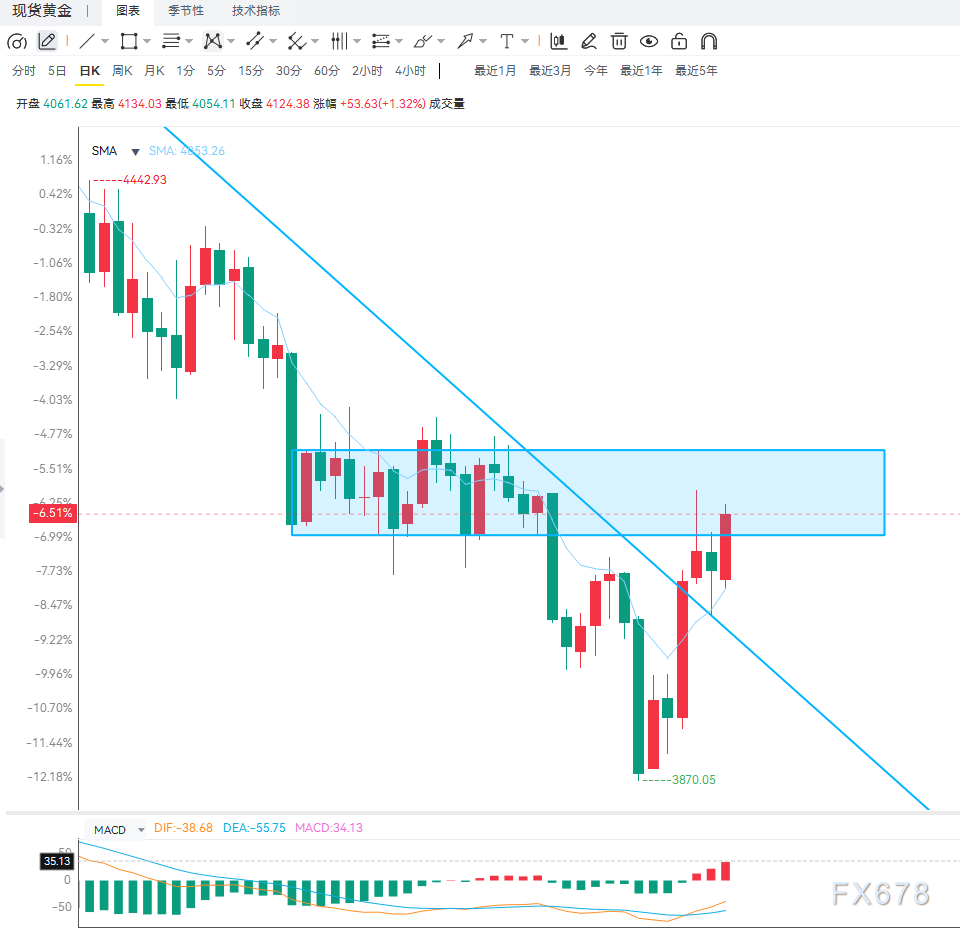
On the chart, gold prices gapped lower on the back of the upbeat employment report, then attempted to recover upwards. Independent metals traders said this was a “litmus test” for this week’s rally. OCBC analysts pointed out that gold prices rose overnight to a two-week high above $4,140 before pulling back partially, following an oil price rebound and a stabilizing dollar, but softening US Treasury yields continued to provide support. The bank also warned that the intensified sell-off in the AI and semiconductor sectors warrants short-term vigilance—if weakness in risk assets triggers broader deleveraging, the market may sell off gold, and gold prices could struggle to remain immune.
However, OCBC also stressed that gold’s relative resilience during the massive sell-off in risk assets is “encouraging”: following recent corrections and a decline in speculative positions, gold may be gradually regaining some safe-haven attributes and could provide shelter amid market turbulence in other corners of financial markets. Whether gold can remain robust in the face of continued weakness in risk assets remains an important test. In the short term, the market focus shifts to the US CPI data due next Tuesday, while oil prices remain a key driver for inflation and rate expectations. Meanwhile, the outcome of the defense budget negotiations and the pace at which conflict-ending expectations are realized will continue to guide the flow of safe-haven funds.
From a technical perspective, on the daily chart, gold prices are still in the
oversold rebound
recovery phase,
and have not yet broken through the box resistance
. The current price of $4,130 is slightly above the midline of the box pattern, with the
$4,180–$4,200 zone
serving as key resistance for directional confirmation—within this, $4,200 coincides with the 100-day moving average, while the upper Bollinger band around $4,225 forms the secondary barrier above; only a strong breakout and sustained hold above $4,180–$4,200 could trigger accelerated bullish momentum and ease the currently bearish tone. In terms of indicators, prices are above the middle track of the 20-day Bollinger band, reflecting underlying demand, but the relative strength index (RSI) is around 50.30 in a neutral zone, indicating the latest rebound still lacks decisive momentum to challenge upper resistance. On the downside,
support near $4,050 is crucial
; as long as this level holds, the structure for a rebound remains; above here, $4,095 provides initial support, while the middle Bollinger band at $4,065 marks the lower boundary for the short-term range. A failure of $4,050 would expose a deeper slide toward the lower Bollinger band near $3,900, at which point bears may turn cautious. On the 4-hour chart, the short-term rebound structure remains intact, but
momentum appears stagnant near highs
: price is repeatedly testing the zone around $4,130, and the box pressure at $4,180–$4,200 has yet to be effectively tested; chasing longs before a breakout has limited risk-reward. Scenario-wise, if a 4-hour breakout with strong volume can hold above $4,200, the daily box breakout would be confirmed and accelerated bullish action could be expected; if the rebound repeatedly stalls and falls back from the $4,180–$4,200 zone, gold prices will retest the $4,095–$4,065 support range, and then probe the key $4,050 line.
Editor's Summary
Currently, gold is caught in a tug-of-war between “rising expectations of an end to the US-Iran conflict and safe-haven buying recovery” and “strong job data, with December rate hike odds at 79.6%”, with
$4,130 only marking the middle of the price box, and the direction still awaits confirmation from either the $4,180–$4,200 or $4,050 ends
. In the medium term, if the Democratic Party continues to push for defense budget cuts and the tightening of financial conditions persists, combined with renewed safe-haven demand triggered by volatility in risk assets, gold could challenge the upper edge of the box and open more upside for bulls; but if employment and inflation data remain strong and the December rate hike materializes, rising real interest rates would suppress gold’s median price, and if risk assets undergo a deleveraging-style sell-off, gold may also experience liquidity-driven selling. Risks and opportunities coexist: before breaking above $4,180–$4,200, caution is needed; as long as $4,050 holds, pullbacks remain normal within the bullish structure. Overall, expect gold to oscillate within the $4,050–$4,200 box, and closely monitor next Tuesday’s CPI, oil price trends, and defense budget negotiations.