
BlackRock’s Bitcoin ETF Posts Second-Largest Inflow Since January Launch

IBIT’s gains stood out as broader Bitcoin ETFs saw mixed flows, showing selective investor demand.

BlackRock’s spot Bitcoin ETF, iShares Bitcoin Trust (IBIT), recorded nearly $1b in inflows on Monday, marking its second-largest single-day intake since its debut earlier this year.
According to SoSoValue data , IBIT pulled in $970.93m, underlining the renewed appetite among institutional investors for crypto assets.
The surge comes amid a broader recovery in Bitcoin markets. Investors have been steadily returning to Bitcoin-linked products, buoyed by signs of resilience in the asset despite volatility in equities.
Crypto supporters have pointed out Bitcoin’s relative stability compared to US stocks during periods of economic uncertainty, a trend that has reignited discussions around Bitcoin’s potential as a safe-haven asset.
The IBIT fund is part of a wave of spot Bitcoin ETFs that launched on Jan. 11. That day marked a turning point for the industry, opening the door for traditional investors to gain direct exposure to Bitcoin through regulated market vehicles. Nine new funds debuted alongside Grayscale’s long-running Bitcoin Trust, which converted into an ETF structure the same day.
Strong BlackRock IBIT Inflows Contrast With Outflows From Rival Funds
James Toledano, chief operating officer at Unity Wallet, said the current momentum stems from multiple factors. He noted that President Donald Trump’s recent silence on crypto matters had helped market sentiment. “Historically, his comments have coincided with price drops, though correlation is not causation,” he said.
Toledano added that easing rhetoric around tariffs and the Federal Reserve has lifted investor confidence, alongside the strong inflows into Bitcoin ETFs that reflect renewed institutional support.
Despite IBIT’s strong performance, the broader Bitcoin ETF market showed mixed momentum, signaling that investor demand remains selective.
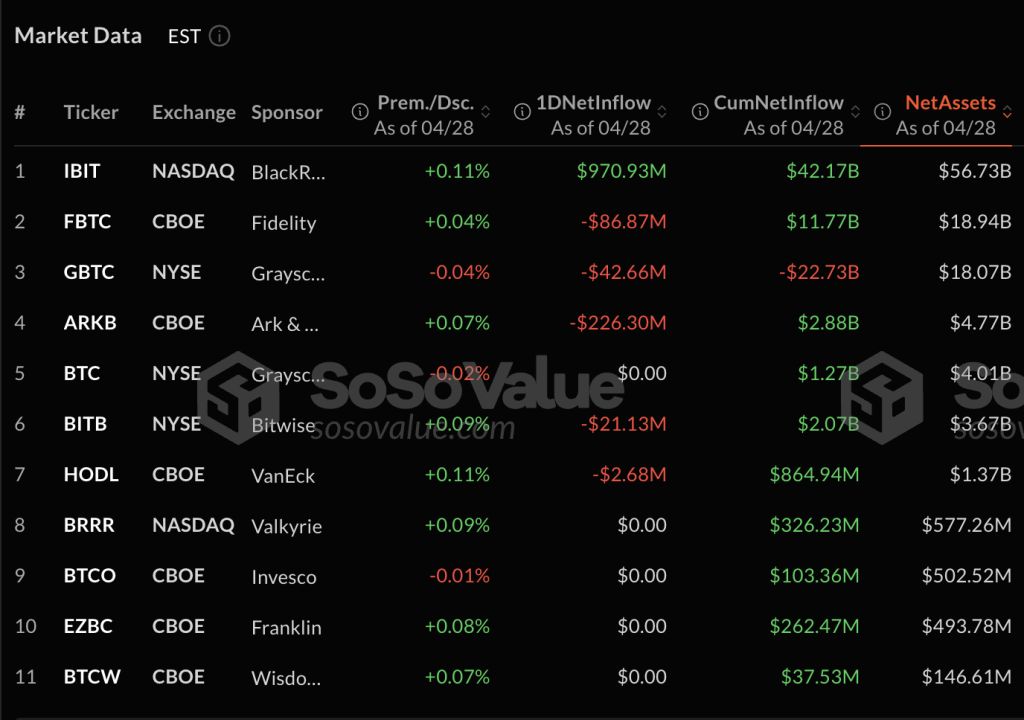 Image Source: SoSoValue
Monday’s inflows were heavily concentrated in BlackRock’s IBIT, which brought in $970m. In contrast, Fidelity’s FBTC recorded outflows of $86.8m, while Grayscale’s GBTC saw $42.66m in net outflows.
Despite IBIT’s Gains, Broader Bitcoin ETF Market Shows Strain
Ark Invest’s ARKB fund posted the largest single-day outflow among major ETFs at $226.3m. Despite IBIT’s strong performance, the broader Bitcoin ETF market showed mixed momentum, signaling that investor demand remains selective.
The rising demand shows how Bitcoin’s narrative as a hedge against macroeconomic uncertainty is gaining traction again. With US equities under pressure and global markets seeking direction, both gold and Bitcoin have benefited from a pivot toward alternative stores of value.
Disclaimer: The content of this article solely reflects the author's opinion and does not represent the platform in any capacity. This article is not intended to serve as a reference for making investment decisions.
You may also like
From Hugging Face to Figure Robots: How NVIDIA Is Betting Billions on the Future of the AI Ecosystem
Jensen Huang is personally leading the $12.9 billion acquisition of Hugging Face and negotiating an additional $1 billion investment in Figure Robotics. To mitigate the risk of "three major customers contributing 44% of revenue," Nvidia is restructuring its landscape with transactions exceeding $140 billion, making heavy bets on humanoid robots and local AI. The core strategy is to use capital to create a "thousand-model era," supporting massive application scenarios to break the monopoly of tech giants and firmly anchor future computing power demand.
Former US Treasury Secretary Rubin Warns: AI Boom May Bring Productivity Dividends But Also Poses Financial and Social Risks
Former U.S. Treasury Secretary Robert Rubin has warned that while the artificial intelligence (AI) investment boom may bring significant productivity gains, it could also create financial and social risks that the market has not yet fully priced in.
WTI posts modest gains above $88.50 on unexpected EIA draw, Middle East conflicts in focus

Crypto prices
More


