
Curve founder says DeFi must ditch token emissions for real revenue

Decentralized finance (DeFi) can no longer rely on inflationary token incentives to sustain growth, according to Curve Finance founder Michael Egorov.
In an interview with Cointelegraph, Egorov said protocols must generate real revenue rather than depend on emissions to attract liquidity.
“Your yield should come from revenues, not from tokens,” Egorov told Cointelegraph. “You need real revenues flowing.” He added that if a token “is not doing something, maybe it’s better for you to not do token at all.”
Egorov contrasted the current environment with the “DeFi summer” of 2020, when triple-digit and even 1,000% annual percentage rates drew capital into new protocols. He said that at the time, speculative premiums drove token prices and bootstrapped total value locked (TVL) for protocols.
“Right now, news doesn’t change prices of tokens anymore,” he told Cointelegraph, arguing that users have “re-evaluated the risks.”
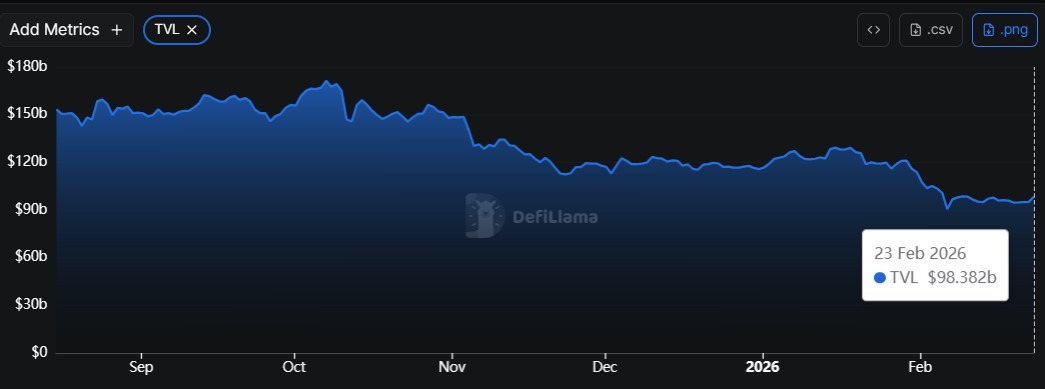 DeFi TVL in the last six months. Source: DefiLlama
His comments come as DeFi’s TVL has fallen about 38% over the past six months, according to DefiLlama. Data from the analytics platform shows TVL dropped from $158 billion on Aug. 23, 2025, to about $98 billion as of Feb. 23.
Curve founder says revenue integration is better than emissions-driven yield
Egorov said protocols “cannot live without real revenues flowing,” arguing that sustainable returns must be tied to actual economic activity.
While token emissions once helped projects accumulate liquidity quickly, he argued that sustainable returns must be tied to actual economic activity.
“In 2020, people didn’t care that much about risks,” Egorov said. High token rewards could offset losses if projects later failed.
“Right now, it’s absolutely impossible. If you deposit something somewhere, you need to be sure that technically the protocol is safe for at least years.”
He also linked tokens to decentralization rather than speculation. Without decentralized governance, he said, a project risks being treated as a regulated financial service.
“Tokens are needed for decentralization, not for getting rich quickly,” he said.
Earlier commentary has echoed similar concerns. In an opinion piece for Cointelegraph, Polygon Labs CEO Marc Boiron wrote that inflationary emissions only create “temporary illusions of success.”
The discussions on DeFi and centralized yield products have also recently resurfaced on social media.
On Feb. 9, Ethereum co-founder Vitalik Buterin argued that DeFi's real value lies in redistributing risk rather than simply generating returns on fiat-backed assets.
Related: Hyperliquid launches DeFi lobby amid ‘critical time’ for US policy
From speculation to durability
Egorov also said speculative attention has shifted. “All the speculative premiums were stolen away by meme coins,” he said, suggesting DeFi tokens now trade more on fundamentals than hype.
He told Cointelegraph that this dynamic makes it harder to attract “mercenary capital” that moves quickly between protocols in search of the highest yield.
He also pointed to a changing market structure. Retail traders have gravitated toward perpetual futures markets, while institutional participants increasingly accumulate spot assets.
Defillama data shows perpetual futures volume reached $1.37 trillion in October 2025.
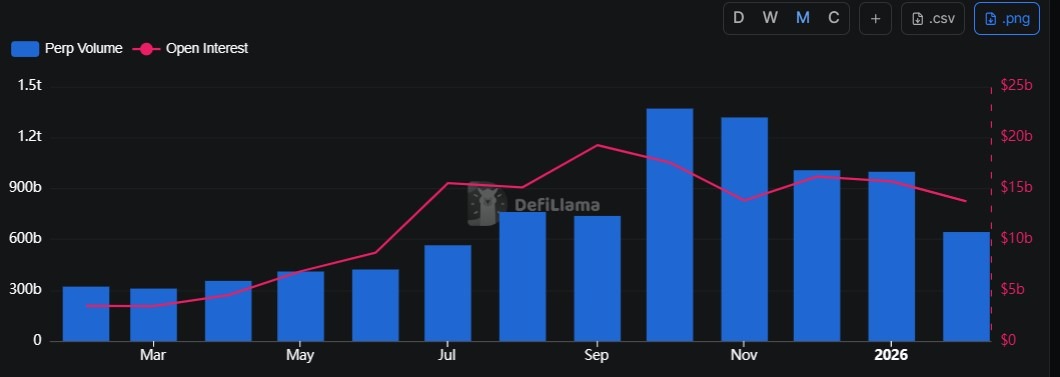 Perpetual futures monthly trading volume. Source:
DefiLlama
Perpetual futures monthly trading volume. Source:
DefiLlama
According to Egorov, durable onchain businesses will need to compete on revenue generation and capital efficiency rather than headline annual percentage yields.
Magazine: 6 weirdest devices people have used to mine Bitcoin and crypto
Disclaimer: The content of this article solely reflects the author's opinion and does not represent the platform in any capacity. This article is not intended to serve as a reference for making investment decisions.
You may also like
$63 Billion: The Largest AI Infrastructure Financing in History! Broadcom CEO Gets Personally Involved, Wall Street Closely Watching Massive Debt Issuance in Q1 Next Year
This deal to help Anthropic lease chips almost fell through due to "indigestion" in the AI debt market. Broadcom CEO Hock Tan urgently facilitated a rare collaboration between banks and Blackstone by offering "higher interest rates plus residual value guarantees" as a concession. Broadcom acted both as the seller and guarantor, creating a controversial “circular financing” loop that deeply ties the company to Anthropic. The issuance of approximately $21 billion in high-grade bonds next quarter will serve as a real stress test.

USD.AI’s $1M CHIP buyback sparks 19% rally amid Elon Musk’s AI warning

Visa (V.US) Q4 revenue increased by 13% year-on-year to $12.1 billion, cross-border payment transaction volume grew by 14%
Visa's net revenue for the fourth fiscal quarter was $12.139 billion, representing a year-on-year increase of 13%.
Crypto prices
More


